
Why people share product links for gift coordination

Sharing product links for wishlists and shared gift lists is primarily a coordination tool: it prevents duplicate gifts, preserves surprises, and makes buying simpler for everyone involved. The core reasons people do it come down to a handful of practical needs:
- Avoid duplicate gifts — when several people buy for the same person, a shared list stops two relatives ordering the same book or gadget.
- Reserve and mark items as bought — private reservations let buyers claim an item without spoiling the surprise for the recipient.
- Track prices — saved links let buyers monitor price drops across multiple retailers before committing.
- Support group contributions — a shared list makes it straightforward to split the cost of a larger gift.
- Simplify checkout — buyers get a direct link to the exact product, removing guesswork about the right size, colour, or model.
WantThis is built around exactly these needs, letting UK shoppers share wishlists with private reservations and price tracking across hundreds of retailers.
Key takeaways
People share product links primarily to coordinate gifts: preventing duplicates, preserving surprises, and making it easier for friends and family to buy the right thing at the right price.
| Point | Details |
|---|---|
| Core purpose | Sharing links prevents duplicate gifts and preserves surprises through private reservations and mark-as-bought features. |
| Recipient preferences vary | Around 32% of UK adults prefer to be asked what they want; around 44% prefer a surprise — occasion and relationship both matter. |
| Etiquette shapes uptake | Frame your list as optional, include a range of price points, and allow guest reservations to maximise participation. |
| Red flags in tools | Avoid tools with no reservation feature, single-retailer lock-in, or sign-up requirements for guests. |
| WantThis | Offers multi-retailer lists, private reservations, mark-as-bought, and price tracking — free for UK shoppers at wantthis.co.uk. |
Table of Contents
- Why consumers share product links: psychological and practical motives
- What are the concrete benefits of sharing product links?
- When do recipients prefer lists, and when do they prefer surprises?
- How to share product links politely: etiquette and message templates
- How do you choose a wishlist or shared gift list tool in the UK?
- Quick ways to encourage friends and family to use your list
- When should you avoid sharing product links?
- A practical note from WantThis
- WantThis makes gift coordination straightforward
- Sources
Why consumers share product links: psychological and practical motives
The motivations to share products for gift coordination are never purely practical. Relational signalling and functional convenience both drive the behaviour, and understanding the mix helps you frame your list in a way that actually gets used.
On the psychological side, gift-giving research consistently shows that givers want credit for their choices. Kellogg behavioural research demonstrates that close givers often diverge from registries to choose freely selected gifts as a way of signalling intimacy, particularly when they will receive attribution for the gift. A separate survey study published in the Journal of Consumer Psychology found that expressive motives — the desire to demonstrate knowledge of the recipient — increase with intimacy and tend to push givers towards hedonic rather than utilitarian choices.
Practically, the reasons for sharing product links are just as compelling:
- Multi-retailer convenience — one list can hold items from Amazon, John Lewis, ASOS, and a specialist independent, so buyers are not locked into a single shop.
- Price monitoring — a saved link lets buyers watch for a price drop before purchasing, which matters on higher-value items.
- Private reservations — buyers can claim an item without the recipient seeing, keeping the surprise intact.
- Marking items as bought — prevents a second buyer purchasing the same thing after the first has already ordered.
These motivations map neatly onto the occasions where shared lists are most common: birthdays, Christmas, weddings, baby showers, and Secret Santa. Each occasion carries a different social contract around surprise and practicality, which is worth keeping in mind as you build your list.
What are the concrete benefits of sharing product links?
Sharing links delivers four tangible advantages that make a real difference in group gifting situations: it avoids duplicates, preserves the surprise, simplifies checkout, and supports group contributions.
- Avoids duplicates — a reservation system means two aunts cannot both buy the same toy; one claims it, the other moves on.
- Preserves the surprise — private reservations are invisible to the recipient, so they still get the pleasure of not knowing what is coming.
- Simplifies checkout — a direct product link removes the risk of a buyer ordering the wrong variant; particularly useful for clothing sizes or tech specifications.
- Supports group gifting — a shared list makes it easy for several people to coordinate a contribution towards one larger item, which is common for weddings and baby showers.
- Price tracking — WantThis price tracking monitors items across hundreds of UK retailers and sends alerts when a price drops, so buyers can time their purchase well.
According to Mintel’s UK gift purchasing journey market report, younger shoppers aged 16–34 are the fastest adopters of digital wishlist tools, with growing demand for price tracking and personalisation. That trend reflects a broader shift: digital lists are now a mainstream part of UK gifting, not a niche workaround.
Stat: YouGov’s 2026 survey found that around 32% of UK adults prefer to be asked what they want for Christmas, while around 44% prefer a surprise — a split that underlines why the features behind a shared list (private reservations, mark-as-bought) matter so much.
When do recipients prefer lists, and when do they prefer surprises?
Recipient preferences vary by occasion and relationship, and the data shows the split is closer than most people assume. According to a 2026 YouGov survey, around 32% of UK adults prefer to be asked what they want for Christmas, while around 44% prefer to be surprised. Women give gifts to friends more often than men, and younger adults are more likely to engage with digital gifting tools.

Ward and Broniarczyk’s research adds useful nuance: recipients’ expectations shift by occasion, meaning the same person might welcome a list for a wedding registry but find one inappropriate for a birthday from a close friend.
Practical rules of thumb:
- Ask when the occasion is practical by nature — weddings, baby showers, and Christmas family groups are all contexts where lists are socially accepted and expected.
- Hint rather than list for close friendships — a few ideas shared casually in conversation often land better than a formal link.
- Avoid lists when the recipient has told you they prefer surprises — respect that preference; suggest alternatives like experience gifts or a budget range instead.
- Use age as a guide — older recipients and young children often respond better to a conversation than a link; teenagers and adults in their 20s and 30s tend to appreciate the directness of a list.
How to share product links politely: etiquette and message templates
Polite sharing frames the list as helpful rather than directive. The tone you use when sending a link matters almost as much as the list itself.
Etiquette rules to follow:
- Keep the message brief and warm; a single sentence of context is enough.
- Make it optional — “no pressure at all” is not filler; it genuinely reduces awkwardness.
- Include a budget range or filter your list by price so buyers do not feel obliged to spend more than they are comfortable with.
- Send the link early enough that buyers have time to browse, but not so early that it feels presumptuous.
- Never reveal what others have reserved; the whole point of private reservations is to protect the surprise.
Sample messages for common UK scenarios:
Birthday (to a group chat): “I’ve put together a small list in case anyone’s stuck for ideas — absolutely no obligation! [link]”
Christmas family group: “Sharing my list for anyone who’d like it. I’ve added a mix of price points. Feel free to ignore it entirely if you’d rather choose something yourself!”
Baby shower: “We’ve set up a gift list with a few things we’d find useful — there’s something for every budget. Thank you so much for thinking of us. [link]”
Secret Santa: “Here are a few ideas under [budget] if it helps — [link]. Happy for you to go completely off-list too!”
Pro Tip: If you’re sharing a list where others have already reserved items, add a note: “Some things may already be taken — the list updates automatically, so just pick anything that shows as available.”
For more occasion-specific sharing ideas, the ways to share gift lists guide covers templates for each scenario in more detail.
How do you choose a wishlist or shared gift list tool in the UK?
Prioritise features that solve the coordination problems above: duplicate prevention, surprise preservation, and multi-retailer flexibility. A tool that lacks any one of these creates friction that reduces participation.
Essential features checklist:
- Multi-retailer support — you should be able to add items from any UK retailer, not just one platform.
- Private reservations — buyers must be able to claim an item without the list owner seeing.
- Mark as bought — prevents a second purchase after the first buyer has already ordered.
- Price tracking and alerts — useful for higher-value items where timing matters.
- Guest reservations without sign-up — requiring family members to create an account before they can reserve anything kills participation.
- Quick adding by link — pasting a product link and having the details filled in automatically makes adding items while browsing straightforward.
Red flags to avoid:
- No reservation feature at all.
- Single-retailer lock-in (e.g. only works with one shop).
- Poor privacy controls — the recipient can see who bought what.
- Clumsy sharing links that require the recipient to log in to view the list.
Pro Tip: If you’re sharing a list with older relatives, choose a tool where the reservation process takes no more than two taps and requires no account creation. Friction at that step is the single biggest reason family members do not participate.
Modern wishlist apps now handle all of the above as standard, turning what used to be a spreadsheet-and-group-chat exercise into a single shared link.
Quick ways to encourage friends and family to use your list
Participation rises when the action required is low-friction and the social reward is clear. A list that nobody uses is usually one that was too complicated to navigate or arrived too late.
- Send one short link, not a long explanation of how the tool works.
- Allow guest reservations so nobody needs to sign up.
- Include a spread of price points so buyers at every budget feel included.
- Set a gentle deadline: “I’ll keep the list live until [date]” removes the open-ended awkwardness.
- Offer a group gift option for one or two larger items, with a note about how to contribute.
- Follow up once, lightly: “Just a reminder the list is there if useful” is enough.
Pro Tip: Add one item you have already reserved yourself as a private example, then mention in your message that reservations are private. It shows people how the feature works without a tutorial.
For more on building lists people actually engage with, the gift list collaboration guide covers group gifting mechanics in detail.
When should you avoid sharing product links?
Sharing links can backfire when it conflicts with the social expectations of the occasion or the preferences of the people involved.
- When the recipient has explicitly said they prefer surprises — a list sent anyway signals that you did not listen.
- When the occasion is intimate and surprise-focused — a Valentine’s Day gift or a spontaneous birthday gesture from a close partner rarely benefits from a list.
- When the recipient prefers cash or experiences — a product list is the wrong format; suggest a contribution to an experience or a gift card instead.
- When a family tradition values the effort of choosing — some families treat independent gift selection as a mark of care; a list can feel like it short-circuits that.
Note: Kellogg research shows that close givers sometimes deliberately ignore registries to signal intimacy. If you know your group includes people who feel this way, frame your list as optional inspiration rather than a directive, and make clear that off-list choices are genuinely welcome.
For occasions where a direct list feels too transactional, discovering gift ideas online offers softer alternatives that still give buyers useful direction.
A practical note from WantThis
The simplest lists tend to get the best uptake: a focused list of five to ten items across a clear price range is easier for buyers to act on than a long, unfocused one. The features that make the biggest difference in practice are private reservations and mark-as-bought: they are the reason a shared list actually prevents duplicates rather than just reducing them.
Price alerts matter most for higher-value items — electronics, kitchen appliances, larger toys — where a buyer might genuinely wait for a better price before committing. For Secret Santa exchanges, the Secret Santa organiser with automatic name draws removes the coordination overhead entirely.
Match your tool choice to the group. A tech-comfortable group of friends in their 20s will navigate any feature set. A mixed-age family group at Christmas needs something that works in two taps with no account required.
WantThis makes gift coordination straightforward
WantThis gives you a free UK wishlist with every feature covered in this article: add items from any retailer, set private reservations, mark gifts as bought, and track prices across hundreds of UK shops. Friends and family can reserve items as a guest without creating an account, which is the single biggest participation barrier most tools leave unsolved.
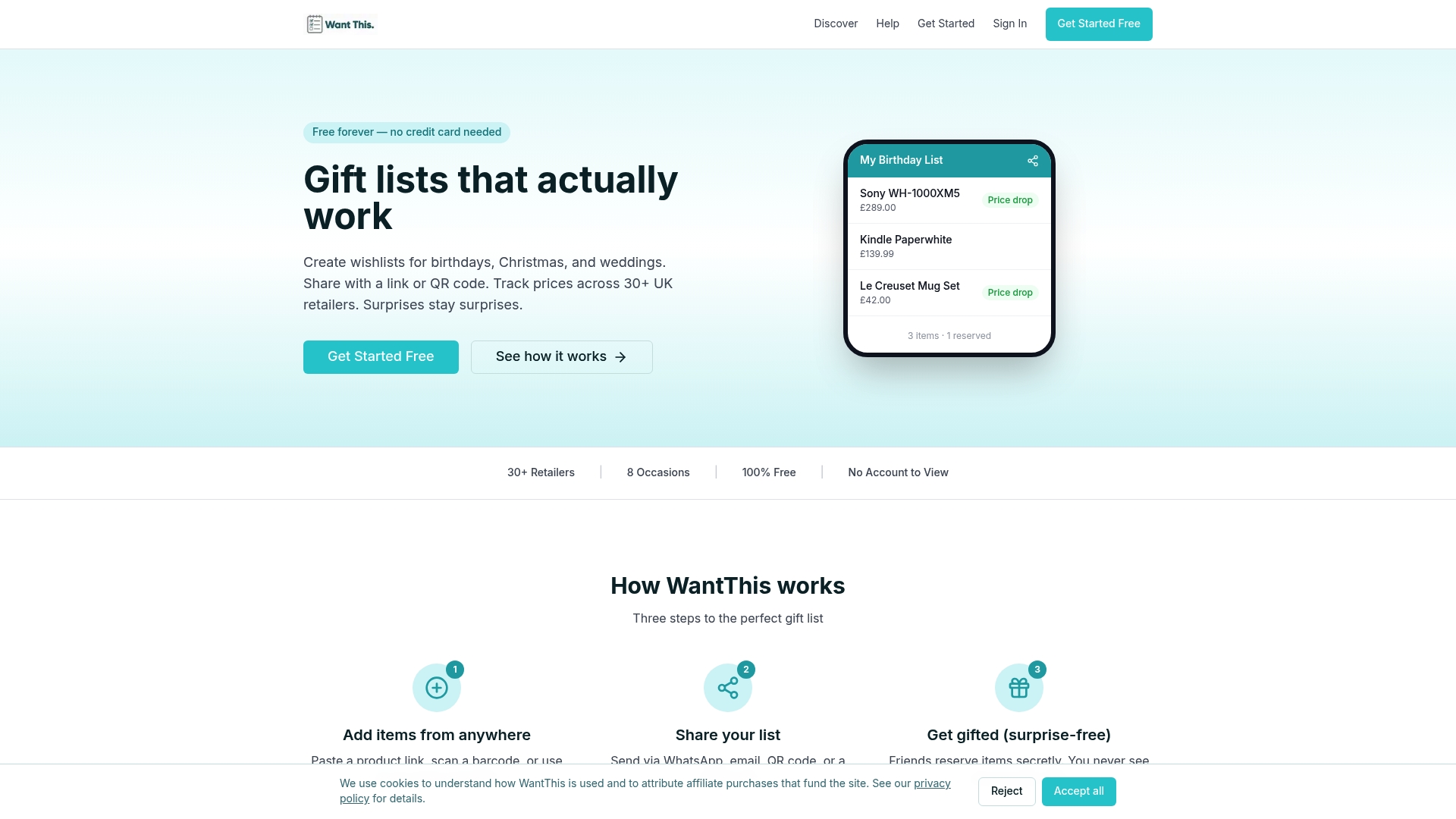
Create a free list at WantThis and share it in minutes. The sharing features page shows exactly how reservations and mark-as-bought work before you commit to anything.
Sources
The following sources informed this article:
- The YouGov big survey on Christmas present shopping and giving
- Ask and you shall (not) receive: Close friends prioritise relational signalling over recipient preferences in their gift choices - Kellogg (Northwestern)
- Ask and you shall (not) receive: Close friends prioritise relational signalling over recipient preferences in their gift choices - Journal source (Ward & Broniarczyk)