
Ways to Share Gift Lists for Any Occasion in 2026

A shared gift list is a curated collection of items you want, made accessible to friends and family so they can buy gifts you’ll actually use. The best ways to share gift lists centre on one principle: centralisation. When everyone accesses a single link, gifts get coordinated, duplicates disappear, and surprises stay intact. Platforms like WantThis make this straightforward by letting you add items from any retailer, organise by occasion, and share one link that updates in real time. Getting the method and etiquette right matters just as much as the list itself.
1. Ways to share gift lists using a universal digital registry
A universal gift list pulls items from multiple retailers into one place, giving every guest a single link to visit. Centralisation reduces guest confusion and prevents the frustration of searching across several stores. This is the foundation of how gift lists work at their best.
Digital registries go well beyond a simple spreadsheet. The most useful features include:
- Secret claiming: Guests mark items as reserved without the recipient seeing who claimed what.
- Real-time updates: Once an item is claimed, it disappears or gets flagged so no one buys it twice.
- Price range filters: Guests can sort by budget, which removes the awkwardness of guessing what to spend.
- Multi-retailer support: Items from Amazon, John Lewis, ASOS, or any other store sit side by side on one list.
- Mobile access: Guests can browse and claim gifts from their phones while shopping.
Digital registries provide one link, real-time purchase tracking, and shipping control. That combination improves the experience for everyone involved, not just the person receiving gifts.
Pro Tip: Build your list at least four weeks before your event. Guests who receive invitations early will check the list immediately, and a sparse list at that stage creates a poor first impression.

2. Sharing via event websites and invitation inserts
Event websites with a labelled “Registry” or “Gift List” tab are the most common and recommended sharing method for weddings, baby showers, and milestone birthdays. The tab is easy to find, always accessible, and keeps the list separate from the formal invitation.
Gift list etiquette in the UK and beyond is clear on one point: never print a gift list link directly on a formal invitation. The invitation is for requesting someone’s presence, not their presents. Instead, use a separate details card or a “further information” insert tucked inside the envelope. This keeps the tone warm rather than transactional.
For digital invitations sent by email, a hyperlinked line at the bottom works well. Keep the language light. Phrases like “For those who asked, we’ve put together a gift list here” land far better than a bold “Click here for our registry.” The framing signals that the list is optional, not obligatory.
3. Direct sharing by text and email
Sharing a gift list by direct text or email is perfectly acceptable and often the most practical route for smaller gatherings. It targets the right people, keeps the list private, and gets the link into their hands quickly.
Text messages work especially well for close family members who may not check event websites. A simple message like “Hey, I’ve put together a birthday list if you’re looking for ideas” is casual, low-pressure, and effective. Email suits slightly larger groups, such as a work team organising a group gift or extended family coordinating for Christmas.
The key with direct sharing is tone. You are offering a helpful resource, not issuing a demand. Keep the message short, make the link obvious, and let recipients know they are free to ignore it entirely.
4. How to prevent duplicates and coordinate group gifts
Secret claiming eliminates duplicate presents by letting each buyer mark an item as taken without revealing their identity to the recipient. The person receiving gifts never sees who bought what, so the surprise is preserved while the coordination happens behind the scenes.
Group gifts add another layer of complexity. When several people want to contribute to one larger item, a shared list needs to support cost-splitting or at least signal that a group contribution is welcome. Here is a practical process for managing this:
- Add a high-value item to your list and note in the description that group contributions are welcome.
- Nominate one organiser among the group to collect contributions and make the purchase.
- Mark the item as reserved once the organiser confirms the group is on board, so no one else buys it independently.
- Use a payment app like PayPal or bank transfer to collect funds before the event date.
- Update the list after purchase so latecomers know the item is covered.
Shared digital lists allow discreet coordination, including group splitting, without exposing purchase details to the recipient. That privacy is what makes the whole system work.
Pro Tip: When sharing your list, add a note that says “some items are great for group gifts.” This gives guests permission to team up without anyone feeling awkward about asking.
5. Alternatives for sharing gift lists: from simple tools to dedicated apps
The right tool depends on your occasion, your guests’ tech comfort, and how much coordination you need. Here is how the main options compare:
| Tool type | Best for | Key limitation |
|---|---|---|
| Shared Google Doc or Sheet | Small, informal groups | No claiming feature; duplicates still happen |
| Notes app shared link | Quick, low-effort lists | No images, prices, or real-time updates |
| Retailer-specific registry | Single-store shoppers | Locks guests into one retailer |
| Dedicated wishlist platform | Any occasion needing coordination | Requires guests to follow a link |
Dedicated platforms like WantThis sit at the top of this comparison for most occasions. You paste a product URL from any retailer, and WantThis automatically pulls in the title, image, and current price. Guests see a clean, shoppable list without needing an account themselves.
For occasions like weddings, a wedding gift list on a dedicated platform handles the volume of guests far better than a shared document. For Christmas, a Christmas gift list with price tracking lets you flag when items drop in price, which is genuinely useful for guests on a budget. For birthdays, a birthday gift list keeps things organised without requiring a formal registry setup.
The factors worth weighing when choosing a tool:
- Privacy: Can guests claim items without the recipient seeing?
- Ease of use: Will your less tech-savvy relatives actually use it?
- Mobile access: Can guests browse and claim from a phone?
- Multi-retailer support: Are you locked into one store?
6. Social media sharing: when it works and when it doesn’t
Social media can work as a sharing platform for gift lists, but it carries real risks. Posting a list publicly can read as demanding rather than helpful. The tone matters enormously here.
A private Facebook group for a hen party or a WhatsApp group for close family sidesteps the public pressure problem. These closed channels let you share the link with a specific audience who already expects to receive it. Public posts on Instagram or X are harder to frame casually, and they expose your list to people who were never invited to the occasion.
If you do share on social media, keep the caption light and make participation clearly optional. A post that reads “I’ve put together a wishlist for anyone who asked” lands very differently from one that reads “Here’s my birthday list!” The first invites. The second demands.
Key takeaways
The most effective approach to sharing gift lists combines a centralised digital platform, clear etiquette around where and how you share, and features like secret claiming to prevent duplicates.
| Point | Details |
|---|---|
| Centralise your list | Use one link covering all retailers so guests never have to search multiple stores. |
| Follow etiquette on invitations | Place list links on event websites or details cards, never on the formal invitation itself. |
| Use secret claiming | Let guests reserve items privately so surprises stay intact and duplicates are eliminated. |
| Match the tool to the occasion | Dedicated platforms handle weddings and large events; shared docs work for small, informal groups. |
| Keep sharing tone casual | Frame your list as a helpful resource, not a requirement, across every channel you use. |
How gift list sharing has actually changed
The biggest shift is not the technology. It is the etiquette catching up to the technology. Five years ago, sharing a gift list felt presumptuous to a lot of people. Now, most guests actively prefer it. Nobody wants to spend an afternoon guessing what to buy, and nobody wants to show up with the same book as three other people.
What still trips people up is the channel choice. Beautifully organised lists can go unnoticed when they are buried on a wedding website with no clear label, and lists shared in public Instagram posts can create genuine awkwardness. The list itself is rarely the problem. How and where you share it almost always is.
The secret claiming feature is the single biggest quality-of-life improvement in modern gift list tools. It sounds like a small detail, but it solves the oldest problem in gift-giving: how do you coordinate without spoiling the surprise? The answer, finally, is that you do not have to choose between the two.
The simplest approach is to pick one platform, build your list properly, and share it through two channels at most. An event website tab and a direct message to close family covers almost every scenario. Adding more channels rarely improves coordination. It usually just creates noise.
WantThis makes gift list sharing straightforward
WantThis is built for exactly this kind of coordination. You paste a product link from any retailer, and WantThis pulls in the title, image, and current price automatically. Your friends and family get one clean link to browse, and they can privately reserve items so nothing gets bought twice.
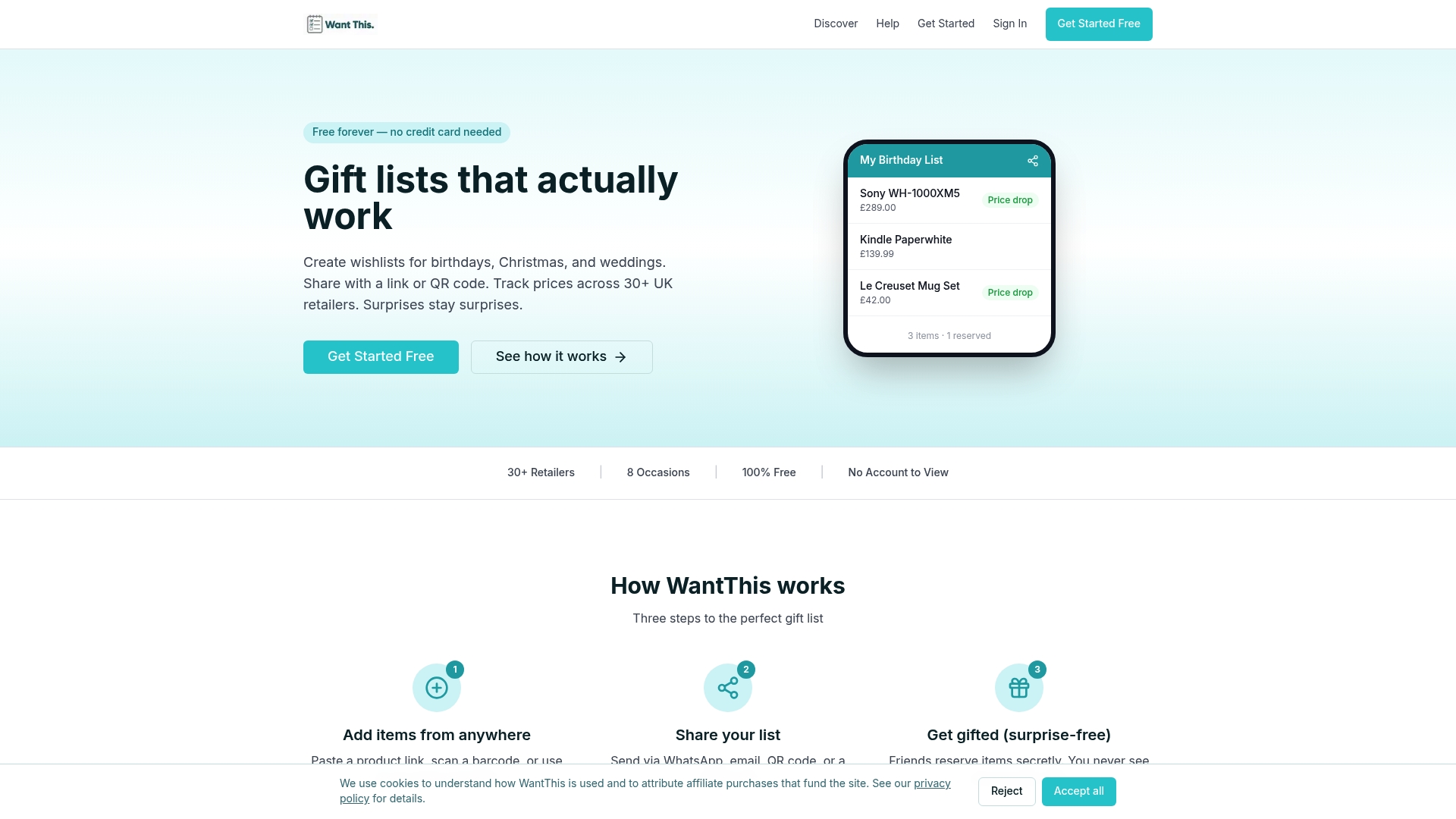
The sharing features on WantThis are free to use, and guests do not need an account to view your list or claim items. For groups organising a Secret Santa, the built-in Secret Santa organiser handles the draw automatically. If you use ChatGPT, the ChatGPT integration lets you work on your list from inside ChatGPT. WantThis covers every occasion from birthdays to baby showers, all in one place.
FAQ
What is the best way to share a gift list?
The best method is a single shareable link from a dedicated platform that supports secret claiming and real-time updates. This prevents duplicates and keeps the experience simple for every guest.
Should I put my gift list on my wedding invitation?
No. Gift list etiquette is clear: place the link on your event website or a separate details card, not on the formal invitation itself. This keeps the tone appropriate and avoids any impression of obligation.
What is a group gift list?
A group gift list is a shared list where multiple people contribute toward one or more items, often coordinated by a single organiser. Dedicated platforms support this by allowing items to be marked as reserved while keeping purchase details private from the recipient.
How do shared gift lists prevent duplicate gifts?
Secret claiming lets each guest mark an item as taken without revealing their identity to the recipient. Once claimed, the item is flagged or hidden so no other guest purchases the same thing.
Is it acceptable to share a gift list on social media?
Sharing in a closed group, such as a private WhatsApp or Facebook group, works well. Public posts carry a risk of appearing demanding, so keep the tone casual and make participation clearly optional if you do post publicly.