
Gift coordination checklist for families: stop duplicates now

TL;DR:
- A shared family gift list with private reservation rules helps prevent duplicates and preserves surprises. Creating and maintaining this list, along with a clear budget and reservation system, takes under ten minutes and reduces last-minute stress. Using a dedicated platform simplifies coordination across devices and keeps family members informed without cluttering group chats.
One shared list and a simple reservation rule will stop duplicate presents, preserve surprises, and save every family member hours of back-and-forth. That is the core of any effective gift coordination checklist for families, and you can put it in place in under ten minutes.
Your one-page checklist (copy and use now):
- [ ] Recipient name and relationship
- [ ] Budget per recipient
- [ ] Gift idea and product link
- [ ] Size, colour, or variant needed
- [ ] Suggested gifter or reserver
- [ ] Reservation status (idea / reserved / bought / wrapped / delivered)
- [ ] Hide location (where the gift is stored)
- [ ] Notes (price drop alerts, delivery dates)
Three actions to start right now:
- Create one shared list and name it (e.g. “Family Christmas 2026”)
- Invite family members with the right permission level
- Reserve at least one big-ticket item before anyone else does
Table of Contents
- What does a gift coordination checklist for families actually cover?
- How do you set up a shared family wishlist that works across devices?
- How do you avoid duplicate gifts and keep surprises secret?
- How do you manage family groups, kids, and multi-generation households?
- How do you set budgets and run group gifts?
- When should you start? A research-backed planning timeline
- What features should you look for in a family gift tool?
- What etiquette rules should families agree before starting?
- What operational habits actually make coordination work?
- Key takeaways
- Why the group chat is the enemy of good gift coordination
- Wantthis makes the checklist practical from day one
What does a gift coordination checklist for families actually cover?
A well-built family gift checklist is a living document, not a one-time form. The steps below turn it into a tool your whole family will actually use.
1. Decide the scope and set a total budget
Before adding a single item, agree whether this list covers one occasion (Christmas, a birthday) or runs all year. Then set a total household budget and divide it by recipient and category. Setting a total budget before deal season prevents impulse buys during Black Friday and January sales.
2. Build a recipient map
Group every recipient by relationship, budget band, and deadline. A simple table works well:
| Recipient | Relationship | Budget | Deadline |
|---|---|---|---|
| Mia (age 7) | Child | £60 | — |
| Dad | Parent | £50 | — |
| Auntie Jo | Extended | — | — |
This map becomes the backbone of your list. It reduces decision friction because everyone can see at a glance who still needs a gift and how much is left to spend.
3. Create the shared list and add baseline items
Add each recipient as a section or tag. For every item, fill in: idea, link, price, size or variant, suggested gifter, and status. Keep the list open for additions but lock the reservation fields to avoid confusion.

4. Agree a reservation rule
The simplest rule: first to reserve buys. Reservations should be private (visible only to the reserver and the list organiser) so surprises stay intact. Set a short lock window of 48–72 hours before purchase day to avoid last-minute changes.
5. Assign owners for big-ticket and pooled items
For any item over £50, name one person as the buyer. For group gifts, name a treasurer who collects contributions and makes the purchase. This single step prevents the most common coordination failure: everyone assuming someone else has handled it.
6. Run a weekly check
Once a week, open the list, mark any status changes, and move purchased items to “wrapped” or “delivered.” Keep the hide-location field updated so nothing gets lost in a spare room.
Pro Tip: Set a recurring calendar reminder every Sunday from October through December. Five minutes of weekly upkeep is far easier than a frantic catch-up in the final week before Christmas.
How do you set up a shared family wishlist that works across devices?
The setup takes about fifteen minutes if you follow a clear sequence. The goal is a list that any family member can open on their phone, tablet, or laptop without needing a tutorial.
Choose a list owner and naming convention
One person creates the list and owns the admin rights. Name it clearly: “Family Christmas 2026” or “Smith Family Birthdays” works better than “Our List” because it is searchable and unambiguous when you have several lists running.
Add the right fields for each item
A well-structured item entry should include:
- Recipient: who the gift is for
- Idea and link: paste the product URL from any UK retailer; a good platform pulls in the title, image, and current price automatically
- Price and variant: note the size, colour, or model so the buyer orders the right thing
- Suggested gifter: who is expected to buy it (optional but useful for large families)
- Reserver: name and date of reservation
- Status: idea / reserved / bought / wrapped / delivered
- Hide location: where the gift is stored after purchase
Including a brief reason why the item is a great choice for that recipient helps non-shoppers decide quickly, especially grandparents or distant relatives who may not know the recipient’s current interests.
Paste links from any UK retailer
Copy the product URL from Amazon, John Lewis, ASOS, Argos, or any other UK shop and paste it into the list. Platforms like Wantthis pull in the title, image, and live price automatically, so the list stays accurate without manual updates.
The single biggest setup mistake families make is building the list in a group chat. Messages get buried under non-gift discussions within hours, and deadlines, links, and budgets become impossible to find. Move all logistical detail into a persistent, link-based workspace and use the group chat only for quick alerts.
Invite family members with the right permissions
Send a share link with a clear permission level:
- Organiser: full edit rights (list owner only)
- Contributor: can add ideas and update their own items
- Reserver: can claim items but not edit others’ entries
- Viewer: read-only access, useful for elderly relatives who just want to see what is needed
No-account sharing (a link anyone can open without signing up) is useful for grandparents or occasional contributors. Require sign-in only for anyone who needs edit or reservation rights.
Check device compatibility first
Test the list on the devices your family actually uses. Wantthis works on web browsers, iOS, and Android, and offers a browser extension for adding items while shopping. Check that the mobile view shows reservation status clearly — that is the field most family members will look at first.
Pro Tip: Send a short voice note or text to less tech-confident relatives explaining how to open the link and what “reserved” means. Two minutes of onboarding prevents a week of confusion.
How do you avoid duplicate gifts and keep surprises secret?
Private reservation is the mechanism that solves both problems at once. When a family member reserves an item, only they and the list organiser can see who has claimed it. Everyone else sees the item as “reserved” without knowing by whom.
Private vs public claiming
A public “claimed” flag tells the recipient who is buying their gift, which ruins the surprise. Private reservation hides the reserver’s identity from everyone except the organiser. Always choose private claiming for any list that includes the recipient as a viewer.

Use a single reserver field with a timestamp
One name and one date per item. This makes responsibility unambiguous and prevents two people from buying the same thing because they both thought the other had not committed yet.
Key practices:
- Reserve large-ticket items as early as October for winter holidays
- Leave smaller items marked “available” until closer to purchase day, so late joiners can still contribute
- Keep a “hide location” field rather than deleting bought items — it doubles as a storage tracker
- Use a no-account share link for viewers; require sign-in for anyone with reservation rights
Pro Tip: If you are the list organiser, do a quick audit every two weeks to check for items that have been “reserved” for more than three weeks without moving to “bought.” A gentle nudge at that point prevents last-minute gaps.
How do you manage family groups, kids, and multi-generation households?
Large families need structure, not just a longer list. The answer is subgroups and clear permission roles.
Create subgroups to reduce noise
Divide recipients into subgroups: core family, grandparents, cousins, and social gifts (colleagues, neighbours, teachers). Each subgroup can have its own section or separate list. This keeps the main family list focused and stops distant relatives from seeing budget details that are not relevant to them.
Set simple permission roles
- Organiser (full access): the coordinator who manages the whole list
- Contributor (add ideas): family members who can suggest gifts for others
- Reserver (claim only): anyone who wants to buy but should not edit the list
- Viewer (read-only): grandparents, elderly relatives, or anyone who just needs to see what is needed
Handle children’s entries carefully
Children should not see their own gift list. Set a parent-approval flag for any item a child adds to their own wishlist, and restrict their view to a separate “my ideas” section. The main family list, with reservation statuses and hide locations, should be visible only to adults.
For elderly relatives who prefer email, most platforms let you share a static link that opens without an account. Print a copy if needed — the goal is inclusion, not technical compliance.
Pro Tip: Create a separate “social gifts” section for batch purchases: teacher gifts, neighbour bottles of wine, colleague collections. Buying these in one go in early December saves three separate shopping trips.
How do you set budgets and run group gifts?
Budget clarity prevents resentment. The simplest approach is to set a per-person budget before anyone starts shopping, then layer in a pooled fund for any big-ticket item that exceeds a single person’s allocation.
Per-person vs category budgets
Per-person budgets work well for immediate family. Category budgets (children, partner, extended family, social) work better for large households where the total spend matters more than individual allocations.
Running a pooled gift
When organising a group gift, follow these steps:
- Add the item to the list with a target price and a suggested contribution range (not a fixed amount — ranges increase participation)
- Name one treasurer who collects payments and makes the purchase
- Set a firm payment deadline at least two weeks before the purchase date
- Keep individual contribution amounts private; only the treasurer needs to know who paid what
- Mark the item “funded” in the list once the full amount is collected
Sample budget split for a typical family Christmas
| Category | Budget | Notes |
|---|---|---|
| Children (2) | — | £60 per child |
| Partner | — | One main gift + stocking |
| Parents (2) | £60 | — |
| Extended family | — | — per person × 4 |
| Social gifts | £50 | Batch buy in early December |
| Total | — | Set before Black Friday |
Suggesting a contribution range rather than a fixed amount is the single most effective way to increase participation in pooled gifts and reduce the social friction that comes with mandatory contributions.
When should you start? A research-backed planning timeline
Build your recipient map and set your total budget by early October for winter holidays. That timeline gives you six to eight weeks before Black Friday to make considered choices rather than reactive ones.
Planning milestone callout:
Starting your recipient map in early October means your budget is set before deal season begins — so Black Friday becomes a tool, not a trap.
Sample timeline: September to December
- September: Agree the scope (which occasions, which recipients) and set the total family budget
- Early October: Build the recipient map; create the shared list; add placeholder items for every recipient
- Late October: Fill in ideas and links; assign big-ticket items to specific buyers
- Early November: Reserve all big-ticket items; set up any pooled gift funds with deadlines
- Black Friday / Cyber Monday: Buy pre-researched items at discount; avoid impulse additions
- Early December: Chase any outstanding reservations; batch-buy social gifts
- Mid-December: Mark all items “bought”; update hide locations; confirm delivery dates
- Final week: Wrap, label, and mark “wrapped” in the list; confirm transport for large items
Families who treat gift planning as a small household project — with a budget, a shared list, and a timeline — consistently avoid the last-minute panic that drives overspending.
What features should you look for in a family gift tool?
Not every wishlist platform handles family coordination well. Here is what actually matters.
Must-have features
- Private reservations: family members can claim items without revealing who is buying what
- Cross-retailer link support: paste URLs from any UK shop (Amazon, John Lewis, Argos, ASOS) and have the platform pull in title, image, and price
- Share-by-link with no-account option: so grandparents and occasional contributors can view without signing up
- Device support: web, iOS, and Android — test the mobile view before committing
- Price tracking: alerts when a saved item drops in price, useful for deciding whether to buy now or wait
Nice-to-have features
- Group fund or money-pooling option for big-ticket items
- Secret Santa organiser with an automatic draw
- Browser extension for adding items while shopping on any site
- Automatic price-drop alerts sent by email or push notification
Trust signals to check
Look for active user reviews, recent platform updates, and clear UK currency and retailer compatibility. A platform that shows prices in dollars or does not recognise UK retailers is not built for UK families.
The question most families forget to ask: can you export your list? If the platform shuts down or you want to switch tools, a data export option means you do not lose a year’s worth of gift research. Check this before you invest time building a detailed list.
Pro Tip: Run a five-minute test before committing: paste a link from John Lewis, invite one family member, and ask them to reserve an item. If either step causes confusion, the platform is not ready for a large family.
What etiquette rules should families agree before starting?
A checklist only works if everyone follows the same conventions. Agreeing a short set of rules at the start prevents conflict later.
- Keep contribution amounts private. Only the treasurer for a pooled gift should know who paid what. Never share individual amounts in the group chat.
- Participation is voluntary. Not every family member can contribute financially. Agree non-monetary ways to participate (wrapping, delivery, organising) so no one feels excluded.
- Avoid frequent changes to a reserved item. Once someone has reserved an item, changing your mind within 48 hours of the purchase deadline is disruptive. Set a lock window and stick to it.
- Let parents manage children’s main gifts. For age-appropriate surprises, parents should have sole edit rights over their children’s primary gift entries.
- Use consistent status labels. Agree on exactly five statuses: idea, reserved, bought, wrapped, delivered. Adding custom labels (“maybe”, “thinking about it”, “possibly”) creates ambiguity and tracking errors.
Pro Tip: Send the agreed rules as a short bullet list in the group chat when you share the list link. Pin it so it stays visible. Most coordination problems come from people not knowing the rules, not from people ignoring them.
What operational habits actually make coordination work?
The recipient map is the most underused tool in family gift planning. Grouping recipients by relationship, budget, and deadline reduces the number of decisions you need to make in the moment. Instead of asking “what should I get Mia?” you ask “what is available in Mia’s £60 budget that nobody has reserved yet?” That is a much easier question to answer.
The second habit that experienced coordinators consistently report is moving logistics out of group chats into a persistent, link-based workspace. Group chats are useful for quick alerts (“I’ve just reserved the bike”) but terrible for tracking deadlines, budgets, and links. Messages get buried within hours.
Coordinators who move deadlines, budgets, and links into a shared workspace report fewer last-minute purchases and clearer ownership of big-ticket items. The group chat becomes a notification channel, not the source of truth.
A recipient map template you can copy
| Recipient | Relationship | Budget | Deadline | Status |
|---|---|---|---|---|
| Mia | Child | £60 | — | 2 ideas added |
| Dad | Parent | £50 | — | Reserved |
| Auntie Jo | Extended | — | — | Idea only |
| Teacher | Social | — | — | Bought |
Shared gift lists reduce stress precisely because they move the cognitive load of remembering who needs what off individual family members and into a shared, always-accessible document.
Pro Tip: Build the recipient map in a spreadsheet first if your family is new to shared lists. Once everyone is comfortable with the concept, migrate to a dedicated platform for the reservation and price-tracking features.
Key takeaways
A single shared list with a private reservation rule is the most effective gift coordination strategy for families of any size.
| Point | Details |
|---|---|
| Start by early October | Build your recipient map and set the total budget before deal season begins. |
| Use private reservations | Private claiming prevents duplicates without spoiling surprises for the recipient. |
| Name one treasurer | For pooled gifts, one person collects contributions and makes the purchase. |
| Set budgets before Black Friday | Pre-set budgets turn deal season into a buying opportunity, not an impulse trap. |
| Wantthis runs the checklist | Wantthis handles shared lists, private reservations, price tracking, and Secret Santa in one place. |
Why the group chat is the enemy of good gift coordination
Most families start coordinating gifts in a WhatsApp group. It feels natural — everyone is already there. But group chats are structurally bad at coordination. They are chronological, not searchable by topic, and every non-gift message pushes the important links and deadlines further up the scroll. By mid-November, the link to the bike someone suggested in October is effectively lost.
The recipient map changes this. It is not a complicated document. It is a table with five columns and one row per person. But it forces a family to make three decisions upfront — who, how much, and by when — that would otherwise be deferred until December and made badly under pressure. Families who build the map in October and move their list into a persistent workspace consistently have a calmer, cheaper December.
The reservation rule matters just as much. The problem with “just tell everyone in the chat” is that messages are missed, misread, or forgotten. A private reservation in a shared list is a record. It has a name and a date. Nobody can claim they did not know the item was taken.
The tools to do this well exist and most of them are free. The barrier is not technology — it is the habit of treating gift coordination as a proper household task rather than something that will sort itself out.
Wantthis makes the checklist practical from day one
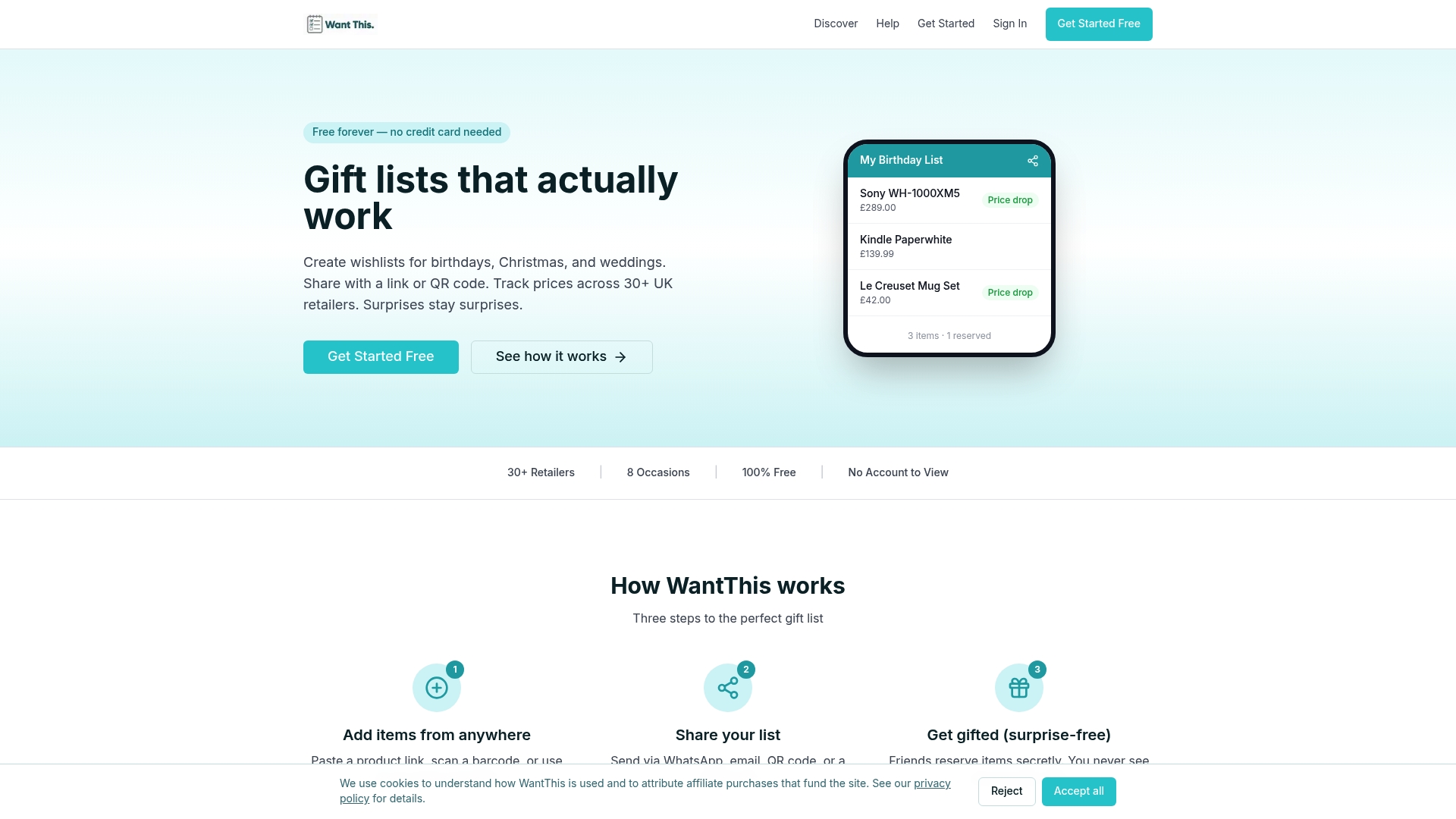
Wantthis is built for exactly this workflow. Paste a link from any UK retailer — Amazon, John Lewis, Argos, ASOS — and Wantthis pulls in the title, image, and current price automatically. Family members can privately reserve items so surprises stay intact, and the list owner can see reservation status without revealing who is buying what to the recipient.
The Secret Santa organiser handles automatic draws, so there is no need for a separate tool at Christmas. Price tracking alerts you when a saved item drops, which is particularly useful for big-ticket items you are watching ahead of Black Friday. The browser extension and iOS/Android apps mean family members can add items while browsing any shop, without switching between tabs.
Getting started takes about ten minutes: create a list, paste your first few links, invite family members with the right permission level, and reserve the items you are buying. The full feature set covers everything in the checklist above, from private reservations to group funds. Create your free family list on Wantthis and have the recipient map ready before October.
Useful sources and tools
- Wantthis — free gift lists and price tracking: the platform used throughout this guide for shared lists, private reservations, and Secret Santa draws.
- Wantthis features page: full breakdown of price tracking, browser extension, sharing options, and device compatibility.
- Christmas gift list on Wantthis: a practical template and example list for winter holiday planning.
- Height Magazine — holiday gift planning for busy families: research-backed timeline and recipient-map guidance used in the planning and EEAT sections above.
- SignUpReady — how to coordinate a group gift: practical steps for running a pooled gift, including the treasurer role and contribution-range approach.
- How couples coordinate wedding gifts: useful for families adapting the checklist to wedding or baby-shower occasions.
- Personalised chef apron gift — Winedrop Cookery: an example of a personalised item families might add to a shared wishlist for a partner or parent.
Quick-start rule: open the recipient map template in this article, fill in one row per person, then paste the first three product links into your shared list. That is enough to start — you can refine the rest over the following weeks.