
Toy Price Tracker UK: How to Spot a Real Toy Deal

The simplest way to track toy prices in the UK is to save each toy to one list, set a target price and let alerts tell you when it drops. WantThis is a free wishlist that does this across 30+ UK retailers, with price history to show whether a “sale” price is actually low. This guide explains what a toy price tracker shows, how to set one up for a toy, how to read the history and where trackers can mislead you.
TL;DR
- A toy price tracker records a product’s price over time at several retailers and alerts you when it falls to a price you choose.
- Save the toy once, set a target price, and buy only when the price history shows the drop is real.
- Compare the deal with the usual price, not the “was” price printed beside it.
- Trackers check periodically, and codes or member-only prices may not show, so always confirm the final price at the retailer’s checkout.
- WantThis is free, tracks 30+ UK retailers, and lets family reserve gifts privately so nobody buys the same toy twice.
Table of Contents
- What a toy price tracker actually does
- Why toys are worth tracking more than most things
- How to track a toy’s price in the UK, step by step
- How to tell a real toy deal from a fake one
- Where toy price trackers can mislead you
- Tracking one toy versus tracking a whole list
- Building a toy plan for the year
- Promo: one free list for every toy you are watching
- Our perspective
- FAQ
- Sources
What a toy price tracker actually does
A toy price tracker watches a product page, notes the price on a regular schedule and stores each reading. Over weeks, those readings become a price history: a simple chart of what a toy cost on which days. An alert then tells you when the price hits the level you set.
That sounds basic, but it fixes the biggest problem with buying toys: prices move around a lot, and the box never tells you whether today’s price is good. A building set can sit at one price for months, jump up before a promotion, then “drop” back to where it started. Without history, you have no way to tell.
A tracker gives you three things:
- The current price at the retailers it watches.
- The history, so you can see the lowest price recorded and how often the toy has been that cheap.
- The alert, so you do not have to keep checking the same pages by hand.
For a parent or gift buyer, the third one matters most. You decide your price once, then get on with life.
Why toys are worth tracking more than most things
Toys have a few habits that suit tracking.
Prices change often and by retailer. The same toy can be priced differently at a supermarket, a toy specialist, a department store and a general marketplace on the same day, and each moves on its own schedule.
Demand is seasonal. Prices on popular toys tend to behave differently in the weeks before Christmas, around birthdays and during big sale events. Watching a toy from early in the year, rather than from the week you need it, gives you far more to go on.
Gifts are planned. Unlike a boiler that breaks, a birthday present has a date. That gives you time to wait for a drop, which is exactly when a tracker pays off.
Lists are often shared. Grandparents, aunts and friends all ask what to buy. A tracked list that others can see answers that question and keeps the price in view.
How to track a toy’s price in the UK, step by step
Here is the routine that works for any toy, from a LEGO set to a doll, a board game or a games console bundle.
1. Save the toy to a list
Copy the product link from any UK retailer and add it to your list. With WantThis, you can bring together products from different retailers in one place, and when you add a link we can import the available product details such as the name and image. You can also use the browser extension or the iOS and Android apps to add toys while you browse. Our features page shows what is available.
What goes wrong here: saving a link to a bundle or a different colour or edition from the one you want. Check the product name and any piece count or age rating before you save.
2. Add the same toy from other retailers
If you see the same toy at more than one shop, save each link. Seeing them side by side tells you which retailer is cheapest right now and which one tends to discount more. Our guide to tracking prices across stores covers how to set this up.
What goes wrong here: comparing two listings that are not identical. A “party pack” and a standard set can look the same in a thumbnail and cost very different amounts.
3. Set a target price
Pick a number you would be happy to pay, not the lowest number you can imagine. A realistic target is a price the toy has reached before, which is why step 4 matters. WantThis offers price alerts and price history for tracked items; the price tracking page explains the options.
What goes wrong here: setting the target too low. If the toy has never been that cheap, you will wait for an alert that never comes and miss a perfectly good price.
4. Read the history before you decide
When an alert arrives, open the history. You are looking for the usual price, the lowest price recorded and how long the drop has lasted. More on this in the next section.
5. Check the retailer before you pay
Follow the link through to the retailer. On WantThis you go to the shop to confirm the latest price and availability and to complete your purchase, so the final check is always on the retailer’s own page. Look at delivery cost, the seller’s name and whether the toy is in stock in the version you want.
6. Mark it as bought
If the toy is on a shared list, mark it as bought so nobody else buys it. Reservations are private, so the child or the gift’s recipient does not see what has been taken.
How to tell a real toy deal from a fake one
The price tag next to a toy is not proof of a discount. A “was £59.99, now £29.99” label only means something if £59.99 was a genuine price. The UK Competition and Markets Authority has set out principles saying that a “was” price must have been offered for a sufficient period on the same website immediately before the discount, and the same document explains that a comparison is only genuine if it meets tests like these. That is the standard retailers are meant to meet, and price history is how you check it yourself.
Use this quick test on any toy deal:
| Question | Where to look | A good sign |
|---|---|---|
| What is the usual price? | The longest stretch of the price chart | The deal is clearly below it |
| What is the lowest recorded price? | The bottom of the chart | The deal is at or near it |
| Did the price rise just before the sale? | The weeks before the drop | A flat line, not a spike |
| How many retailers are at this price? | Your side-by-side list | More than one, or the others are higher |
| What is the total cost? | The retailer’s basket | Delivery is included or low |
A worked example. Say a building set is printed at £74.99 with a promotional price of £37.49. Your history shows it sat at £49.99 for most of the year, dipped to £39.99 once in spring and spiked to £74.99 two weeks ago. The “50% off” is a deal against a price it barely held. The real saving against the usual price is £12.50, and it is £2.50 short of the best price you have seen. That might still be worth buying for a birthday next week. If the party is in December, you can wait for the lower price with a clear conscience.
The same logic applies in reverse. A toy that looks only slightly reduced, but is at its lowest ever price on your chart, is a better buy than a dramatic percentage.
Where toy price trackers can mislead you
A tracker is a guide, not a guarantee. Knowing its limits makes you a better user of it.
Checks are periodic. A tracker looks at a page every so often, not every second. A short flash deal may be over by the time you open the alert, and how often a page is checked can vary by service and product. If an alert arrives and the price has gone, set it again rather than assume you were cheated.
Some prices are invisible. Discount codes, member-only prices, gift-card offers and multi-buy bundles often do not appear as the page’s list price, so a tracker may not show them. If you have a loyalty card or a code, your real price may be lower than the chart. That is good news, but check at checkout.
Third-party sellers vary. Large marketplaces list many sellers. A low price from a seller you do not know can come with slower delivery, different returns terms or even a different version of the product. Check who is selling and who is sending it before you click buy.
Stock is a separate question. A good price is no use if the toy is sold out or only available in a different edition. Confirm availability on the retailer page.
Total cost matters. Delivery fees can erase a small saving. Compare the final basket total, not just the item price.
The practical rule: treat the tracker as the way you find and judge the opportunity, and the retailer’s checkout as the final word on what you will pay.

Tracking one toy versus tracking a whole list
Most people start with one toy, then end up with ten. A birthday list for a child, a Christmas list for two nephews and a few things for yourself quickly outgrow a single browser tab.
A list-based approach solves three things:
- You see everything in one place. Instead of 12 tabs, you have one list with each toy, its current price and its history.
- You can budget. With prices side by side, you can see what the whole list costs and swap an expensive item for a cheaper one.
- You can share it. Send the list to family so they pick from toys you are happy with. They can reserve an item privately, so there are no duplicates and no spoiled surprises. Our sharing feature explains how.
If you shop at one of the large UK toy chains, our guide to Smyths price drop alerts shows how to follow its toys through a shared list. For video games and consoles, which behave similarly, see our guide to game price drop alerts.
Building a toy plan for the year
A tracker works best when you give it time. Here is a simple plan that suits most UK households.
Early in the year: Save the toys you expect to need, such as birthday presents and the toys a child keeps asking for. Start the history early so you can judge them later.
Through spring and summer: Let alerts come in. Do not buy at the first drop unless it matches your target and your history check. Notice which retailers tend to discount your toys.
Autumn: Narrow your list to the toys you will really buy for Christmas. Check history again and move your target prices to realistic figures.
November and December: Buy the toys that have reached your target, and mark them as bought on shared lists. If family members are buying, make sure they can see what is reserved.
Christmas with a group: If your family draws names for presents, our Secret Santa organiser runs the draw automatically, and participants can link to their own lists.
This is not rocket science. It is just giving yourself the time that most buyers do not have.

Promo: one free list for every toy you are watching
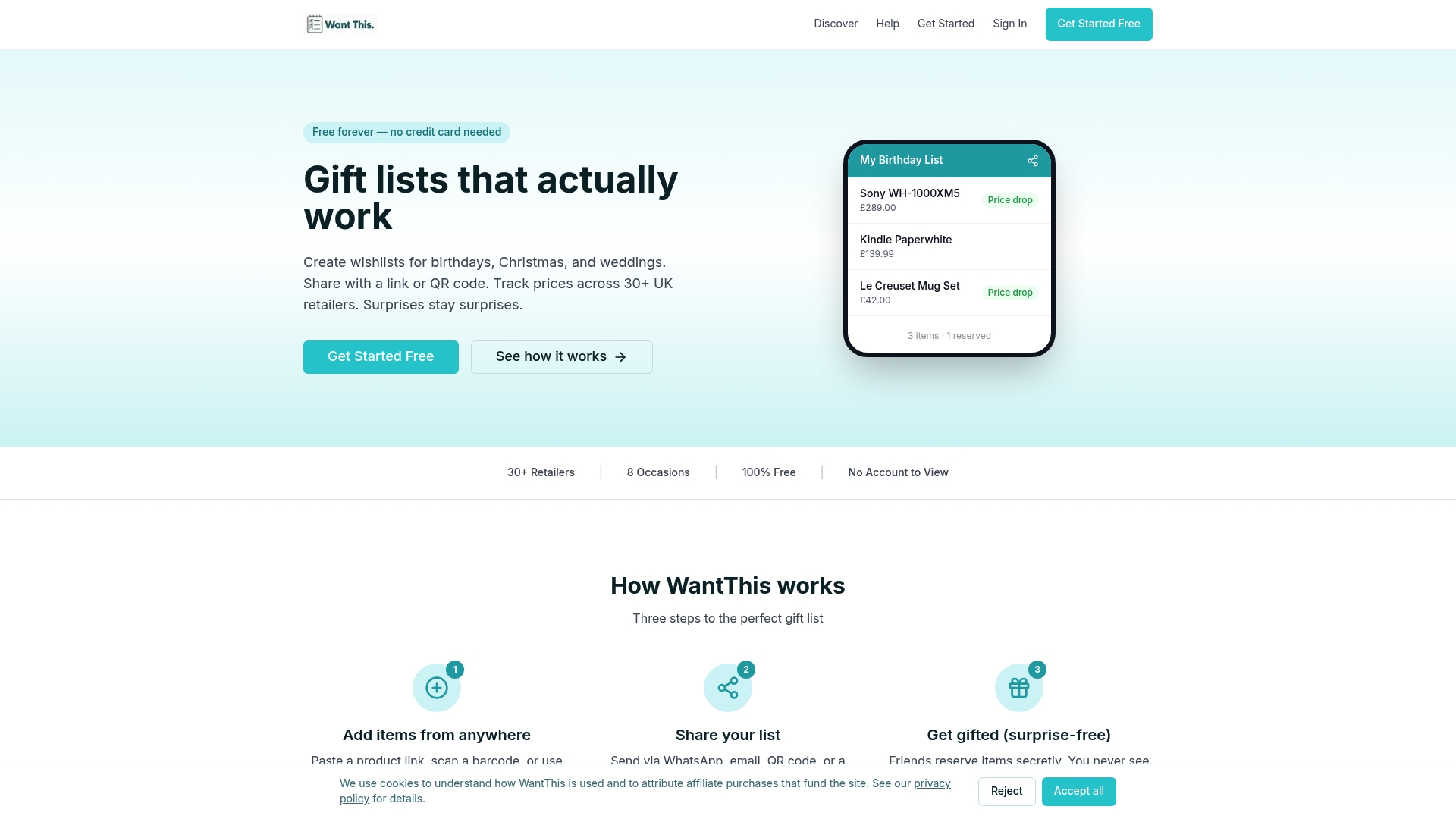
WantThis is a free UK wishlist and gift-list platform. You can add toys from any online retailer, organise them by occasion such as birthdays or Christmas, track price drops across 30+ UK retailers with alerts and price history, and share the list privately so family can reserve gifts without duplicates. You can build your list from the browser extension or the iOS and Android apps. Start your free list on WantThis and add the first toy.
If you want more detail on how alerts work first, the price tracking guide walks through it, and our post on the fastest way to track price drops in the UK covers the basics.
Our perspective
We built WantThis around a simple idea: people should not need a spreadsheet to buy a toy at a fair price. A tracker that sits on one product at one shop answers only half the question. The other half is what else you are buying, who else is buying for the same child and whether the price is good compared with what it has been.
That is why we put price tracking inside a wishlist. You add toys from different retailers to one free list, and we bring together the price alerts and history across 30+ UK retailers. When it is time to buy, you follow the link to the retailer to check the latest price and availability and complete your purchase. Where we use affiliate links, we disclose it.
The sharing side matters just as much. A toy bought twice is a wasted saving, and a toy a child spots on the list is a spoiled surprise. Private reservations let grandparents and friends choose what to buy without either happening.
Our advice is to start early, set a target you have seen the toy reach, and let the list do the watching.
Stuart
FAQ
Is there a free toy price tracker in the UK?
Yes. WantThis is free to use. You can save toys from any online retailer, track prices across 30+ UK retailers and set alerts for drops. You can also add items through the browser extension or the iOS and Android apps.
How do I know a toy price drop is genuine?
Compare the new price with the usual price and the lowest price on the toy’s history, not with the “was” price on the page. The CMA’s principles say a reference price must have been offered for a sufficient period immediately before the discount. If the price jumped just before the sale, the saving is not as big as it looks.
How often do price trackers check toy prices?
It varies by service, retailer and product, and trackers check periodically rather than continuously. That means a very short deal can end before you see the alert. Treat the alert as a prompt, and confirm the price and stock on the retailer’s page before you buy.
Can I track the same toy at several shops?
Yes. Save the product link from each retailer to the same list and compare them side by side. This shows which shop is cheapest now and which one tends to reduce prices, and our guide to price alerts for wishlists shows how.
Can family see what I am buying from a shared list?
Gift reservations on a shared WantThis list are private, so people can reserve or mark toys as bought without the surprise being spoiled. That helps avoid duplicate presents.