
Never Miss UK Wishlist Price Alerts: Track 30+ Retailers with WantThis

The fastest way to get reliable wishlist price alerts in the UK is to use a UK-aware wishlist tracker, or to enable retailer deal notifications and then double-check any drop against price history. Retailer alerts are convenient but event-focused, so pairing them with a tracker that covers multiple stores gives you far better odds of catching a genuine bargain. WantThis, a UK wishlist platform, adds price tracking across a wide range of retailers so you can add an item once and let the alerts do the watching.
TL;DR:
- Price tracking with a UK-aware wishlist platform like WantThis offers better chances of catching genuine bargains across multiple stores than single retailer alerts.
- Push notifications are the fastest method for real-time alerts but require app installation and permission, while email alerts suit less time-sensitive deals.
- Monitoring price history over 365 days and confirming seller and condition details help verify if a price drop is truly a good deal.
- Setting realistic target prices based on past data prevents waiting for rarely occurring discounts or fake deals.
- UK regulations require accurate pricing practices, making historical data and full cost checks essential before purchasing.
Table of Contents
- How wishlist price alerts actually work
- Practical methods to get wishlist price alerts in the UK
- How to check a price drop is actually worth buying
- How WantThis supports wishlist price alerts and gift coordination
- Legal and regulatory factors behind UK price alerts
- Realistic expectations when using wishlist alerts for gifts and personal buys
- Try wishlist price tracking with WantThis
- Sources
- FAQ
How wishlist price alerts actually work
Most price alert systems rely on one of three delivery methods: push notifications, email alerts or browser-extension pop-ups. Push notifications tend to arrive fastest, often within minutes of a price change, because the app is polling or receiving updates directly. Email alerts are usually a little slower and can land in a promotions folder, so they suit shoppers who check their inbox once or twice a day rather than those chasing a flash sale. Browser extensions sit somewhere in between: they can flag a price change while you are actively shopping, but they only work on the sites you’ve installed them for.
Underneath the notification itself, there are a few different triggers worth understanding. A target-price threshold fires when an item drops to or below a price you’ve set yourself. A percentage-drop alert fires on a relative fall, useful when you don’t have a specific number in mind but want to know when something is meaningfully cheaper. Event-based alerts are tied to sales periods such as Black Friday or Amazon’s Lightning Deals, and these are what most retailer apps are actually built around. Amazon’s own guidance confirms that its wish list deal notifications are geared towards events and deals rather than an arbitrary price you choose yourself.
How often a tracker checks prices matters more than most shoppers realise. A tool that polls every few hours will usually catch a standard price cut, but it can easily miss a Lightning Deal that lasts less than an hour. This is one reason a single retailer’s notifications rarely tell the full story: a deal might expire before your alert even lands.
A few practical points worth bearing in mind before you switch anything on:
- Push notifications are the quickest but need an app installed and notifications permitted on your phone.
- Email alerts are reliable for daily or weekly checking rather than time-sensitive drops.
- Browser extensions only monitor pages you visit or products you’ve flagged, and usually ask for permission to read the page you’re on, so it’s worth sticking to well-known tools and reviewing what access you’re granting.
- Cross-retailer monitoring matters because the same product is often listed at different prices across several UK shops, and a single-store alert will never tell you that.
For UK shoppers comparing prices across more than one retailer, that last point is the one that saves the most money over a year of casual shopping.
Practical methods to get wishlist price alerts in the UK
There are three realistic routes to setting up wishlist price alerts, and each suits a slightly different kind of shopper.
- Retailer app notifications. In the Amazon app, deal notifications sit under Profile, then Settings, then Notifications, then Deals and recommendations, and once switched on they’ll flag Lightning Deals and event sales on items in your wish list, as Amazon UK explains. It’s a five-minute setup, but it only watches Amazon, and it won’t tell you when a price simply drops outside a sale event.
- Multi-store wishlist platforms. Tools built specifically for wishlists let you paste a product link from almost any online shop, then track that item’s price over time. These suit anyone building a shared gift list, since the tracking sits alongside the sharing and reservation features rather than as a separate app.
- Browser extensions and standalone trackers. These add convenience while you’re actively browsing, showing a price history pop-up on product pages, though coverage varies by retailer and some only work on the sites they were built for.
To get started with any of these, the actions are much the same: paste or save the product link, set a target price if the tool allows it, and choose whether you want push, email or in-app alerts. A one-off buyer hunting a single gift is often best served by a quick retailer notification. A family gift coordinator juggling several wishlists across birthdays and Christmas benefits far more from a multi-store platform that keeps everyone’s lists and price drops in one place. A long-term watcher tracking a big-ticket item, a sofa or a games console, for instance, gets the most value from a tracker with a genuine price history, since that’s what tells you whether today’s price is actually low.
Pro Tip: Set a realistic target price based on past prices rather than wishful thinking. A tracker with price history will show you what’s normal for an item, so you’re not waiting for a discount that’s never happened before.
How to check a price drop is actually worth buying
A price drop only means something if you check it against the item’s history and the actual seller you’re buying from. Marketplaces often list the same product under several sellers and conditions, and a “sale” on a third-party used listing is a completely different thing from a cut on the price sold and shipped by the retailer itself.

Some numbers to know: price-history tools such as CamelCamelCamel track prices over a 365-day window and separate Amazon, third-party new and third-party used prices, showing the lowest, highest and average value for each. That separation matters because a drop shown against the wrong price type can make an ordinary price look like a bargain.
Before buying, it’s worth running through a short checklist:
- Check the 365-day price history, not just the current price, to see whether this is genuinely low or just back to normal.
- Confirm the seller and condition match what you expected, since Amazon, third-party new and third-party used all carry separate histories.
- Add delivery cost and any returns restrictions into the total, because a shipping threshold can wipe out a saving on bulky items.
- Watch for bundling or post-discount shipping charges that appear only at checkout, and note whether the retailer offers price matching if you spot it cheaper elsewhere.
A comparator such as PriceRunner can help here too, and for UK shoppers interested in broader tools and strategies, exploring the best theartfulcollection.com alternatives offers useful insights on comprehensive options, since PriceRunner checks prices across thousands of UK stores in one search, giving you a second opinion before you commit to a purchase.
How WantThis supports wishlist price alerts and gift coordination
WantThis is built around the exact problem this guide is solving: watching prices on items you actually want, without checking a dozen retailer apps by hand. You paste a product link from any online shop, and the price, title and image are pulled in automatically, ready to track.
- Multi-retailer price tracking, covering a wide range of UK retailers so a single wishlist can hold items from several shops at once.
- 365-day Amazon UK price history on saved items, giving the same kind of context that makes a price drop worth trusting rather than guessing at, as covered in our price history guide.
- Private reservations, so friends and family can mark an item as bought without spoiling the surprise or duplicating a gift.
- A Secret Santa organiser with an automatic name draw, useful for workplace or family exchanges where lists need to stay private between participants.
- A browser extension and iOS/Android apps, so items can be added to a wishlist while shopping rather than typing links in later.
Affiliate relationships are disclosed on the site, so the pricing you see reflects what Amazon UK is charging. You can read more about how the price-tracking features work, or see the practical setup steps in this guide on tracking price drops in the UK.
Pro Tip: If you’re coordinating gifts for several occasions at once, birthdays, Christmas, a baby shower, keep them as separate lists rather than one long list. It makes price tracking and sharing far easier to manage.
Getting started takes three steps: paste a product link into a new wishlist, switch on price tracking for that item, and set the target price you’re waiting for.
Legal and regulatory factors behind UK price alerts
UK retailers advertising discounts are bound by consumer protection rules that require pricing to be accurate and not misleading, which is one reason a genuine 365-day price history is so useful when judging a claimed saving. Regulations covering pricing practices mean a retailer can’t simply invent a higher “was” price to make a discount look bigger than it is, though enforcement varies and shoppers are still wise to check history themselves rather than take a banner’s word for it.
Delivery costs and total pricing also fall under scrutiny in UK ecommerce, since a headline price that excludes shipping can distort what looks like a saving once the true cost is added at checkout, an issue covered in analysis of UK ecommerce pricing practices. None of this makes price alerts themselves regulated products, but it does mean the alert is only the starting point: the responsibility for confirming a fair price still sits with the shopper, checking the seller, the condition and the full basket total before buying.
Data protection is a smaller but real consideration too. Any tracker or extension asking for account details, browsing history access or location should be treated with the same caution as any other UK service handling personal data, sticking to well-known tools with a clear privacy policy.
Realistic expectations when using wishlist alerts for gifts and personal buys
In practice, people use price alerts in three fairly consistent ways: long-term tracking for a big purchase they’re in no rush to make, event-driven buying around Black Friday or Christmas, and shared family lists where several people are watching the same wishlist for different reasons. Success rarely looks dramatic. It looks like a sofa bought £40 cheaper than the week before, or a Christmas list where nobody ends up with two of the same present.
Automated alerts do the heavy lifting, but for anything expensive, it’s worth a short manual check before you buy. Look at the price history yourself, confirm the seller, and glance at delivery costs. A five-minute check on a big purchase is a small price for the confidence that you’re not buying into a fake discount.
— Stuart
Try wishlist price tracking with WantThis
If you’re tired of checking prices manually across half a dozen tabs, WantThis brings that watching into one free wishlist. Paste a link from any UK retailer, and the price, title and image are added automatically, ready for tracking and sharing.
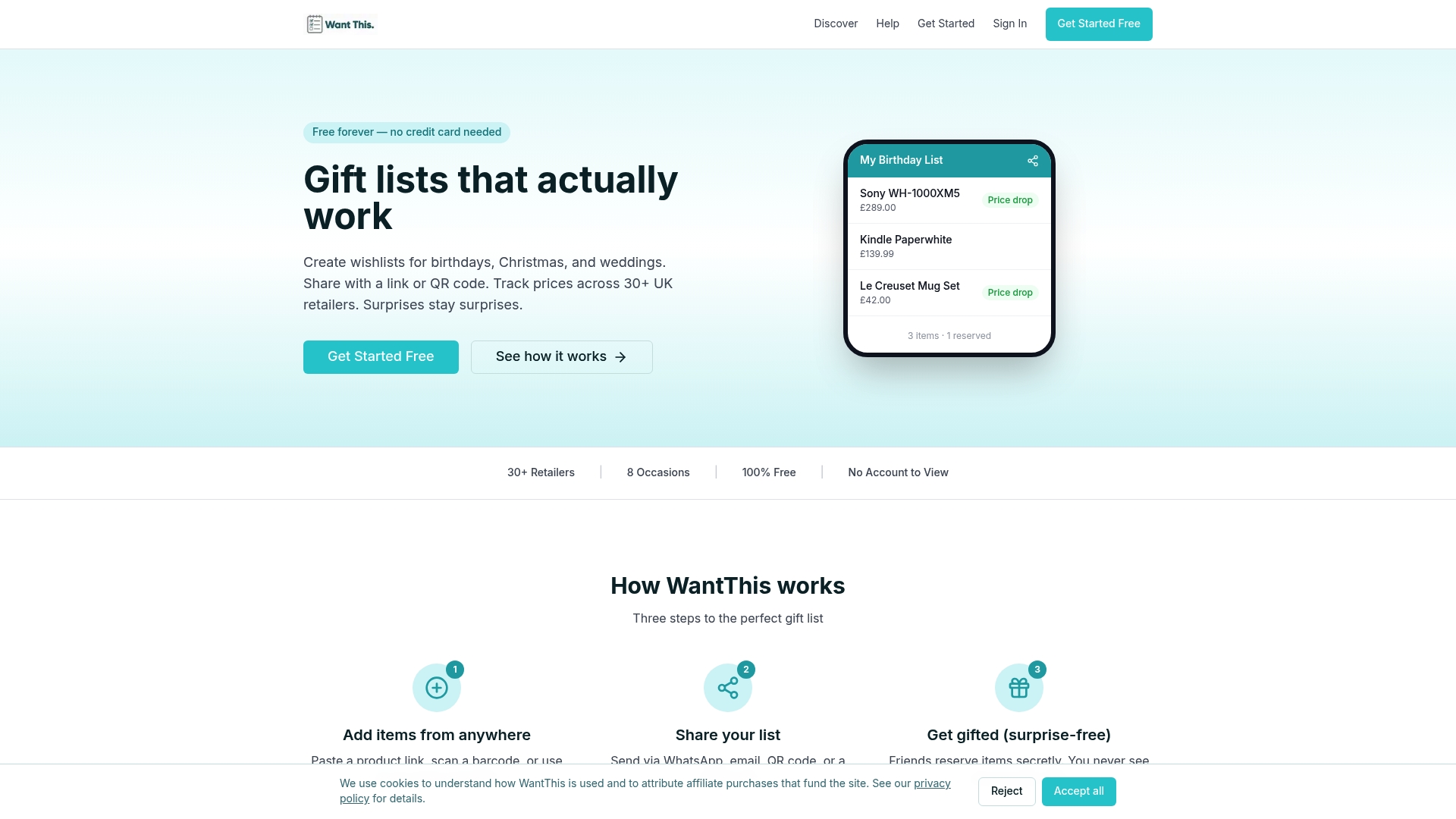
- Create a free wishlist in a couple of minutes, no account required just to browse or gift.
- Paste product links from any retailer and let WantThis track the price for you.
- Enable price alerts so you’re told the moment a saved item drops towards your target.
It’s a genuinely UK-built alternative to single-retailer wish lists or US-focused registry tools, and it’s free to start. Create your wishlist at WantThis and add your first item today.
Sources
For setup, Amazon UK’s own guidance covers deal notifications directly. For verification, CamelCamelCamel’s price history and comparators such as PriceRunner show whether a drop is genuine. For gift coordination itself, WantThis’s sharing features are worth a look.
FAQ
What is the best price checker app in the UK?
There’s no single official “best” app, since price checkers vary between retailer-specific trackers, browser extensions and multi-store wishlist platforms. Comparators such as PriceRunner cover a broad spread of UK stores, while a wishlist platform like WantThis suits anyone who also wants to share and coordinate gifts.
How do I get price drop alerts?
You can enable deal notifications directly in a retailer’s app, such as Amazon’s Profile, Settings, Notifications, Deals and recommendations menu, as Amazon UK explains. For coverage across several shops at once, a wishlist tracker that lets you paste any product link and set a target price is usually more reliable.
Does Amazon Wish List notify on a price drop?
Amazon’s wish list notifications are focused on deals and events, such as Lightning Deals or sales periods, rather than an arbitrary price you set yourself, according to Amazon UK’s guidance. For a genuine target-price alert, a separate tracker or wishlist platform is usually needed.
Which price tracker is best for UK shoppers?
The right tracker depends on what you’re doing: a retailer’s own app suits quick, single-store checking, while a multi-store wishlist platform such as WantThis suits shoppers tracking items across more than 30 UK retailers and coordinating gifts with family. Pairing either with a price-history tool such as CamelCamelCamel helps confirm whether a drop is genuinely worth acting on.
How do I know if a price drop is genuine?
Check the item’s price history over the past year rather than trusting the current display, since a “was” price can sometimes be inflated. Also confirm the seller and condition match what you expected and include delivery costs in your total before deciding.