
Save on UK Games: Price Drop Alerts Across 30+ Stores and Wishlists

To avoid missing UK game discounts, combine a cross-retailer price tracker with a store wishlist and set your alert threshold using historical lows rather than guesswork. This gives you redundancy across platforms and helps you judge whether a discount is genuinely good or just marketing noise. WantThis is one option built for UK shoppers who want price tracking alongside gift and wishlist planning.
TL;DR:
- Combining a cross-retailer tracker with a wishlist ensures comprehensive coverage and enables confident purchasing at genuine lows.
- Setting alert thresholds around 10% of a game’s historical low helps avoid overpaying during seasonal sales and flash deals.
- Price history tools reveal whether current prices are close to all-time lows or seasonal dips, guiding smarter buying decisions.
- Regularly pruning tracked items prevents notification fatigue, maintaining focus on the most valuable deals.
- WantThis simplifies UK game price tracking and gift planning by aggregating offers across multiple stores and enabling easy sharing.
Table of Contents
- What price drop alerts actually do
- Practical ways to get price alerts
- Setting up alerts that actually work
- Using price history to decide whether to buy now
- How WantThis helps UK shoppers track game price drops
- When alerts help, and when they create noise
- Try WantThis for UK price tracking and gift planning
- Where to check price history and sale calendars
- Sources
- FAQ
What price drop alerts actually do
A price drop alert watches a product page and messages you when the price changes in your favour. The mechanics behind that vary a lot, and they affect how trustworthy the alert is.
Some services pull data directly from a retailer’s own systems, which tends to be accurate and fast. Others rely on scraping public pages, which can lag or misfire if a store changes its layout. Coverage of authorised UK stores matters more than raw speed, since an alert for a store you can’t actually buy from is useless.
- Polling frequency ranges from hourly checks to once-daily scans, which affects how quickly you learn about a flash sale.
- Notification channels typically include email, push notifications and, on some services, Telegram integration.
- Historical-low tags are calculated from the lowest recorded price across a game’s lifetime, not just its current sale price.
- Edition and region mismatches are a common gotcha: a Standard Edition alert won’t fire for a Deluxe or Game of the Year bundle.
Practical ways to get price alerts
You have four realistic routes into game price alerts, and most experienced shoppers end up using more than one.
Dedicated cross-retailer trackers such as IsThereAnyDeal pull offers from multiple authorised stores into one dashboard, with price-history charts showing where today’s price sits against past dips. Check that the tracker covers the UK stores you actually shop at, since some tools skew towards US pricing.
Platform wishlists, built into Steam, the PlayStation Store, the Nintendo eShop and the Microsoft Store, notify you directly and let you buy in one click. Their weakness is coverage: they only watch their own storefront and sometimes cap how many titles you can save.
Browser extensions and mobile apps make adding a game to a list quick while you’re already browsing, and they often push notifications straight to your phone. Messaging tools, including email digests and RSS feeds, work well as a backup channel so a missed push notification doesn’t cost you a deal.
- Use a cross-retailer tracker for breadth and history.
- Use a platform wishlist for a direct, one-click purchase path.
- Use a browser extension for quick additions while shopping.
Pro Tip: Turn off in-app notifications for anything you’re not actively hunting, and keep push alerts reserved for titles with a genuine target price.
Privacy-wise, only give a tracker the permissions it needs, and avoid services that ask for account credentials rather than just a product link.

Setting up alerts that actually work
Getting a useful alert takes a few careful minutes rather than a single click.
- Find the right product page. Confirm the edition, region and platform match what you actually want, since a Standard Edition and a Deluxe bundle often have separate listings and separate prices.
- Add it to a tracker or wishlist. Choose whether you want an alert for an exact price, a percentage drop, or simply a new all-time low.
- Set your threshold using history. A common rule among deal hunters is to buy once the price sits within roughly 10% of its historical low, and to wait if it’s still well above that.
- Turn on notifications and test them. Add a cheap item with a loose threshold first, just to confirm the email, push or Telegram alert actually arrives.
- Prune your list regularly. Remove games you’ve bought or lost interest in, so genuine deals don’t get buried in noise.
Pro Tip: Review your tracked list every few months; a list that grows unchecked becomes the very notification fatigue you were trying to avoid.
Using price history to decide whether to buy now

The number that matters most isn’t the discount percentage, it’s how today’s price compares with where the game has actually sat over time.
Price-history tools show a historical low, a current low, and store-by-store offers side by side, which turns “50% off” from a headline into a checkable fact. SteamDB’s price history tools are useful here too, particularly for spotting the difference between a genuine all-time low and a “sale floor” the game repeatedly dips to during every seasonal sale.
- If today’s price sits within roughly 10% of the historical low and no major sale is imminent, buying now is a reasonable call.
- If the gap is wide, a wishlist alert set at your target price costs you nothing while you wait.
- Mainstream titles rarely justify a purchase above a 50% discount once they’re a year or two old, since deeper cuts tend to follow.
One in ten UK console shoppers now faces a changed pricing landscape following the 2026 rise in console prices, which is linked to a memory shortage affecting hardware costs. That volatility has knock-on effects for software: publishers sometimes hold back on deep game discounts while hardware pricing is in flux, which is worth factoring in if you’re timing a big-ticket purchase around Black Friday or a Steam seasonal sale.
How WantThis helps UK shoppers track game price drops
WantThis is built for UK shoppers who want price tracking without giving up the gift-planning side of wishlists. You paste a link from any online retailer, including a game’s store page, and the title, image and current price are pulled in automatically.
- Prices are tracked across 30 or more UK retailers, so a saved game gets flagged the moment its price drops, not just on one storefront.
- Lists can be shared with friends or family, who can reserve or mark an item as bought so a birthday or Christmas gift doesn’t get duplicated.
- A built-in Secret Santa organiser runs automatic name draws, useful for any group swapping gifts.
- A browser extension and mobile apps let you add a game to a list the moment you spot it, wherever you’re browsing.
For a fuller rundown of how the price tracking works day to day, the feature page covers the mechanics without the sales pitch.
When alerts help, and when they create noise
Aggressive alerts, set close to today’s price, make sense when you want a specific title urgently and can’t wait for a deeper cut. Patient collectors do better setting alerts near the historical low and letting them sit for months.
The mistake most people make is tracking everything they’re vaguely curious about. A list of 60 loosely-wanted games generates constant pings and trains you to ignore them. Keep the list short and the thresholds meaningful. Gift shoppers get more value from shared lists and reservations than from alerts alone, since coordinating a surprise matters more than shaving a few pounds off a birthday present.
— Stuart
Try WantThis for UK price tracking and gift planning
WantThis brings the two habits together: watching prices and keeping a gift list organised, without needing an account just to browse. Paste a link, set a target, and you’ll hear about a genuine drop across 30 or more UK retailers rather than checking store pages by hand.
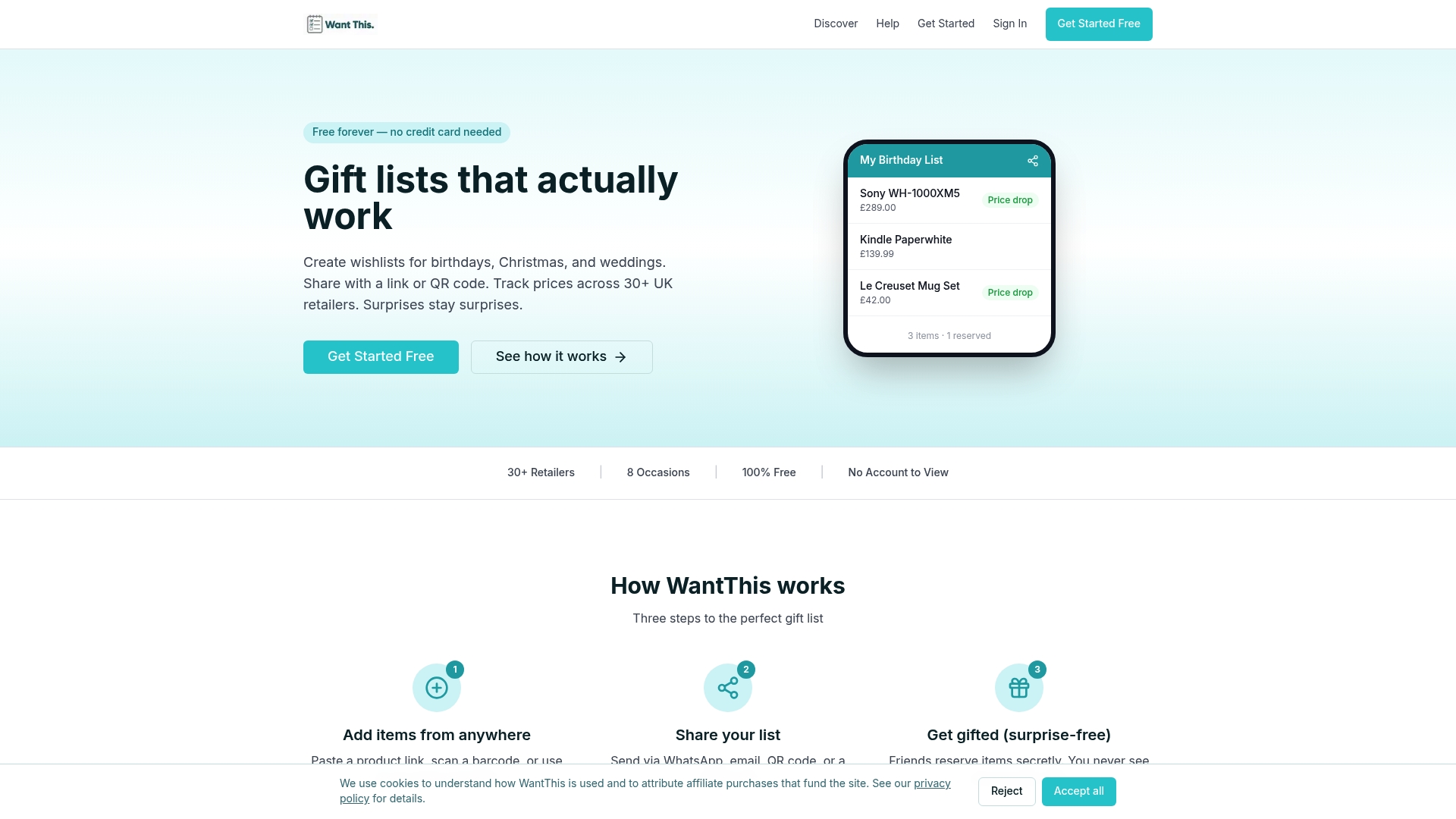
- Add a game you’re watching and let the price tracking do the rest.
- Share the list with whoever’s buying your next gift, so nothing gets duplicated.
- Start on the free WantThis landing page and set your first alert today.
Where to check price history and sale calendars
- Steam price history tools and SteamDB for historical lows.
- IsThereAnyDeal for cross-store UK deal aggregation.
- Retro and secondhand markets, such as Retro Pulse or Eagle Saver, for older titles and trade-in value.
Sources
- Steam Price History: Regional Prices, Discounts & Lows | Steam Dashboard
- SteamDB price history tools
- IsThereAnyDeal
- Xbox, PS5 and Switch 2 price increase: the UK numbers, and the memory shortage behind it
FAQ
How can I get notified when a price drops on an item?
Add the item to a cross-retailer price tracker or a store wishlist and set an alert for your target price. Most services notify you by email or push notification, and some support Telegram for faster delivery.
Are game prices dropping?
Discounting varies by title and season, and 2026’s console price rises have made some publishers more cautious about running deep game discounts in the short term. Checking a title’s price history is the most reliable way to see whether a specific game is actually trending cheaper.
Is there a game price tracker available?
Yes, tools such as IsThereAnyDeal track offers across multiple authorised stores, and platform-native wishlists on Steam, PlayStation Store, Nintendo eShop and Microsoft Store cover their own storefronts. WantThis also supports tracking a game’s price once you paste its store link, alongside the rest of a UK gift list.
Is the PS5 coming down in price?
There’s no indication of a PS5 price fall; UK console prices have instead risen during 2026, linked to a memory shortage affecting hardware manufacturing. Software discounts on PS5 titles still follow their usual seasonal pattern, largely independent of the console’s own price.
What counts as a good time to buy a game on sale?
A common rule of thumb is to buy when the current price sits within roughly 10% of its historical low, rather than judging by the discount percentage alone. Tools that separate a genuine all-time low from a recurring sale floor, such as SteamDB’s history charts, make that comparison straightforward.