
Save with One Wishlist: Track Prices Across UK Stores (Hundreds of Retailers)

The quickest way to track prices across UK stores is to pair a universal price tracker or wishlist tool with your supermarket’s own comparison app, checking price history before you buy rather than trusting the “deal” label. For single items, tools that accept any product link work best. For groceries, basket comparison apps do the job. For coordinated gift buying, a wishlist platform like WantThis combines both, tracking price drops across UK retailers while letting you share the list.
TL;DR:
- Price comparison sites like PriceRunner provide broad retailer coverage and real-time updates, especially useful for single-item searches.
- Universal trackers such as Whisprice watch specific product links and send notifications when prices drop, ideal for confirmed purchases.
- Basket comparison apps like Trolley are essential for tracking weekly grocery prices, considering offers, delivery fees, and store variability.
- Setting realistic price alerts involves reviewing historical price data, including delivery and return costs, to avoid missing genuine deals.
- Wishlist tools like WantThis centralise multiple item tracking, facilitate gift sharing, and monitor prices across many UK retailers without extra cost.
Table of Contents
- Which methods actually help you compare prices UK-wide?
- How do you set price alerts that actually save you money?
- Grocery baskets vs one-off purchases: different tools, different logic
- Wishlists, browser extensions and where WantThis fits in
- How long does price tracking take, and how often do prices update?
- What does price tracking cost in the UK?
- A shopper’s honest take on price alerts
- How WantThis brings gift tracking and price alerts together
- Sources
Which methods actually help you compare prices UK-wide?
Four distinct tools solve four different shopping problems, and knowing which one fits your situation saves a lot of wasted app downloads.
Price-comparison websites give you breadth. They pull listings from thousands of shops and let you see, at a glance, who sells a specific product cheapest right now. Sites like PriceRunner index millions of offers and refresh them regularly, which matters because a comparison site with stale data is worse than useless. These are best when you’re hunting for one specific item and want maximum retailer coverage in a single search.
Universal price trackers work differently. Instead of searching a catalogue, you paste a link from any retailer’s product page, and the tool watches that exact listing over time. Whisprice, for instance, checks saved links regularly and sends a push notification the moment the price shifts. These suit shoppers who already know what they want and just need to know when it’s cheap enough.
Supermarket and grocery apps solve a different problem entirely: comparing a whole shopping basket, not one product.
Browser extensions and in-app barcode scanners cover the physical world, letting you scan a price tag in-store and check it against online listings before you buy.
- Groceries: basket comparison apps
- Electronics and fashion: universal trackers with price history
- One-off big purchases: comparison sites for breadth, then a tracker for the final decision
- Gifts and multi-item lists: wishlist tools that track several items at once
How do you set price alerts that actually save you money?
A price alert is only useful if the target price you set reflects reality, not wishful thinking. Set it too high, and you’ll never get notified. Set it based on a single low outlier from a flash sale, and you might wait months for a price that isn’t coming back.
Here’s a practical sequence for setting one up:
- Check the item’s price history over the past few months, if the tracker shows one. Amazon-specific tools like camelcamelcamel display this clearly for anything sold on Amazon UK.
- Note the lowest genuine price you can see. Ignore any single-day spike or crash; those are usually stock errors or clearance blips, not the “real” price band.
- Set your alert slightly above that historic low, factoring in delivery and return costs rather than just the sticker price.
- Choose push notifications if you check your phone often, or email if you’d rather review alerts once a day. Idealo’s alert system offers both routes free of charge.
- Review your active alerts monthly and delete the ones for items you no longer want.
A price-history chart usually shows a jagged but repeating pattern, dips around known sale events, then a return to baseline. A single sharp spike downward that never repeats is worth treating with suspicion rather than urgency.
Pro Tip: Track recurring purchases like nappies or toothpaste against their lowest price over a long historical period, rather than just a few recent weeks. Short windows make ordinary prices look like bargains.

Grocery baskets vs one-off purchases: different tools, different logic
Tracking a weekly food shop and tracking a laptop are not the same job, and treating them the same wastes time.
Grocery prices move constantly, and the “best” supermarket changes week to week depending on offers, loyalty pricing, and delivery slots. This is why dedicated basket-comparison services exist. Trolley compares thousands of grocery items across major UK supermarkets so you can see which retailer wins on your actual shopping list, not just one item. A club-card price at one chain can undercut a headline discount elsewhere once you account for minimum spend thresholds and delivery fees, so single-item checks can genuinely mislead you here.
Non-grocery tracking runs on a different rhythm. You’re not comparing a whole basket weekly; you’re watching one or two items over weeks or months, waiting for a specific price threshold.
- Weekly-shop workflow: compare your whole basket across two or three supermarkets, factor in delivery charges and minimum order values, then pick the cheapest total.
- Single-item workflow: save the product to a tracker, set a realistic target price based on history, and wait for the alert.
- Mixed approach: use basket tools for food, universal trackers for everything else.
Wishlists, browser extensions and where WantThis fits in
A wishlist turns scattered tracking into one manageable list, which matters once you’re watching more than two or three items.

Paste a link from any online retailer into a wishlist tool, and it pulls the title, image, and current price automatically. From there, you get the same price-history visibility a standalone tracker gives you, except every item you care about sits in one place instead of scattered across five different apps and browser tabs.
This matters most for gifting. A shared wishlist lets family members privately reserve or mark items as bought, so nobody buys the same thing twice and nobody spoils a surprise by asking what’s still needed.
WantThis is built around exactly this workflow. Paste a link, and the platform tracks the price automatically across more than 30 UK retailers, sending an alert when it drops. Lists can be shared with anyone, organised by occasion, and paired with a built-in Secret Santa organiser for group gift exchanges.
- Paste any UK retailer link to add an item automatically
- Get price-drop alerts across hundreds of tracked retailers
- Share lists for private reservation, avoiding duplicate gifts
- Add items by link, barcode or manual entry, from any browser
Amazon links on the platform carry disclosed affiliate relationships, and pricing data comes directly from the retailer rather than an estimate.
How long does price tracking take, and how often do prices update?
Setting up a tracked item takes seconds. Paste a link or search a product, confirm the item is correct, and the tracker starts watching straightaway. There’s no ongoing effort beyond glancing at notifications when they arrive.
Update frequency is where tools genuinely differ. Comparison sites that index large retailer catalogues, like PriceRunner, refresh prices on a rolling basis across millions of listings, so any single item might update anywhere from several times a day to once every day or two depending on how often the retailer itself changes it. Universal trackers such as Whisprice check saved links on their own schedule and push a notification the moment a change is detected, rather than waiting for you to reopen the app.
In practice, this means a fast-moving category like electronics during a sales event can show multiple price changes in a single day, while a niche home-goods item might sit unchanged for weeks. Grocery basket tools tend to update on a similar rhythm to when supermarkets publish new weekly pricing, which is typically once every few days rather than in real time.
None of this requires you to actively refresh anything yourself. The entire value of tracking, rather than manually checking, is that the notification comes to you. Set it up once, then let the alert do the work whenever the price actually moves.
What does price tracking cost in the UK?
Most core price-tracking tools cost nothing to use. Comparison sites like Idealo run free alerts funded by referral commission when you click through to a retailer, not by charging shoppers directly. Amazon-specific trackers such as camelcamelcamel work the same way, and universal trackers like Whisprice follow the same free-to-use model for standard alerts.
Wishlist platforms including WantThis operate on this same principle: creating lists, tracking prices, and sharing with family costs nothing, because the platform earns a small commission when someone clicks through from a shared list and buys, rather than charging users a subscription.
Where costs can creep in is with premium tiers on some standalone tracking apps, which occasionally gate features like unlimited watched items or SMS alerts behind a paid plan. It’s worth checking an app’s pricing page before assuming a feature is free, since the basic tier and the paid tier aren’t always clearly separated on the download listing. Browser extensions rarely charge anything, since they’re usually a lightweight companion to a free web account.
The other cost to watch isn’t monetary: it’s notification overload. An account with dozens of untuned alerts becomes noise you eventually ignore, which defeats the purpose regardless of what the tool cost you.
A shopper’s honest take on price alerts
The biggest mistake isn’t picking the wrong tool, it’s ignoring delivery costs and returns when judging a “good” price, or letting alerts pile up until every notification gets ignored. A £15 saving disappears fast against a £6 delivery charge and a faff of a return window.
Before buying, run through a short checklist: check the price history, add delivery and returns to the total, and confirm you actually still want the item. A conservative alert on a laptop, based on its lowest price over the previous year rather than a flash-sale price, only fires when the price matches real history, not noise.
How WantThis brings gift tracking and price alerts together
WantThis is the practical alternative to juggling five separate tracker apps for one Christmas list. Instead of pasting the same product into a comparison site, then a tracker, then texting family about who’s buying what, one wishlist handles tracking, sharing, and reservations together.
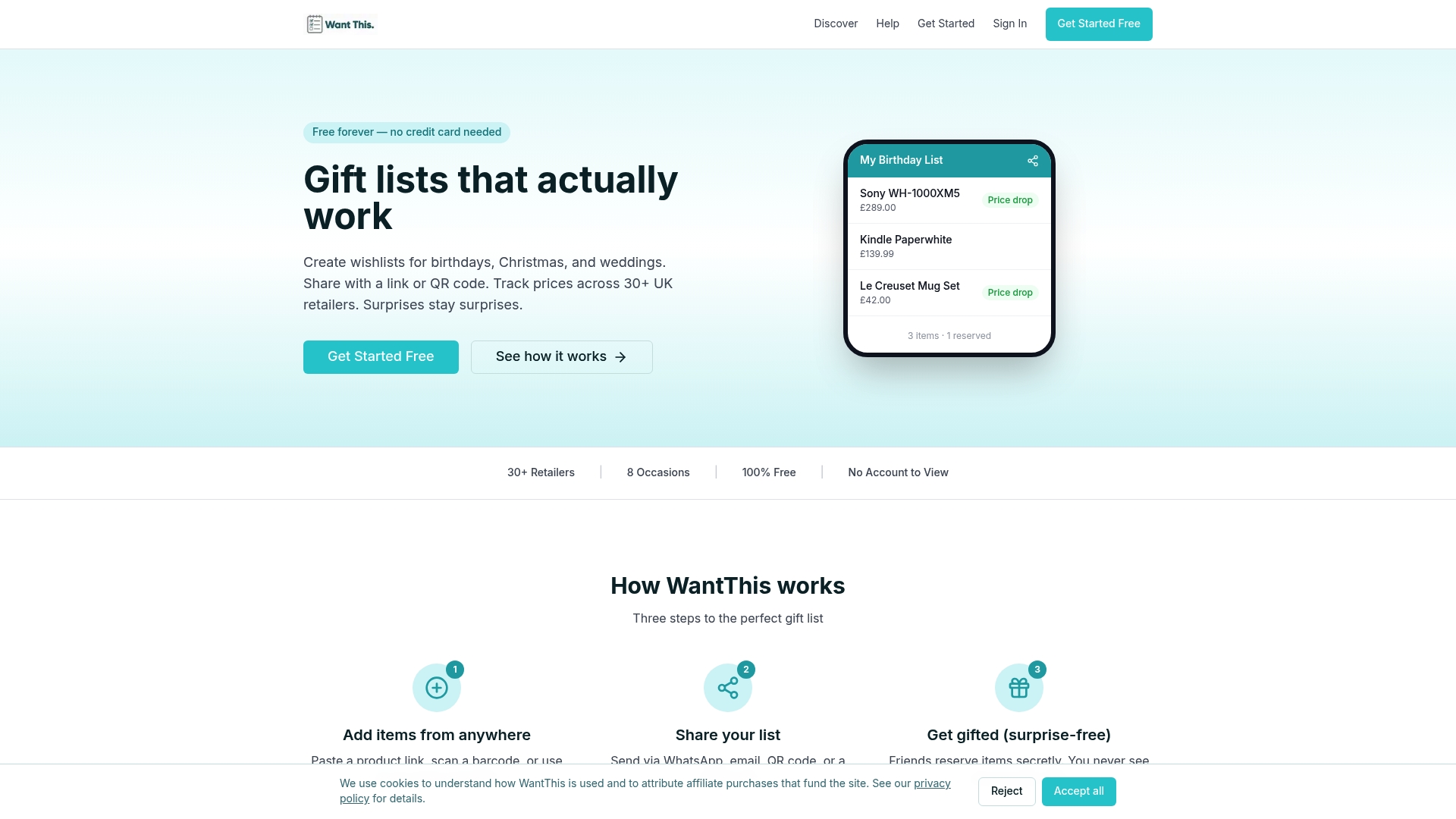
Getting started takes three steps: paste a product link from any UK retailer, set a price alert if you want to wait for a drop, then share the list with whoever needs to see it. WantThis tracks prices across more than 30 UK retailers, and the feature set covers adding items by link, barcode or manual entry from any browser, plus a built-in Secret Santa organiser for group exchanges. Affiliate relationships with retailers like Amazon are disclosed openly, and the platform doesn’t charge users to create or share lists.
If you’re planning ahead for birthdays, Christmas, or a group gift swap, start a list now and add the first item you’ve been meaning to track.
Sources
- idealo — price alerts (UK)
- camelcamelcamel — Amazon UK price tracker
- Whisprice — Track prices across UK online stores