
Catch Deals Before You Buy: UK Price Alerts on Amazon & 30+ Stores

The quickest way to catch a price drop is to check the item’s price history first, then set a target price with a tracker built for the retailer you’re watching: Keepa or CamelCamelCamel for Amazon UK, a supermarket app for groceries, or a UK wishlist tool like WantThis for anything else. Paste the product link into your chosen tracker, set a realistic target, and let the alert do the waiting for you.
TL;DR:
- Tracking price history before setting alerts helps avoid false positives and ensures you target genuine lows, especially around major sales events like Black Friday and Boxing Day.
- Using dedicated trackers like Keepa or CamelCamelCamel for Amazon UK provides the most reliable historical data, but multi-retailer wishlist tools like WantThis better manage gift lists across many shops.
- Routing alerts through automation services such as IFTTT or Zapier to push notifications ensures you receive immediate updates on your phone, reducing missed deals on high-priority items.
- Cross-checking price drops with secondary sources or multiple trackers prevents falling for inflated or misleading sale claims that don’t match actual historical prices.
- Building a simple, trusted setup with a couple of trackers and clear thresholds consistently yields the best savings without overwhelming you with notifications.
Table of Contents
- How price drop alerts work and the main methods UK shoppers use
- How to choose the right alert method for your needs
- Step-by-step setup for Amazon UK alerts and routing notifications to your phone
- WantThis: a UK wishlist that tracks prices across dozens of stores
- Price transparency and misleading pricing: what UK rules say
- Comparing UK price drop alert services
- Getting alerts into WhatsApp and other apps you already use
- What price alert tools typically cost in the UK
- Spotting fake alerts and unreliable tracking services
- Why the best alert setup is the boring one
- Start tracking prices with WantThis today
- Sources
- FAQ
How price drop alerts work and the main methods UK shoppers use
Most price drop tools work the same way underneath: they scan a product page on a schedule, compare today’s price against yesterday’s, and fire a notification when it crosses a threshold you set. The differences are in coverage, speed, and how much noise you’re willing to tolerate.
For Amazon UK, dedicated trackers pull years of pricing data and let you set a target in pounds. RiverPrice documents Amazon UK price history and unlimited free alerts, noting that the largest drops tend to cluster around Black Friday, Boxing Day, Prime Day and the January sales.
- Amazon ASIN trackers watch a specific product code and alert on price or stock changes, best for one-off purchases you’re timing carefully.
- Multi-retailer wishlist trackers monitor items across dozens of shops at once, better suited to ongoing gift lists or general browsing.
- Page monitors watch any web page for changes, useful for retailers with no dedicated tracker but noisier without price-history context.
- Supermarket trackers follow loyalty-card and till prices rather than headline web prices, which matters because in-store discounts can differ from what’s advertised online.
Email tends to be the slowest but least intrusive channel, push notifications are near-instant but can pile up if you’re tracking dozens of items, and SMS or webhook routing sits somewhere in between depending on how you configure it.
Before acting on any alert, it’s worth glancing at the price history to confirm the “drop” isn’t just a return to normal after an inflated list price. Setting a target near a genuine historical low, rather than reacting to any small dip, cuts down on false positives considerably.
A repeated pattern across price trackers is that Amazon UK’s biggest discounts fall around Black Friday, Boxing Day, and January, so alerts set well ahead of those windows tend to catch more meaningful drops.

How to choose the right alert method for your needs
The right setup depends less on which tool has the most features and more on how you shop. A few questions narrow it down quickly:
- How much is the item worth? High-value purchases justify checking price history manually and setting a tight target; low-value items are fine with a loose alert you barely think about.
- How often do you want to check in? Daily digests suit casual browsing, while instant push alerts suit time-sensitive launches or limited stock drops.
- How many items are you tracking? A handful of items works fine with any single tracker; a long list benefits from a wishlist tool that handles multiple retailers in one place.
- Do you need coverage beyond one retailer? Amazon-only trackers won’t help if you’re comparing prices across several shops for the same gift.
A shopper planning one big purchase, like a laptop, does best setting a single tight alert on a dedicated tracker and checking the price history before committing. Someone building a running wishlist for birthdays and Christmas is better served by a multi-store tool that tracks everything in one list. Grocery deal-watchers get more value from a supermarket-specific app that accounts for loyalty pricing than from a generic web tracker.
Whichever route you take, cross-check any alert that looks too good against a second source before buying, such as checking Ferus Outdoors deals for price updates on outdoor gear. Practitioner guides recommend confirming a dip with a secondary tracker as a habit, not just a one-off check.
Pro Tip: Set your target price a little above the lowest point you’ve ever seen, not at it. Rock-bottom prices are rare and waiting for an exact match can mean missing perfectly good drops.
Step-by-step setup for Amazon UK alerts and routing notifications to your phone
Getting alerts onto your phone rather than buried in an inbox takes a bit of setup but pays off once it’s running.
- Check the price history first. Look at a Keepa or CamelCamelCamel chart for the product to see its realistic range over the past year. Cross-checking both services helps confirm the pattern before you commit to a target.
- Set a target near the previous low, not an arbitrary round number. If a jacket has dipped to £45 twice in a year, £45 to £48 is a sensible target rather than hoping for £30.
- Create the alert using the product’s ASIN or URL, enter your target in pounds, and filter by seller if you only want Amazon-fulfilled stock rather than third-party listings.
- Route the alert to your phone. A free automation service such as IFTTT or Zapier can forward tracker emails to a push notification app like Pushbullet or to a Telegram channel, so you see it the moment it lands.
- Set priority filters so high-value or time-sensitive items ping instantly while everything else batches into a daily digest.
Before you actually buy on an alert, run through a short checklist:
- Check whether any coupon or voucher code shown still applies at checkout.
- Confirm delivery timing and the returns window match what you need.
- Check the seller is Amazon or a well-rated third party, not an unrated new account.
This kind of layered setup, price history check, a primary tracker, a backup tracker, and a push relay for anything urgent, reduces false alarms while still catching fast-moving deals. For flash sales or limited launches, tightening the check frequency for the first few hours and relaxing it afterwards catches short windows without flooding you with notifications the rest of the time.
WantThis: a UK wishlist that tracks prices across dozens of stores
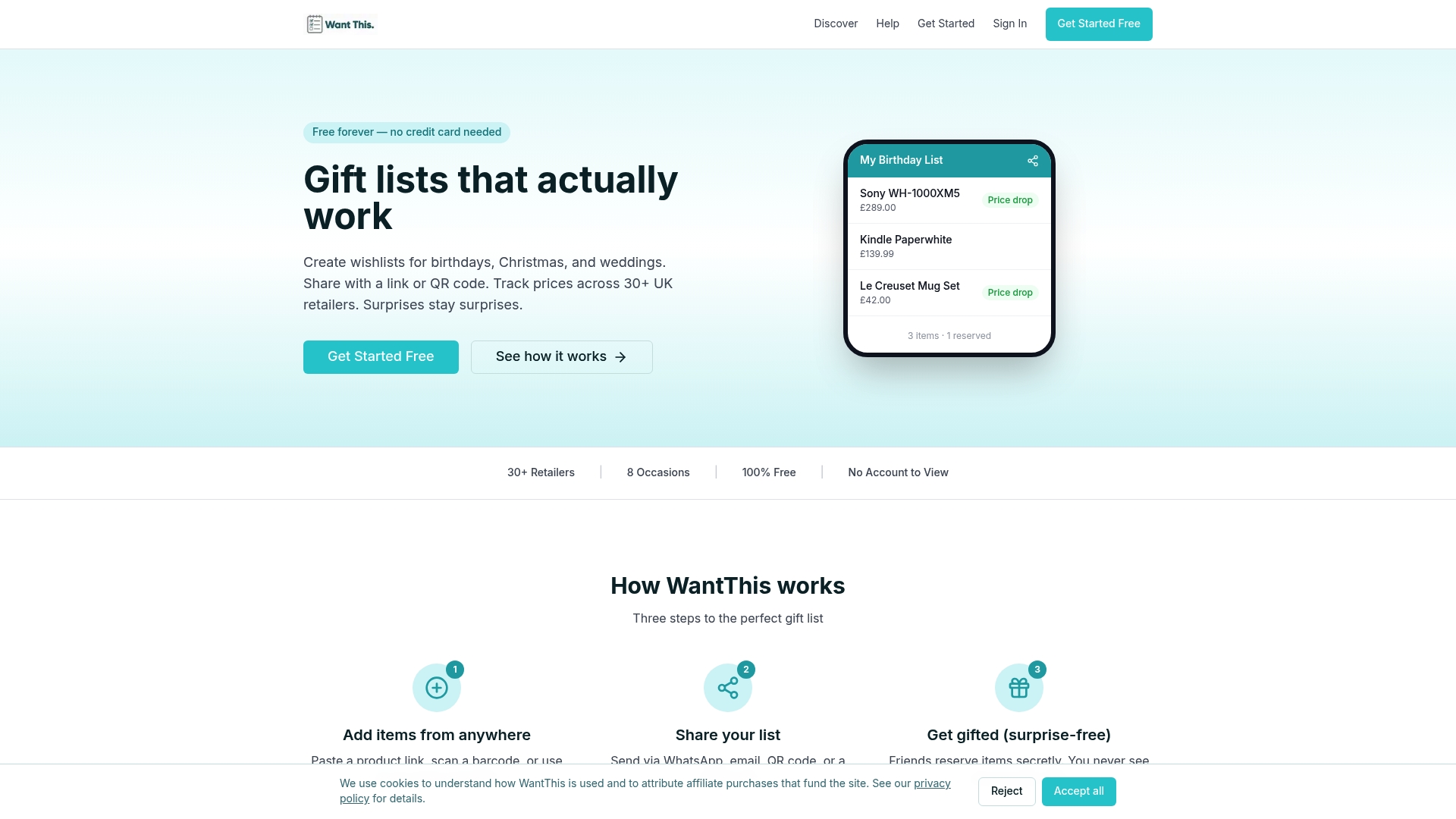
If you’re buying gifts rather than a single item for yourself, a dedicated tracker per product gets unwieldy fast. WantThis lets you paste a product link from any online retailer and automatically pulls in the title, image and current price, then tracks price drops across more than 30 UK retailers from one list, as detailed on its price tracking page.
- Paste any link and WantThis fills in the product details automatically, no manual entry needed.
- Organise by occasion, keeping birthday, Christmas or wedding lists separate.
- Track price drops across 30+ UK retailers without juggling separate trackers per shop.
- Browse without an account, useful if you just want to see how it works first.
It suits shared gifting and multi-store wishlists better than single-item Amazon tracking, since you’re watching a whole list rather than one product.
Price transparency and misleading pricing: what UK rules say
Not every “sale” badge reflects a genuine discount, and UK consumer law gives shoppers some protection here. The Competition and Markets Authority’s price transparency guidance requires that headline prices be clear and all-inclusive, and warns that indicative or “from” pricing can mislead shoppers if used carelessly.
Separately, the Consumer Protection Act 1987 and its associated pricing regulations make misleading price indications a criminal offence. Retailers claiming a reduction must show the genuine previous price, which generally should reflect a price offered for a reasonable period rather than being invented solely for the sale.
For shoppers, the practical takeaway is simple: treat a single “was £X, now £Y” label with a healthy dose of scepticism unless you can verify it. This is exactly where price-history tools earn their keep. A tracker showing twelve months of actual prices tells you whether that “was” price is real or simply the highest the item has ever been listed at. If a retailer’s claimed saving doesn’t match what a tracker like Keepa or CamelCamelCamel shows for Amazon UK listings, the sale price may not be the bargain it appears. Checking history before checkout costs a minute and avoids buying into an inflated comparison.
Comparing UK price drop alert services
UK shoppers have a handful of realistic options, each suited to a different kind of tracking.
| Service type | Best for | Main limitation |
|---|---|---|
| Amazon-specific trackers (Keepa, CamelCamelCamel) | Deep Amazon UK price history and target alerts | Amazon only, no multi-retailer coverage |
| Supermarket trackers | Grocery deals including loyalty-card pricing | Limited to participating supermarkets |
| Generic page monitors | Any web page, including niche retailers | No price-history context, more false positives |
| UK wishlist tools (WantThis) | Gift lists spanning many retailers in one place | Not built for granular single-SKU obsessive tracking |
Amazon-specific trackers give you the richest historical data for that one retailer, which is why cross-checking Keepa against CamelCamelCamel is a common habit among frequent deal-hunters. Supermarket trackers such as Basketr cover 13 UK supermarkets including loyalty-card pricing, which matters because a till price with a loyalty card can undercut the advertised web price. Generic page monitors fill gaps for retailers with no dedicated tool but tend to generate more noise since they lack historical context. Wishlist tools trade some of that granular depth for breadth, useful when you’re managing a list of gifts rather than obsessing over one product.
Getting alerts into WhatsApp and other apps you already use
Most trackers send alerts by email by default, which is easy to miss among everything else landing in your inbox. Routing them somewhere you’ll actually see promptly takes a small amount of setup.
Free automation tools like IFTTT or Zapier can watch for a tracker’s alert emails and forward them automatically to a messaging app, a push notification service, or a dedicated channel. A common setup forwards Keepa or CamelCamelCamel alerts into Telegram or Pushbullet, since both support instant push notifications on iOS and Android. WhatsApp doesn’t offer the same open automation hooks, so most UK shoppers route alerts through Telegram or a push app instead and check WhatsApp separately.

For wishlist-based tracking, WantThis’s browser extension and iOS and Android apps let you add items while you’re browsing on your phone, so the price tracking sits inside the same app you already use to build your list rather than needing a separate automation chain.
Whichever route you choose, it’s worth separating urgent alerts (a big-ticket item hitting your target) from routine digests (general wishlist updates), so the important ones don’t get lost in a flood of minor price wobbles.
What price alert tools typically cost in the UK
Most of the well-known UK-relevant trackers are free at the core. RiverPrice offers unlimited free alerts on Amazon UK products, and Basketr’s supermarket alerts are also free to set per product. WantThis is free to use for building wishlists and tracking prices, with no account required just to browse.
Where premium tiers exist among trackers generally, they tend to add extras like higher check frequencies, more items tracked simultaneously, or additional notification channels beyond email. For most casual shoppers watching a handful of items, the free tier of any of these tools covers the basics: price history, a target price, and an alert when it’s hit.
The practical cost consideration isn’t usually money, it’s time spent setting things up and tuning thresholds so alerts stay useful rather than becoming background noise you learn to ignore.
Spotting fake alerts and unreliable tracking services
A price alert is only useful if it’s accurate, and not every service tracking UK retailers gets that right. A few checks help filter out the unreliable ones.
Look for a visible price history chart rather than a single current price. A tool that shows you the trend over months gives you something to verify against, while one that just flashes “price dropped” with no context is harder to trust. Cross-checking two independent trackers, such as Keepa against CamelCamelCamel for Amazon UK, is a simple habit that catches the odd tracker showing a stale or incorrect price.
Be cautious of services that ask for payment details before showing you any historical data, or that push you toward an “act now” countdown timer with no way to see what the price actually was before. Genuine trackers built around Amazon’s public pricing data, UK supermarket loyalty pricing, or wishlist tools like WantThis that display real retailer prices don’t need artificial urgency to make their alerts useful.
If an alert looks unusually generous, a discount that seems too steep compared with the item’s normal range, treat it as a prompt to check the history yourself rather than something to act on immediately.
Why the best alert setup is the boring one
The temptation with price tracking is to chase every ping, but the shoppers who actually save money tend to run the least exciting setup: a couple of trusted trackers, sensible thresholds, and a habit of checking history before buying rather than after.
Cross-referencing two sources before acting is not paranoia, it’s the difference between a genuine bargain and a relisted “sale” price. Start small: watch three or four items you actually intend to buy, give yourself a clear buying window once an alert fires, and resist the urge to add every product you glance at. Splitting high-priority alerts from a daily digest keeps the system useful instead of becoming another feed you scroll past.
— Stuart
Start tracking prices with WantThis today
Setting up separate trackers for every gift on your list gets tedious fast, especially once you’re coordinating birthdays, Christmas and a Secret Santa exchange at the same time. WantThis solves that by letting you build one list across multiple retailers you shop at, with price tracking built in rather than bolted on.
Getting started takes a few minutes:
- Paste a product link from any retailer and WantThis pulls in the title, image and price automatically.
- Set your list up by occasion, so birthday, wedding and Christmas gifts stay separate.
- Share the list with friends or family, who can privately reserve items so nothing gets bought twice.
Head to Wantthis to build your first list, or browse gift ideas by category if you’re starting from scratch.
Sources
- Price transparency: providing clear and accurate information about prices (CMA209)
- Regulations under the Consumer Protection Act 1987 (price indications guidance)
- Amazon United Kingdom Price Tracker — Free Price History & Drop Alerts | RiverPrice
- Herm
FAQ
How do I get an alert when a price drops?
Add the product to a price tracker such as Keepa or CamelCamelCamel for Amazon UK items, or paste the link into a wishlist tool like WantThis for multi-retailer tracking. Set a target price close to the item’s historical low and the tool will notify you by email or push notification once it’s hit.
What is the best price comparison site in the UK?
There isn’t a single tool that covers every UK retailer equally well: Amazon-specific trackers like Keepa give the deepest history for Amazon UK, while wishlist tools such as WantThis cover items across more than 30 UK retailers in one place. The right choice depends on whether you’re watching one product or managing a broader gift list.
What is the best price tracker?
For Amazon UK specifically, Keepa and CamelCamelCamel are the most commonly used, and checking both together helps confirm a genuine drop. For tracking gifts across multiple retailers at once, a wishlist tool like WantThis handles that breadth better than a single-retailer tracker.
Is there an app that notifies you when things go on sale?
Yes, several apps track prices and send notifications, including Amazon-focused trackers, supermarket apps that follow loyalty pricing, and UK wishlist apps like WantThis, which offers browser extension and mobile app support for tracking items you’ve saved. Which one suits you depends on whether you’re watching a single product or a whole list of gifts.