
The fastest way to track price drops in the UK

The best way to track price drops in the UK is to use an all-in-one wishlist and price-tracking platform that covers UK retailers and sends push or email alerts the moment a saved item falls to your target price. Save the product link now, or paste it straight into your chosen tool, and let the tracking do the waiting for you.
Two things matter before you commit to a tool:
- Check it actually covers the UK stores you shop at, not just Amazon.
- Confirm it offers both push and email alerts, so you’re not tied to checking one inbox.
Key takeaways
Combining a wishlist platform with price history checks and the right alert type is the most reliable way for UK shoppers to catch genuine price drops.
| Point | Details |
|---|---|
| Set alerts on real history | Base your target price on repeated lows, not the first discount you see. |
| Match tool to habit | Use extensions for desktop browsing, apps for mobile, wishlists for gifts. |
| Choose alert speed deliberately | Push suits fast, limited-stock deals; email suits slower, less urgent tracking. |
| Check UK retailer coverage | Confirm the tool tracks the specific stores you actually shop at. |
| Use WantThis for shared gifting | WantThis tracks prices on pasted links and lets shared lists prevent duplicate gifts. |
Table of Contents
- How to set a price alert step by step
- Types of price tracking tools and how they differ
- How to read price history and know when to buy
- How to choose the right tracking tool for you
- How WantThis helps you track wishlist and gift prices
- Combining tools for more thorough coverage
- Where price tracking tools fall short in the UK
- Why most price-tracking advice misses the point
- Track prices and coordinate gifts in one place
- Sources
How to set a price alert step by step
Setting a price alert takes under a minute once you know the sequence. Most tools, whether a browser extension, an app, or a wishlist platform, follow the same basic pattern.
- Find the product page on the retailer’s site (Amazon UK, Argos, Currys, wherever you’re browsing).
- Copy the link, or use a browser extension that grabs it automatically as you shop.
- Set a target price or percentage drop. Base this on the item’s price history rather than a guess.
- Choose your notification method. Push for speed, email if you’d rather check less often.
- Confirm the alert and test it. Some tools let you send a sample notification so you know it’s working before you rely on it.
Picking a sensible target price is where most people go wrong. If an item has never dropped below £45 in six months, setting an alert at £30 means you’ll wait indefinitely. idealo’s price alert documentation recommends checking recent price history first, then setting an “ideal price” close to the lowest point the item has genuinely reached.
Watch for three common snags: duplicate product listings (same item, different URL), variant SKUs (a different colour or size tracked as a separate product), and currency or domain mismatches when a retailer runs both a UK and international site.

Pro Tip: If a tracker shows no price history at all for an item, it’s often a newly listed product or a marketplace seller page. Give it a week before trusting any alert threshold you set.
Types of price tracking tools and how they differ
Not every tracker suits every shopper, and picking the wrong format is the main reason people give up on price tracking altogether. A Lifehacker roundup on the best price-tracking tools makes exactly this point: fragmentation is the industry’s biggest weakness, and matching the tool to your shopping habits matters more than picking the “best rated” one.
- Browser extensions work well if you shop mostly on desktop and want alerts to appear inline as you browse. The drawback is that they’re tied to that browser, so they miss anything you do on your phone.
- Mobile apps send push notifications wherever you are and often let you track any UK store by pasting a link. The trade-off is usually a signup requirement and the odd battery or permission prompt.
- Price comparison sites offer broad retailer coverage and detailed price history graphs, but alerts often arrive by email rather than instantly, which suits patient shoppers more than deal-hunters.
- Wishlist and all-in-one platforms persist across devices and let you share lists with other people, which is genuinely useful for birthdays, weddings and group gifting. Many rely on affiliate links to fund the free tracking, which reputable platforms disclose openly.
How to read price history and know when to buy
A price history graph tells you far more than today’s price ever could. Look for three patterns. A single sharp peak followed by a long flat line usually means a temporary promotion pushed the price up before it settled back down, so don’t panic-buy near that peak. Repeated low points at roughly the same price, say three dips to £89 over four months, tell you that figure is a realistic floor, not a fluke. Seasonal patterns matter too: electronics often dip around Black Friday and January sales, while garden and outdoor items tend to bottom out in autumn.

The practical rule of thumb: wait for a repeated low rather than reacting to the first dip, and use that repeated figure as your target price. The exception is limited-stock items, where waiting for a “better” price can mean missing the item entirely.
Checking price history before buying is one of the simplest habits that separates a genuine bargain from a marketing trick, according to idealo’s guidance on price alerts, which frames history as more reliable than any single alert.
How to choose the right tracking tool for you
Run any tool through this checklist before you commit your first wishlist to it.
- Coverage: does it actually track the UK retailers you use, such as Amazon UK, Argos, Currys, John Lewis or ASOS, rather than a narrow list of big brands?
- Alert speed and type: push notifications suit fast-moving deals and limited stock; email suits slower tracking and record-keeping.
- Price history clarity: can you see a proper graph, and how often does the tool actually check the price, hourly or daily?
- Privacy and data policy: what does it store about your browsing, and how are affiliate links disclosed?
- Cost structure: most trackers offer a free tier with limits on tracked items or check frequency, with paid plans reserved for heavier use.
Pro Tip: If you’re comparing tools, test one product across two or three of them for a fortnight. You’ll quickly see which one actually catches a real price change first. For more on comparing retailer prices generally, this guide to comparing prices online covers the basics well.
How WantThis helps you track wishlist and gift prices
WantThis is built for exactly the scenario most trackers ignore: coordinating gifts with other people, not just watching your own basket. Paste a product link from any retailer, and it pulls in the title, image and current price automatically, then keeps tracking that item and alerts you if it drops.
- Add items from any online retailer, not a fixed shortlist.
- Organise by occasion, birthdays, Christmas, weddings, baby showers, or a Secret Santa exchange with automatic name draws.
- Share the list so family members can privately reserve or mark items as bought, which stops duplicate gifts.
A typical flow looks like this: add a gift idea from a retailer’s product page, set it to alert you on any price drop, then share the list with your family so nobody buys the same thing twice. Shared wishlists reduce duplicate gifting precisely because everyone sees reservations in real time.
WantThis discloses its Amazon affiliate relationships openly, and you choose who to share each list with.
Combining tools for more thorough coverage
No single tracker covers every UK retailer at every price-check frequency, which is why relying on just one tool leaves gaps. The most reliable approach pairs a wishlist platform for gift-specific tracking with a browser extension for everyday desktop browsing, and a comparison site for the occasional deep dive into an item’s full price history before a big purchase.
A sensible split looks like this: use a wishlist platform for anything you’re buying as a gift or sharing with others, since persistent tracking and shared visibility matter more there than speed. Use a browser extension for impulse browsing on sites you visit often, where inline alerts catch a drop the moment you’re already looking at the page. Reserve a comparison site for expensive, considered purchases, television, furniture, appliances, where seeing months of price history before committing genuinely changes the decision.
The overlap isn’t wasted effort. If a wishlist platform catches a drop your extension missed because you were shopping on your phone, that’s the system working as intended. Running two or three tools in parallel costs nothing beyond a few minutes of initial setup, and the redundancy matters more than the neatness of using a single app for everything.
The one thing to avoid is setting the same item on multiple trackers with different target prices. It creates confusing, contradictory alerts and often means you end up ignoring all of them. Pick one target price per item, based on its actual price history, and let every tool you use work towards that same number.
Where price tracking tools fall short in the UK
Price tracking tools are useful, but they’re not infallible, and knowing their limits saves you from false confidence. Coverage gaps are the biggest issue: many trackers specialise in a handful of major retailers and simply don’t index smaller UK stores or marketplace sellers, so an item you’re watching might never appear at all.
Price history can also be misleading on newly listed products, where a short data window makes a normal price look artificially low or high. Marketplace listings compound this, since the same product might be sold by several sellers at different prices under one listing, and a tracker often only follows the default seller.
Alert timing has its own quirks. Free tiers on many tools check prices daily rather than in real time, which matters on genuinely limited-stock flash sales where a price can rise again within hours. Retailers also run short-lived “was/now” pricing that inflates the apparent discount, something price history exposes but a bare alert won’t.
Finally, most trackers rely on affiliate links to stay free, which is standard practice and usually disclosed, but it’s worth checking a tool’s privacy policy to understand what shopping data it collects and how it’s used. None of this makes price tracking pointless. It just means treating any single alert as one data point rather than gospel, and cross-checking against price history before you buy.
Why most price-tracking advice misses the point
Most guidance on tracking price drops treats it as a solo sport: one shopper, one browser, one bargain. That’s a narrow view of how UK households actually buy things. A huge share of purchases, gifts especially, involve coordinating with other people, and conventional advice rarely accounts for that.
The gap shows up around Christmas and birthdays every year. Someone sets a price alert on a solo tracker, buys the item the moment it drops, and has no idea their sister bought the same thing three days earlier. Price tracking solved the cost problem and created a duplication problem.
What the evidence in this article actually supports is prioritising coverage and shareability over sheer alert speed. A tool that checks prices once a day but lets your whole family see reservations will save more money and more awkward conversations than one that pings you instantly but only you can see. Start with where the gifts are going, not just where the discount is.
Track prices and coordinate gifts in one place
Juggling separate browser extensions, comparison sites and a group chat to avoid duplicate presents gets tiring fast, especially once several occasions land in the same month. WantThis solves the coordination problem the tools above don’t: paste a product link, get price tracking and a shareable list in the same place, so everyone buying a gift sees the same up-to-date price and the same reservations.
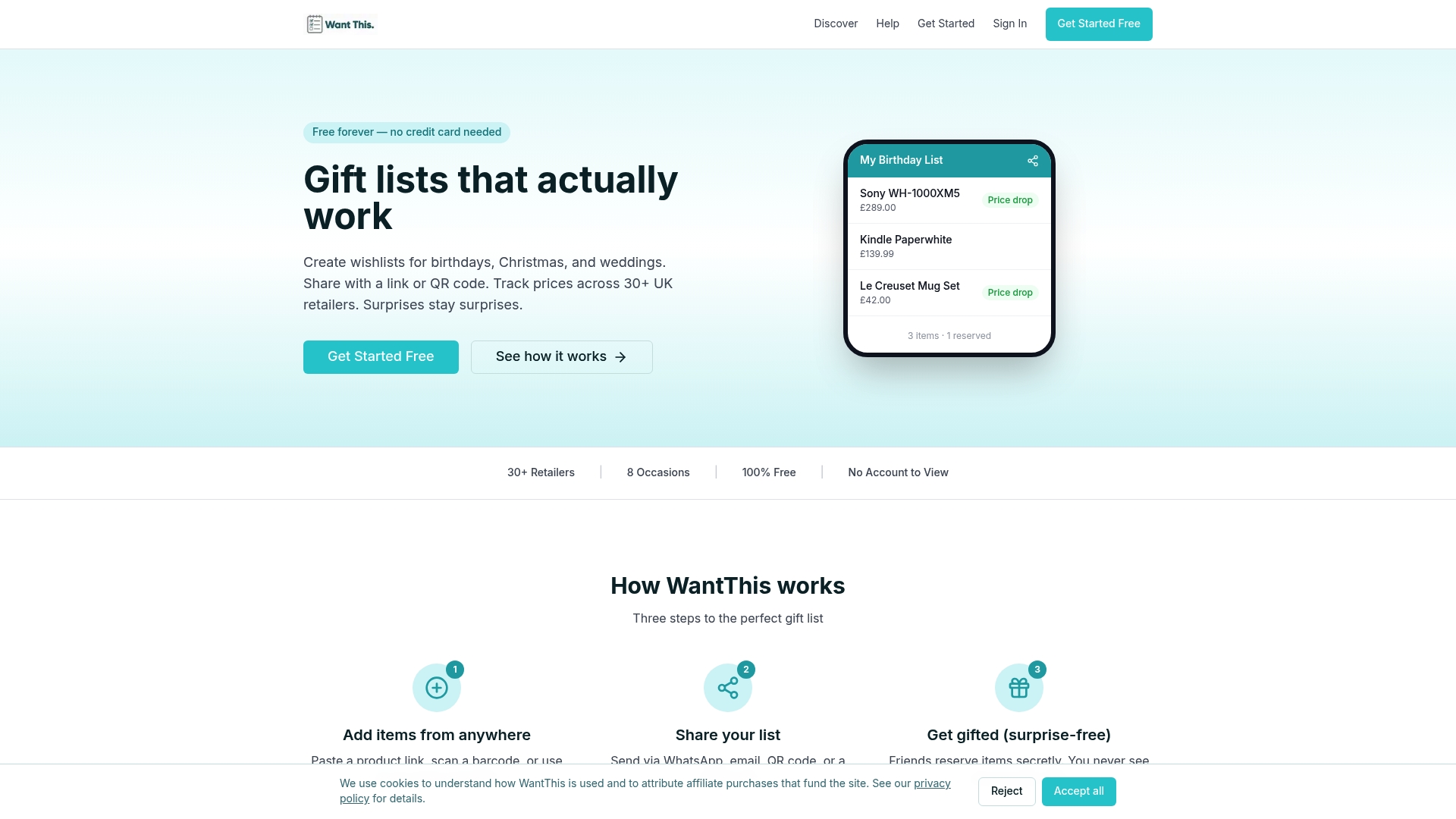
Add an item from any UK retailer, set it on a birthday or Christmas list, and share the list with family so nobody buys a duplicate. If you’re organising a group exchange this year, the Secret Santa organiser handles the draw automatically too. Start by pasting your first product link and building a list at wantthis.co.uk.