
What is collaborative gift planning? A UK guide

TL;DR:
- Collaborative gift planning involves groups working together to choose, reserve, and buy gifts for a shared recipient. Using structured processes and tools like shared wishlists, it prevents duplicates, maintains surprise, and simplifies coordination.
Collaborative gift planning is the process of a group working together to choose, reserve, and buy gifts for a shared recipient, so everyone contributes fairly and nothing gets duplicated. It follows a simple three-phase lifecycle: set objectives (agree on the recipient’s preferences and a budget), coordinate (share a list, reserve items, and collect contributions), then evaluate (confirm purchases and adjust if anything changes). If you want to start today, Wantthis is built exactly for this: shared wishlists, private reservations, and price tracking across 30+ UK retailers, all free to use.
At a glance:
- Define what the recipient wants and set a group budget
- Create a shared wishlist and invite contributors to reserve items
- Track prices and confirm purchases before the occasion
Table of Contents
- What is collaborative gift planning and why do groups use it?
- How the three-phase planning lifecycle works in practice
- Which features make collaborative gift planning simple?
- Common mistakes groups make and how to fix them
- Timelines and message templates for common UK occasions
- Privacy, etiquette, and money handling for UK groups
- Key takeaways
- Why collaborative gift planning matters more than most guides admit
- Wantthis makes collaborative gift planning straightforward
- Useful sources and further reading
What is collaborative gift planning and why do groups use it?
Individual gift-buying is straightforward when you are shopping alone. The moment a group gets involved, the risks multiply: two people buy the same thing, someone spends twice what others do, or the recipient finds out what they are getting before the day. Collaborative gift planning solves all three problems by giving the group a shared, visible plan to work from.
The core benefits are practical rather than sentimental:
- Transparency: everyone sees what has already been claimed, which removes the anxiety of guessing
- No duplicates: private reservations update the list instantly so two people cannot buy the same item
- Fairer budgeting: splitting a larger gift across several contributors makes expensive items achievable
- Surprise preserved: reservations are visible to contributors but hidden from the recipient
- Less stress: shared gift lists cut the back-and-forth messages that typically consume hours of coordination
A common worry is that involving more people makes the process slower or more complicated. The opposite tends to be true when the right tools are in place. As planning researchers note, automation of routine tasks such as status tracking and availability monitoring reduces coordination overhead rather than adding to it.
Collaborative gifting works because visibility replaces guesswork. When contributors can see what is reserved and what remains, they make faster, more confident decisions — and the recipient gets a gift that is genuinely wanted.
How the three-phase planning lifecycle works in practice
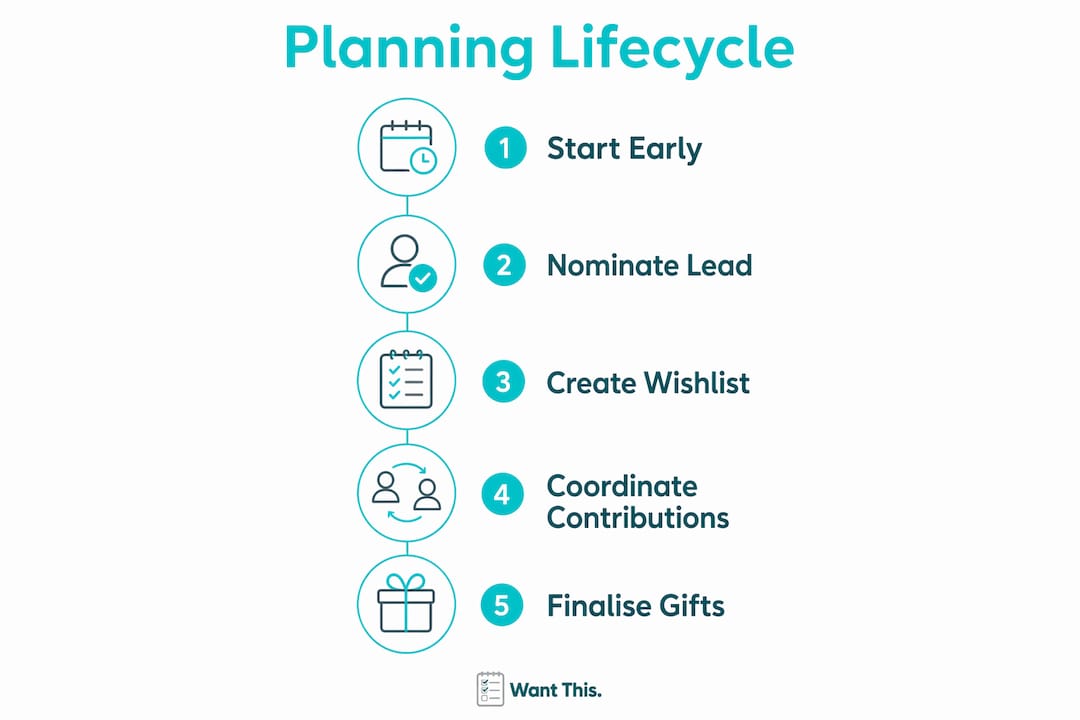
A repeatable three-phase structure keeps any group gift on track, whether you are organising a wedding collection or a quick Secret Santa.
Phase 1: Set objectives
- Identify the recipient’s preferences (ask them directly or check their wishlist)
- Agree a total budget and individual contribution range
- Nominate one lead organiser who owns the list and handles queries
- Choose your platform and create the shared wishlist
Phase 2: Coordinate
- Share the list with contributors via a private link
- Each contributor reserves the item they plan to buy
- For pooled gifts, agree who collects money and by when
- Monitor the list for price changes or out-of-stock items
Phase 3: Evaluate
- Confirm all items are reserved or purchased before the deadline
- Chase any unreserved items at least one week before the occasion
- Adjust if a price drops significantly or an item sells out
- After the occasion, note what worked for next time
Quick-start timing by occasion:
- Weddings: begin Phase 1 six to nine months before; coordinate from three months out
- Christmas: start in September; finalise reservations by late November
- Baby showers: open the list six to eight weeks before the shower date
- Secret Santa: launch the draw two to four weeks before the exchange
Managing multiple lists across different occasions is straightforward when each list is organised by event.

Which features make collaborative gift planning simple?
Not every wishlist tool supports genuine group coordination. The features below are the ones that materially reduce the work involved.
| Feature | What it does | Why it matters for groups |
|---|---|---|
| Shared wishlist | One list, multiple contributors | Replaces group chats and spreadsheets |
| Private reservations | Marks an item as taken without telling the recipient | Prevents duplicates and preserves surprise |
| Price tracking | Monitors price changes and sends alerts | Avoids overpaying; flags stock issues early |
| Browser extension / app | Add items from any retailer while browsing | Builds the list faster across multiple shops |
| Secret Santa organiser | Automatic name draw with wishlist links | Removes the need for manual draws and paper slips |
| Privacy controls | Recipient cannot see reservations | Keeps the surprise intact |
Wantthis covers every row in that table. Paste a product link from any UK retailer and it pulls in the title, image, and current price automatically. Contributors open the shared list, reserve their chosen item privately, and the list updates in real time so no one else picks the same thing. Price alerts notify the group if a tracked item drops in price, which is particularly useful for higher-value wedding or baby shower gifts where timing a purchase well can save a meaningful amount.
Treating the wishlist as a living document that updates with every reservation is the single most effective way to prevent duplicate purchases in a group.
Common mistakes groups make and how to fix them
Most collaborative gift plans fail for the same handful of reasons. Here is what to watch for and what to do about it.
- Starting too late: coordination failures almost always trace back to a delayed start. Early interaction builds consensus and prevents last-minute panic. Fix: set a firm start date and send the list link the same day.
- No nominated lead: when everyone is responsible, no one is. Fix: one person owns the list, chases stragglers, and handles refunds.
- Duplicate purchases: happen when reservations are not used or the list is shared too late. Fix: make private reservations mandatory before anyone buys.
- Unclear payment rules: contributors drop out or pay different amounts without a clear agreement. Fix: state the contribution amount and deadline in the invitation message.
- Over-complicated rules: too many contributors or intricate sign-off steps cause decision paralysis. Fix: keep the group to the people who genuinely want to contribute.
- Price or stock changes: an item sells out or jumps in price after the list goes live. Fix: use price alerts and check the list weekly in the run-up to the occasion.
Pro Tip: Keep the group small and the rules simple. A lead organiser, a shared list, and a clear deadline are all you need. Every extra layer of approval or sign-off adds delay without adding value.
Timelines and message templates for common UK occasions
Weddings
- Six to nine months before: create the shared list and invite close family to contribute ideas
- Three months before: share the list link with the wider guest group
- Six weeks before: send a reminder to reserve items; chase any gaps
- One week before: confirm all purchases and arrange delivery or collection
Invitation message:
Christmas
- September: agree on the group and nominate a lead
- October: create the list and share it
- Late November: final reservation deadline
- Early December: confirm purchases and arrange wrapping
Baby shower (six to eight weeks before)
- Week 1: create the list and share with the core group
- Week 3: open to wider friends and family
- One week before: chase any unreserved items
Secret Santa (two to four weeks before)
Use the Wantthis Secret Santa organiser for an automatic draw. Each participant links their wishlist so their match knows exactly what to buy.
Contribution request message: For more sharing options, gift list sharing guides cover the practical steps for each occasion type.
Privacy, etiquette, and money handling for UK groups
Good etiquette keeps the process comfortable for everyone involved.
- Ask before adding personal items: deeply personal or sensitive gifts (medical devices, clothing sizes) should be suggested privately to the lead, not added to a public list without consent.
- Mark reserved items clearly: use the platform’s reservation feature rather than informal messages, which get lost.
- Respect budget expectations: if the group has agreed a £30 per-person contribution, do not add a £200 item without discussion.
- Use private share links: share the list via a direct link rather than posting it publicly, so the recipient does not stumble across it.
- Keep personal data minimal: the list needs names and an occasion date, not addresses or financial details beyond what a payment app requires.
For money pooling, tracked payment apps (such as PayPal, Monzo, or a shared notes app) work well for small groups. Agree in writing (even a group chat message) who holds the funds, what the deadline is, and how refunds are handled if someone drops out. The lead organiser should keep a simple record of who has paid and what was purchased.
Collective gifting guides cover the etiquette of pooling money in more detail for larger groups.
Key takeaways
Collaborative gift planning works best when you start early, nominate one lead, and use a shared wishlist with private reservations to keep surprises intact and eliminate duplicates.
| Point | Details |
|---|---|
| Start the lifecycle early | Begin Phase 1 at least six weeks before the occasion; for weddings, six to nine months ahead. |
| Nominate a lead organiser | One person owns the list, chases contributors, and handles any payment queries. |
| Use private reservations | Real-time reservations update the list instantly and are the most effective way to prevent duplicate purchases. |
| Track prices throughout | Price alerts flag stock issues and price drops so the group can act before the occasion. |
| Wantthis covers all phases | Create a free shared wishlist, invite contributors, reserve items privately, and use the built-in Secret Santa organiser for seasonal exchanges. |
Why collaborative gift planning matters more than most guides admit
There is a tendency in gift-giving advice to treat coordination as a minor inconvenience, something a group chat can handle. In practice, the group chat is where gift plans go to die. Messages get buried, someone forgets to reply, two people buy the same thing, and the recipient ends up with three copies of the same book.
The real value of a structured approach is not the technology. It is the clarity of roles. When one person owns the list and contributors know exactly what to do (open the link, reserve an item, pay by a specific date), the social friction disappears. The lead does not have to chase; the contributors do not have to guess.
What most guides underestimate is how much the evaluation phase matters. Checking the list weekly in the final run-up to an occasion catches the problems that derail group gifts: an item going out of stock, a price spike, a contributor who reserved something but never bought it. A five-minute check each week is far less stressful than a last-minute scramble.
The tools matter, but only because they enforce the process. A platform that updates reservations in real time, sends price alerts, and keeps the recipient in the dark does the administrative work so the group can focus on the part that actually counts: choosing something the recipient will genuinely love.
Wantthis makes collaborative gift planning straightforward
Wantthis is a free UK platform built for exactly this kind of coordination. Paste a product link from any retailer, and it pulls in the title, image, and current price automatically. Share the list with your group, and contributors can reserve items privately without the recipient ever seeing what is coming.
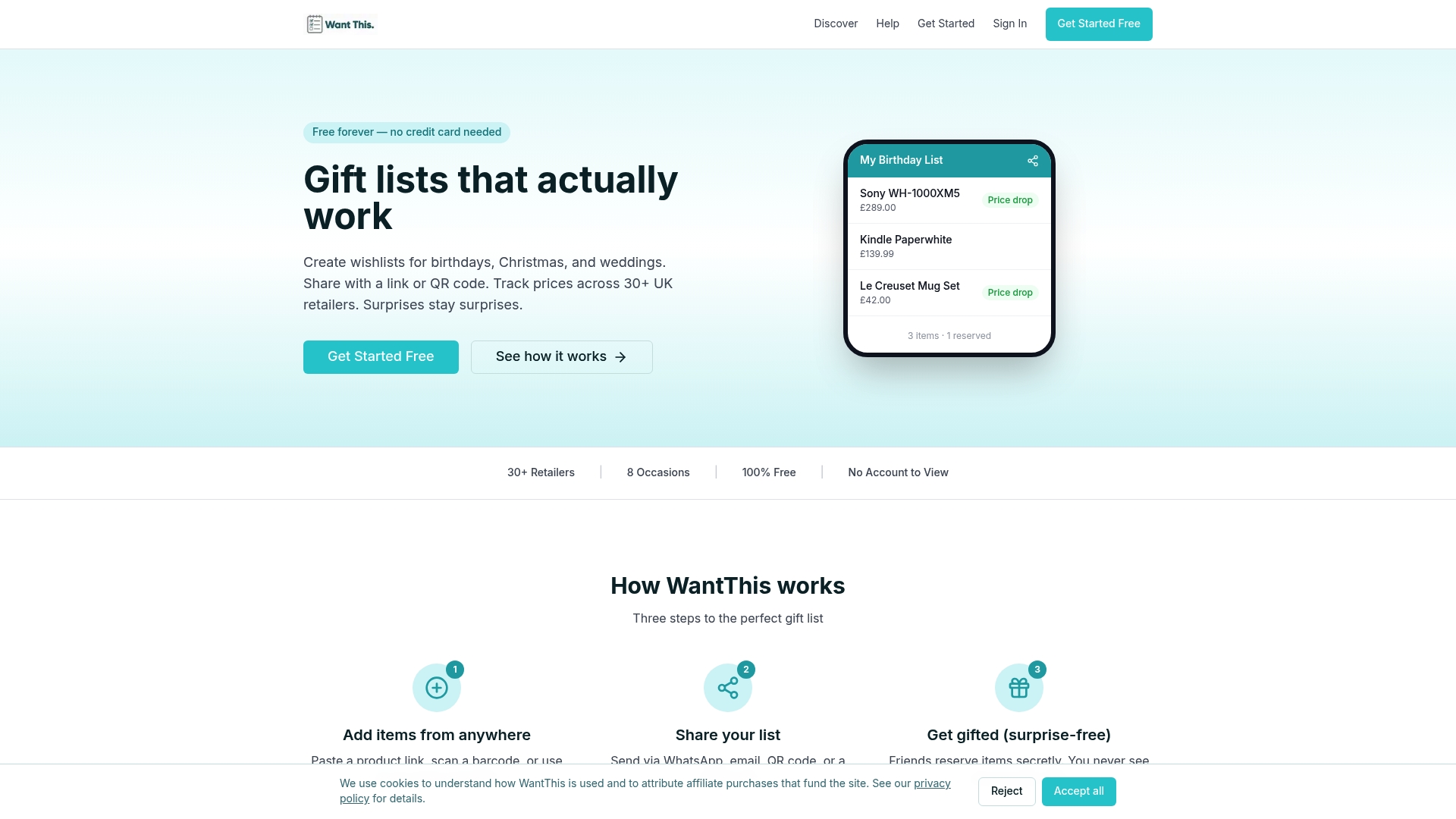
Three steps to get started:
- Create a free list at wantthis.co.uk and organise it by occasion
- Paste links from any UK retailer; Wantthis pulls in the product details and tracks the price
- Invite contributors via a private share link; they reserve items and buy in their own time
The Secret Santa organiser handles automatic draws and links each participant’s wishlist to their match, removing the need for paper slips or manual coordination. Price tracking covers 30+ UK retailers with alerts when a saved item drops in price.
Wantthis is free to use. It earns a small affiliate commission when contributors click through to a retailer and complete a purchase, which is disclosed on the site. There are no subscription fees and no lock-in.
Useful sources and further reading
- Collaborative Planning Guide (MindOnMap) — covers the three-phase lifecycle, real-time reservation logic, and the case for automation in group planning
- 8 Tips for Collaborative Planning (Edutopia) — practitioner guidance on the KISS principle, early feedback loops, and nominating a lead
- Wantthis features overview — full list of platform capabilities including price tracking, private reservations, and browser extension
- Social gifting explained (Wantthis blog) — background on how group and social gifting works in the UK context
- Gift ideas and inspiration (Wantthis) — a broad idea bank to help groups populate a shared list quickly