
What Is Social Gifting Online? A Clear 2026 Guide

Social gifting online is the practice of exchanging gifts digitally through social network services or dedicated platforms, without any physical shipping required. Instead of mailing a wrapped box, you share a URL, send an e-gift card via text, or pool contributions with friends toward a single high-value item. The whole exchange happens in seconds, and the recipient redeems it on their own terms.
Two distinct formats define the space. Microgifting covers low-cost digital tokens sent casually to maintain connections or say thank you. Collaborative group gifting lets multiple people chip in toward something more expensive, like a games console or a weekend experience. Both serve real social purposes, just at different scales.
Key elements of social gifting online at a glance:
- Digital delivery via URL, email, or social media message, with no address needed
- Immediacy — gifts arrive in seconds rather than days
- Personalization options including scheduled delivery, video messages, and custom notes
- Common formats such as e-gift cards, digital vouchers, streaming subscriptions, charitable donations, and virtual goods
- Social connectivity — the act is visible to a network, or kept private, depending on the platform
- Emotional motivation rooted in gratitude, celebration, and relationship maintenance
Gifting has always been a social activity at its core. Digital platforms have simply removed the friction, making it easier to act on the impulse the moment it strikes.

How does social gifting online differ from traditional gifting?
Traditional gifting centers on physical objects exchanged in person or sent by post. You choose an item, wrap it, and either hand it over or pay for shipping to a physical address. The whole process takes planning, time, and often a fair amount of coordination.

Online social gifting flips that model. Delivery happens via a link or message, the recipient needs no fixed address on file, and the giver can complete the entire process from a phone in under a minute. That low friction is the defining difference.
A few other contrasts worth knowing:
- Speed: Traditional gifts take days or weeks to arrive; digital gifts are instant or scheduled to the minute
- Personalization: Online gifting supports multimedia additions like video clips, GIFs, and timed delivery that physical gifts cannot replicate
- Collaboration: Group gifting online is straightforward — contributors click a link and pay their share; coordinating the same thing by post is genuinely complicated
- Address requirements: Social gifts can be sent knowing only someone’s email or social media handle, removing a common barrier
- Cultural reach: Digital gifts cross borders without customs delays or international shipping fees
- Psychological shift: The perceived worth of a digital gift depends heavily on personalization; without a thoughtful message, it can feel transactional in a way a wrapped present rarely does
Neither format is universally better. Physical gifts still carry weight for major milestones. But for casual appreciation, quick celebrations, or long-distance relationships, the online format wins on almost every practical measure.
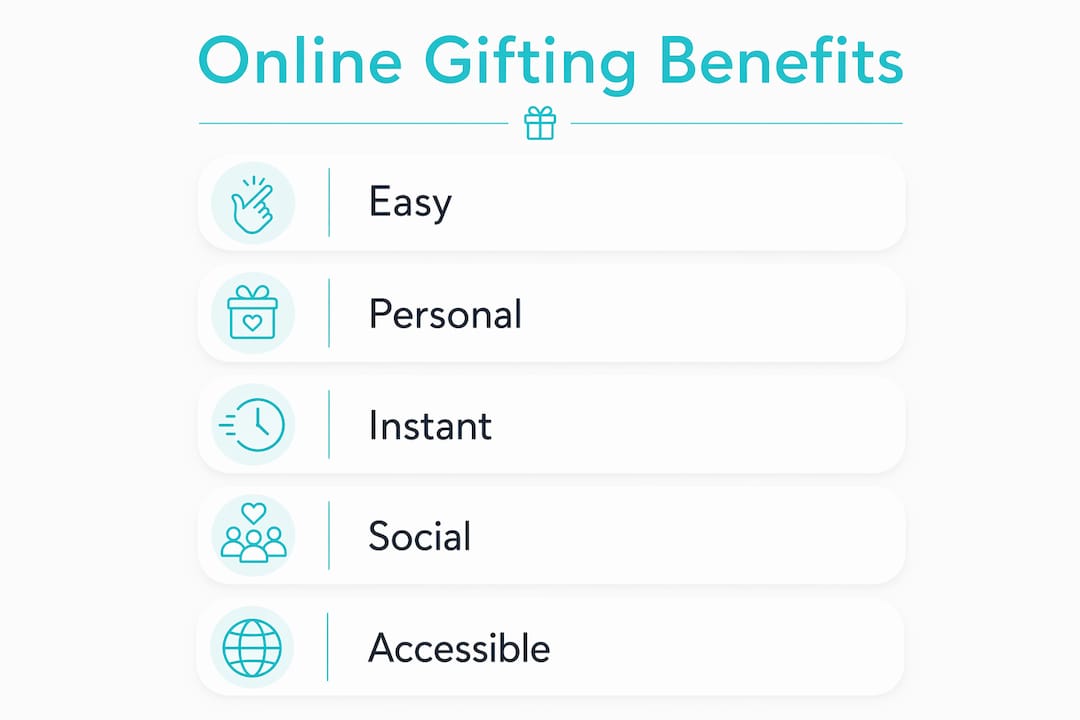
What are the benefits and popular use cases of online gifting?
The clearest benefit is convenience. Consumer research finds that “not a hassle to purchase” and “not a hassle to pass on” rank among the top reasons people choose social gifts, alongside the ability to suit the recipient’s tastes and lifestyle. Speed matters too: the appeal is acting on a generous impulse without a shopping trip.
Beyond convenience, online gifting suits a wide range of occasions:
- Casual thanks — a coffee voucher or small gift card sent after someone helps you out
- Group gifts for high-value items — friends pooling contributions toward electronics, experiences, or travel, coordinated through a shared gift list
- Digital subscriptions — streaming services, audiobook credits, or online courses gifted as a link
- Charitable donations — giving in someone’s name to a cause they care about
- Celebrations at a distance — birthdays, promotions, and new babies reached instantly regardless of geography
- Corporate recognition — employee gift boxes and client appreciation sent without logistics overhead
Gift cards sit at the center of most of these use cases because they satisfy both sides of the exchange. The giver acts quickly and without guesswork; the recipient chooses what they want at a time that suits them. Social gifting is currently most popular among younger, digitally native generations, though research suggests it will expand to busy professionals and older adults managing remote family relationships.
Pro Tip: Pair a gift card with a short personal note referencing something specific about the recipient. That one sentence is what turns a convenient transaction into something genuinely memorable.
The social and psychological side of digital gift giving
Gifting is not a modern invention. Anthropologist Marshall Sahlins traced gift exchange rituals back to the Stone Age, and the emotional logic behind them has barely changed. What digital platforms have done is adapt that behavior to the speed and scale of social networks.
Research published in Information Systems Research in 2018 identified five factors that drive decisions to gift via social network services: convenience, symbolic representation, relationship support, pleasure, and social gifting norms. Reciprocity plays a strong role too. When someone sends you a digital gift, the social expectation to respond in kind increases interaction frequency and builds what researchers call social capital within a network.
Personalization is the variable that separates a meaningful digital gift from a forgettable one. Yale behavioral scientists note that convenience alone does not equal thoughtfulness. Adding a video, referencing a shared memory, or timing delivery to the exact moment of a birthday transforms the same e-gift card into something that feels considered. Multimedia additions, inside jokes, and specific personal references all significantly raise the emotional impact beyond the monetary value.
Privacy shapes how comfortable people feel participating publicly. Many platforms offer both public gift feeds, where sent gifts appear for others to see and draw inspiration from, and fully private options where only the sender and recipient are aware. AI-driven anonymization can strip personally identifiable details from public messages while preserving the warmth and humor of the original note. That balance between social visibility and personal privacy is what makes the public feed model work without feeling intrusive.
Online gifting culture also varies by region and relationship type. In markets where digital gifts feel as warm as physical ones, the format has become a genuine social norm rather than a fallback. Cultural fit, timing, and the right format for the relationship all determine whether a digital gift lands well or feels like a shortcut.
Key Takeaways
Social gifting online combines the emotional logic of traditional gift exchange with the speed and reach of digital platforms, making personalization the single most important factor in whether a digital gift feels meaningful.
| Point | Details |
|---|---|
| Two core formats | Microgifting covers low-cost digital tokens; collaborative group gifting pools contributions toward higher-value items. |
| No address needed | Social gifts are sent via URL, email, or social media handle, removing a key barrier to spontaneous giving. |
| Personalization drives impact | Attaching a video, personal note, or timed delivery raises emotional value well beyond the gift’s monetary cost. |
| Reciprocity builds networks | Social gifting increases interaction frequency and social capital among connected users, benefiting both relationships and platforms. |
| Adoption is expanding | Currently led by younger, digitally native users, social gifting is expected to grow among busy professionals and remote families. |