
Ways to Manage Multiple Wishlists for Every Occasion

Managing multiple wishlists efficiently means centralising your gift and shopping desires so nothing gets lost, duplicated, or forgotten. The best ways to manage multiple wishlists combine universal wishlist tools, occasion-based organisation, and real-time item reservation to keep gift planning clear and coordinated. Whether you are building a birthday gift list, a Christmas haul, or a wedding registry, the right system saves time and prevents the awkward moment when two people buy the same thing. This guide covers the practical strategies that actually work for UK shoppers in 2026.
1. What are universal wishlist tools and why do they matter?
A universal wishlist tool, also called a retailer-agnostic or multi-retailer wishlist, is a platform that lets you save products from any online store into a single list. Instead of maintaining separate wishlists on Amazon, John Lewis, ASOS, and every other retailer you shop at, you manage everything in one place. Universal wishlist apps remove the need to juggle per-site accounts and support sharing and deal alerts in a single hub. That consolidation alone cuts the time you spend managing lists by a significant margin.

The cross-device syncing that comes with these tools is equally important. Desktop and mobile activity syncs instantly, removing the friction of maintaining multiple tabs or screenshots when you spot something you want. You can add an item on your phone while browsing a retailer’s app, then view and share it from your laptop later without any manual copying.
Key features that define a strong universal wishlist tool include:
- Cross-retailer product saving from any website via a browser extension or app
- Real-time item reservation so gift-givers can mark items as bought without alerting the list owner
- Price tracking and alerts that notify you when a saved item drops in price
- Sharing controls that let you send a list to specific people or via a public link
- Multi-device sync so your lists are always current across phone, tablet, and desktop
Pro Tip: Set up your chosen wishlist tool before you start shopping, so saving an item is as quick as pasting its link.
2. How to organise multiple wishlists by occasion
Occasion-based organisation is the single most effective method for keeping multiple wishlists manageable. The principle is simple: one list per event or purpose. A birthday list for yourself, a Christmas list for the kids, a wedding registry, a baby shower list, and a personal “want later” list each serve a different audience and timeline.
Wishlists organised this way act as planning tools that reduce social friction between friends and family. When everyone knows exactly which list to check for which occasion, there is no confusion about what to buy or who is buying it.
A practical approach to occasion-based organisation:
- Name lists clearly. Use names like “Sarah’s 30th Birthday” or “Christmas 2026 Kids” rather than generic titles like “Wishlist 1.”
- Set a deadline or event date. Noting the occasion date helps gift-givers know how much time they have.
- Assign a priority level to each item. Mark items as high, medium, or low priority so buyers know what matters most.
- Add notes to individual items. Specify size, colour, or variant preferences to avoid wrong purchases.
- Archive completed lists. Once an occasion passes, archive the list rather than deleting it so you have a record of what was received.
- Create a personal “someday” list. Keep a separate private list for items you want but are not tied to any occasion.
Pro Tip: For a Christmas gift list, start building it in October or November. Early organisation gives family members enough time to coordinate without last-minute panic.
3. What features to look for in wishlist management tools
Choosing the right tool shapes how well your entire wishlist system works. Not all platforms offer the same capabilities, and the gap between a basic wishlist and a full-featured management tool is significant.
The table below outlines the core features to evaluate when selecting a wishlist management platform:
| Feature | Why it matters |
|---|---|
| Unlimited list creation | You need separate lists for each occasion without hitting a cap |
| Cross-device sync | Lists stay current whether you add items on phone or desktop |
| Sharing with permission levels | Control who can view, reserve, or edit each list |
| Price tracking and alerts | Catch price drops on saved items before buying |
| Multi-retailer support | Save products from any website, not just one store |
| Item reservation (private) | Gift-givers mark items bought without spoiling surprises |
| Browser extension or app | Add items quickly while browsing any retailer |
Wishlist features like creating multiple lists, adding notes, editing, sharing, and receiving price alerts are now considered standard in quality platforms. If a tool is missing two or more of these, it will create friction rather than reduce it. The ability to move or copy items between lists is a smaller but genuinely useful feature when you realise an item belongs on a different occasion list than where you originally saved it.
4. Tips for sharing wishlists without compromising privacy
Sharing a wishlist is where most people make avoidable mistakes. The most common error is applying the same privacy setting to every list. Configuring distinct privacy settings per list is the correct approach, with visibility set according to each list’s purpose.
Practical sharing guidelines to protect privacy and prevent spoiled surprises:
- Set each list’s visibility independently. A personal “want later” list should be private. A birthday list should be shared only with the people buying gifts. A group gift list might be semi-public within a defined group.
- Use link-based sharing for simplicity. Sending a direct link is easier than requiring recipients to create an account, and sharing via simple links with collaborative features is now standard in quality tools.
- Enable private item reservation. This feature lets a gift-giver mark an item as claimed without the list owner seeing it, which protects the surprise.
- Avoid sharing your own list with yourself. Some platforms show reservation status to the list owner if they access the shared version. Check this before sending your list.
- Review sharing settings before each occasion. A list you shared publicly last year may still be live. Audit your active lists every few months.
Wishlists provide clear signals to friends and family for coordinated gift giving, but only when the right people can see the right list. Getting the sharing configuration right is what separates a useful gift list from a source of confusion.
5. How to use price tracking to time your purchases
Price tracking is one of the most underused features in wishlist management. Saving an item to a wishlist is not just about remembering it. It is also a way to monitor whether the price changes before you or someone else buys it.
Price drop alerts on saved wishlist items help buyers catch deals and make better purchasing decisions. For high-value items like electronics or kitchen appliances, waiting for a price drop can save a meaningful amount. WantThis tracks prices on saved items and sends alerts when the price falls, which is particularly useful in the weeks around Black Friday or the January sales.
The practical approach is to add items to your wishlist as soon as you identify them, even if you are not ready to buy. The tool monitors the price in the background. When the alert arrives, you can decide whether the drop is large enough to act on or whether to keep waiting. This turns a passive wishlist into an active shopping tool.
6. How AI and browser extensions improve wishlist management
AI integration is changing how wishlist tools work, particularly for users managing large numbers of items across many occasions. WantThis offers a ChatGPT integration that connects your lists to ChatGPT, which can help when brainstorming gift ideas for a particular occasion or recipient.
Beyond AI, browser extensions remain the most practical tool for adding items quickly. The workflow is straightforward: you browse any retailer’s website, spot something you want, click the extension, and the item is saved to your chosen list with the title, image, and current price pulled in automatically. No copying links. No switching apps.
Features now common in leading wishlist platforms include:
- AI-generated gift suggestions based on occasion, budget, or recipient preferences
- One-click saving from any retailer via a browser extension
- Automatic price and image updates when product details change on the retailer’s site
- Cross-platform apps for iOS and Android so you can add items while shopping in-store or on your phone
- Collaborative lists where multiple people can add items, useful for group gift planning or shared household wishlists
The combination of AI suggestions and browser-based saving removes the two biggest friction points in wishlist management: knowing what to add and actually adding it quickly.
7. How to manage Secret Santa and group gift lists
Secret Santa and group gift lists require a different organisational approach than personal wishlists. The core challenge is coordination: multiple people need to see what is available, claim items privately, and avoid duplicates, all without revealing who is buying what.
A dedicated Secret Santa organiser solves this cleanly. WantThis includes a Secret Santa organiser with an automatic draw, so participants are assigned a recipient without any manual coordination. Each participant can then build a wishlist that their assigned buyer can view and shop from.
For group gifts where several people contribute to one larger purchase, the best approach is a shared list with item reservation enabled. One person creates the list, adds the target item, and shares it with the group. Contributors mark their portion as reserved so the group can track progress toward the full amount without overlap.
Key Takeaways
The most effective way to manage multiple wishlists is to use a retailer-agnostic platform with occasion-based organisation, private item reservation, and price tracking built in.
| Point | Details |
|---|---|
| Use a universal wishlist tool | Save products from any retailer into one platform instead of managing per-site lists. |
| Organise by occasion | Create separate, clearly named lists for each event to reduce confusion and improve coordination. |
| Configure privacy per list | Set visibility independently for each list to protect surprises and control who sees what. |
| Enable item reservation | Let gift-givers mark items as bought privately so duplicates never happen. |
| Activate price tracking | Save items early and let alerts tell you when the price drops before you commit to buying. |
Why wishlist management is worth getting right
Most people underestimate how much organisational friction costs them. It is common for several people to buy the same gift because nobody had a shared system, or for someone to miss price drops on an item they wanted for months because they saved it in a notes app instead of a tool with alerts.
The shift that makes the biggest difference is treating your wishlist as a living document rather than a static list. Occasion-based naming, per-list privacy settings, and item reservation are not complicated features. They are the baseline for any system that actually works. The people who get the most value from wishlist tools are the ones who set them up properly at the start of each gifting season rather than scrambling in December.
The other thing worth saying plainly: a retailer-agnostic platform beats any single-store wishlist for almost every use case. When you are not locked into one retailer, you can save the best version of any product from wherever it is sold at the best price. That flexibility, combined with price tracking, is what makes the difference between a wishlist that helps and one that just sits there.
WantThis makes managing gift lists straightforward
WantThis is built for UK shoppers who want one place to manage gift lists for every occasion, from birthdays and Christmas to weddings and baby showers. Paste any product link from any retailer and WantThis pulls in the title, image, and current price automatically.
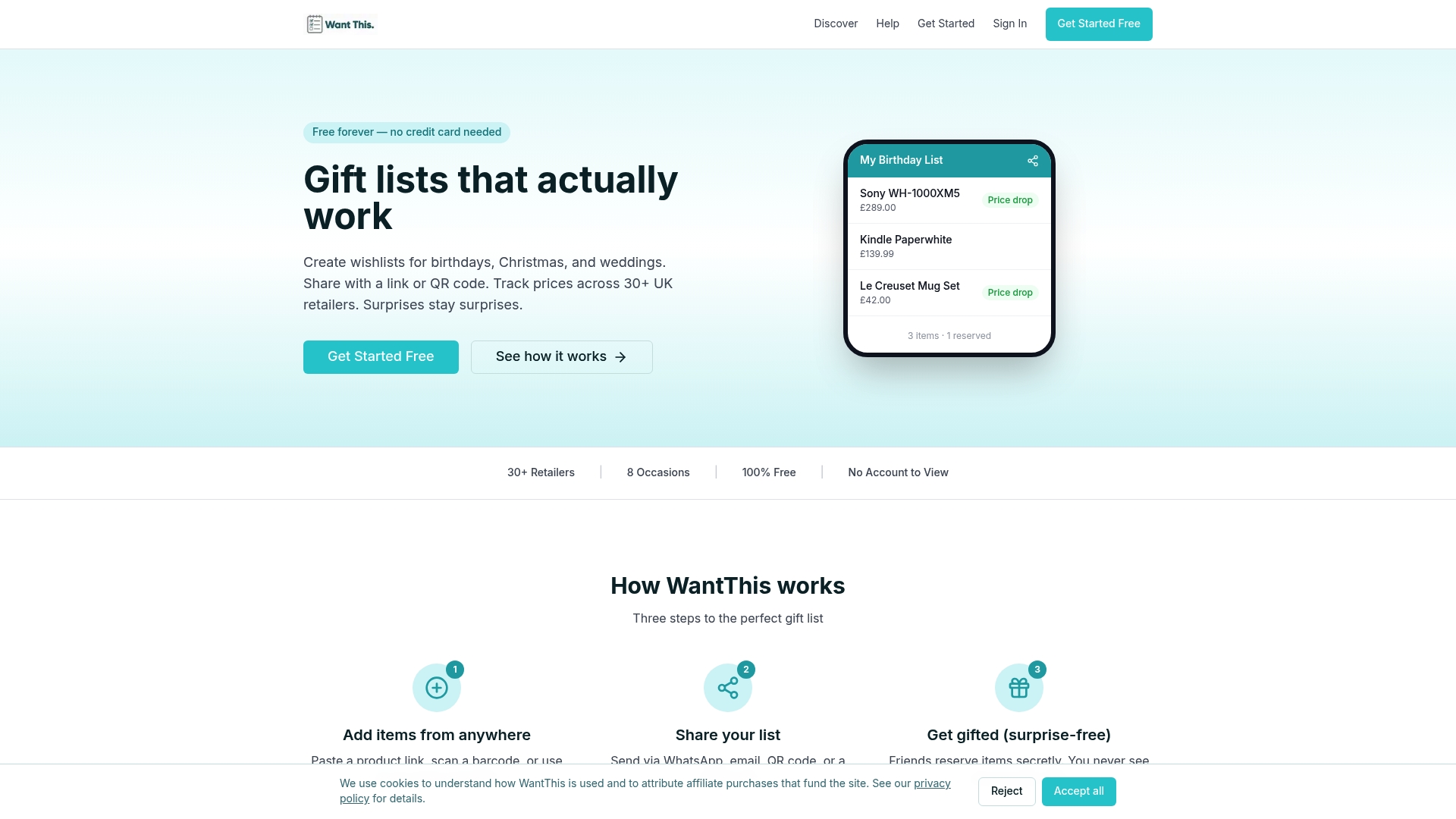
You can create as many lists as you need, organise them by occasion, and share them with friends and family using a simple link. Gift-givers can reserve or mark items as bought privately, so surprises stay intact and duplicates never happen. Price tracking runs in the background and sends alerts when saved items drop in price. Start your free wishlist on WantThis today.
FAQ
What is a universal wishlist tool?
A universal wishlist tool is a platform that lets you save products from any online retailer into a single list, rather than maintaining separate wishlists on each store’s website. It typically includes sharing, price tracking, and cross-device sync.
How do I stop people from buying duplicate gifts?
Use a wishlist platform with private item reservation, where gift-givers can mark an item as bought without the list owner seeing it. This prevents duplicates without spoiling any surprises.
How many wishlists should I have?
Create one list per occasion or purpose, such as a birthday list, a Christmas list, and a personal “want later” list. Keeping lists separate by occasion makes coordination easier for everyone involved.
What is the best way to share a wishlist without spoiling surprises?
Share the list via a direct link and enable private item reservation so you cannot see which items have been claimed. Set each list’s privacy level independently rather than using the same setting for all lists.
Does price tracking on wishlists actually save money?
Yes. Price drop alerts on saved items notify you when the price falls, which is particularly useful for high-value gifts around sale periods like Black Friday or the January sales.