
Wedding No Gifts Wording in the UK: Copyable Lines, Where to Share

If you would like to give, you will find our wedding wishlist at [link] is the simplest wording for most couples, and the right place for that link is your wedding website or a separate details card, never the main invitation. One UK option for building that list is available online. The rest comes down to tone, timing and where you put the words.
TL;DR:
- Set up the list at least three months before invitations go out, so guests can browse and plan gifts before the wedding.
- Keep cash or honeymoon requests on the wedding website, offer one to three choices, and frame each contribution as optional rather than expected.
- For a no gifts message paired with a list, reassure guests first, make the list a secondary option, and mention it only once.
- Restrict access to people with the link and enable private reservations, so guests can claim gifts without exposing their choices or causing duplicate purchases.
Table of Contents
- Wording examples for your registry, money or charity request
- Where and when to put your registry wording
- How to ask for money or charity donations politely
- Setting up and sharing your wishlist without duplicate gifts
- Cultural etiquette and common phrases in UK weddings
- Wording for blended situations: no gifts plus a wishlist
- Keeping the tone warm while setting guest expectations
- Suggesting experiences and charity options without sounding prescriptive
- Printed invitations, registry links and postal etiquette
- What I learned choosing wedding wishlist wording
- Setting up your wedding wishlist with WantThis
- FAQ
- Sources
Wording examples for your registry, money or charity request
The exact phrase matters less than matching it to how formal your wedding feels. Here are templates you can copy straight onto a details card, website or RSVP note.
For a formal information card or website:
- “Your presence at our wedding is the only gift we need, but for those who have asked, we have created a wishlist at [link].”
- “We have put together a few gift suggestions at [link], entirely optional and much appreciated.”
- “Should you wish to mark our day with a gift, our wedding list can be found at [link].”
For a friendlier or more casual invite:
- “We’re lucky enough to have everything we need, but if you fancy treating us, here’s our wishlist: [link].”
- “No pressure at all, but if you’re stuck for ideas, we’ve popped a few on a list here: [link].”
- “Honestly, just come and dance with us. If you’d still like to give something, it’s all on [link].”
For a money or honeymoon fund, worded carefully and placed on the website only:
- “We’re saving for our honeymoon, so a contribution towards that would mean the world: [link].”
- “In lieu of traditional gifts, a small contribution to our new home fund would be gratefully received: [link].”
- “If you would like to help us start married life, our honeymoon fund is here: [link].”
For charity donations in lieu of gifts:
- “We would love it if, instead of a gift, you considered a donation to [charity name]: [link].”
- “We’re supporting [charity name] this year. A donation in our name would mean a great deal: [link].”
- “Rather than gifts, we’re asking guests to donate to [charity name], a cause close to our hearts.”
Pro Tip: Match your wording tone to your invitation design: a formal typeset card calls for formal phrasing, while a relaxed, illustrated invite can carry a more conversational line.
Where and when to put your registry wording
Your main invitation should stay focused on the day itself: names, date, venue, dress code. Registry details belong on a separate information card or your wedding website, which is where Debretts suggests couples keep this kind of practical detail. Putting gift wording on the invitation itself tends to read as presumptuous, however gently it is phrased.
Timing matters too. According to Debretts’ how-to guide, lists should be set up well in advance before invitations go out, giving guests plenty of time to browse before save-the-dates even land.
Sample lines that work well in these spots:
- On an information card: “Further details, including travel and gift suggestions, can be found at [website].”
- On the website itself: “We’ve created a small wishlist for anyone who would like to give us a gift: [link].”
Keep registry mentions understated wherever they appear. A quiet line on a details card does the job without turning the invitation into a request.
How to ask for money or charity donations politely
Money requests still make some UK couples uneasy, but handled well they read as practical rather than presumptuous. An etiquette expert’s guidance on wedding registries is consistent on this: keep the request to your wedding website, never the invitation itself.
Three honeymoon or cash-fund templates that keep things light:
- “We’re dreaming of our honeymoon, so a contribution towards flights or experiences would be treasured: [link].”
- “If you would like to give towards our future together, our fund is here: [link].”
- “A gift towards our new home would help us start this next chapter: [link].”
Three charity-in-lieu templates that are specific about how to give:
- “In place of gifts, we would love a donation to [charity], made directly via [donation link].”
- “We’re asking guests to support [charity] instead of giving gifts: [donation page link].”
- “A donation to [charity], in whatever amount feels right, would mean more to us than any present.”
The same etiquette guidance recommends keeping the registry link easy to find but not prominent, offering one to three options rather than a long list, and writing with sincerity and gratitude rather than obligation.
Statistic callout: According to Debretts, wedding lists should be set up well in advance before invitations are sent, giving guests time to plan their gift or contribution well ahead of the big day.
Setting up and sharing your wishlist without duplicate gifts
Once you have decided on wording, the practical side takes minutes rather than days.
- Create your list and add items by pasting product links from any retailer you like, rather than being tied to one shop.
- Mix in a few money or charity options alongside physical gifts if that suits your situation.
- Switch on private reservations or mark-as-bought so guests can claim a gift without anyone else seeing, keeping surprises intact.
- Set the list’s visibility so only people with the link can view it.
- Publish the link on your wedding website or information card, using one of the templates above.
- Keep the list updated as gifts arrive, removing anything that is no longer needed.
A wishlist with built-in reservations solves the classic wedding list problem: three people buying the same toaster. On WantThis, each saved item can be privately reserved or marked as bought, so the list updates for everyone sharing it. Price tracking across UK retailers is also handy for guests deciding whether to buy now or wait for a drop.
Pro Tip: Include a short line with the link itself, such as “no obligation at all”, so the wording never reads as an instruction.
Anything you share should carry a few basics: a brief line of context, the gift or contribution options, a charity link if relevant, and a way for guests to ask questions if something is unclear.
Cultural etiquette and common phrases in UK weddings
British wedding etiquette still leans towards modesty when it comes to gifts, even as digital wishlists have become the norm. The traditional line “your presence is the greatest gift of all” remains common precisely because it lets couples mention a registry without seeming to ask for one.
Phrases that soften a request tend to do well with UK guests: “should you wish to”, “entirely optional”, “no obligation at all” and “if you would like to help us celebrate” are common in the examples above because they put the decision back with the guest. This matters more in UK etiquette than in many other wedding cultures, where registry mentions can be more direct.
Humour has its place too, particularly for younger or more informal weddings, but it works best alongside a clear, simple link rather than replacing one. A joke about already owning enough towels still needs a sentence telling guests where to look if they want to give something. The safest approach across most UK weddings is warmth first, practicality second: thank guests for coming, then mention the list almost as an afterthought.

Wording for blended situations: no gifts plus a wishlist
Many couples want to tell guests not to feel obliged, while still giving those who insist on bringing something a clear place to look. This blended approach needs a slightly different structure from a straightforward registry mention.
Lead with the reassurance, then offer the option as a secondary note: “Your company is all we ask for, but for those who would like to bring a gift, we’ve put together a short list here: [link].” This ordering matters. Putting the wishlist first can make the whole message read as a request rather than an invitation.
Another version works well for couples who genuinely want to steer guests towards one or two preferred options: “We don’t expect gifts, but if you’re set on bringing something, a contribution to our honeymoon fund or an item from our list would be lovely: [link].” Keeping the sentence short avoids it reading as a menu of demands.
The blended wording works best placed once on the website, rather than repeated across the invitation, information card and RSVP. One clear mention, written with warmth, does more than three scattered reminders.
Keeping the tone warm while setting guest expectations
The line between helpful and presumptuous is thin, and UK guests tend to notice when it is crossed. The fix is less about which words you choose and more about where you put them and how often you repeat them.
Gratitude should come first in every version of this wording. “We’re so grateful you’re joining us” reads very differently from “gifts can be given via the following link”, even when both sentences appear on the same page. Leading with thanks, then mentioning the practical details, keeps the whole message feeling like an invitation rather than an instruction.
Repetition is the other common misstep. Mentioning the wishlist once on the website, in a tone that matches the rest of your invitation, sets expectations clearly without pressure. Mentioning it on the invitation, the information card and again in a reminder email starts to feel transactional, however well-intentioned. A single, well-placed mention respects guests who want to bring a gift and those who would rather not be reminded at all.
Suggesting experiences and charity options without sounding prescriptive
Not every couple wants a conventional list of homeware. Experience-based suggestions and charity donations are common alternatives, but the wording needs to stay suggestive rather than directive.
“If you’d like to contribute towards a cookery class or a weekend away, we’d love that” works better than naming a specific product or amount, because it leaves the guest room to interpret the gesture their own way. The same applies to charity wording: naming the cause and explaining briefly why it matters to you, rather than specifying an amount, keeps the tone personal rather than transactional.
A short list of options, rather than a single instruction, also helps: mentioning that guests could choose between a contribution to a honeymoon fund, an item from the wishlist or a donation to a named charity gives everyone a way to give that suits their own budget and preference. Three options is usually enough. More than that starts to feel like a checklist rather than an invitation.
Printed invitations, registry links and postal etiquette
UK etiquette guidance is consistent on one point: registry or wishlist details do not belong on the formal invitation itself, and this is as much about courtesy as tradition. A printed card listing gift preferences can arrive looking like an expectation rather than an option, which is why Debretts’ wedding list guidance recommends an information pack or website instead.
There is no legal restriction on printing a web address or QR code on wedding stationery in the UK, so the postal consideration is really about etiquette rather than regulation. A separate details card, included in the same envelope as the invitation, is the accepted way to pass on a website address without putting it on the invitation itself. Many couples also add the website link to save-the-date cards, which arrive before formal invitations and give guests time to visit the site at their own pace.
QR codes have become common on these details cards, offering a tidy way to link directly to a wedding website without printing a long web address. Whichever method you choose, keeping it off the main invitation card remains the detail that UK etiquette experts return to most consistently.

What I learned choosing wedding wishlist wording
When I was putting together wording for my own wedding website, the hardest part was not the phrasing itself but deciding where it should sit. I drafted three versions before settling on something close to “should you wish to give, we’ve created a small list here”, placed quietly on the website rather than the invitation.
The practical side made more difference than I expected. Once the list was shared with private reservations switched on, gifts stopped doubling up, and writing thank-you notes afterwards was far simpler because every gift had a name attached to it already. I used an online wishlist service for this, mainly because it let me add items from several different shops rather than being tied to one retailer’s registry.
The wording mattered, but the tidy list behind it is what actually saved the stress.
— Stuart
Setting up your wedding wishlist with WantThis
Once you have settled on wording, publishing it takes minutes. This kind of service typically lets you paste a product link from any online retailer and pulls in the title, image and price automatically, so your list can include anything from kitchenware to experience vouchers without hunting through a single store’s catalogue.
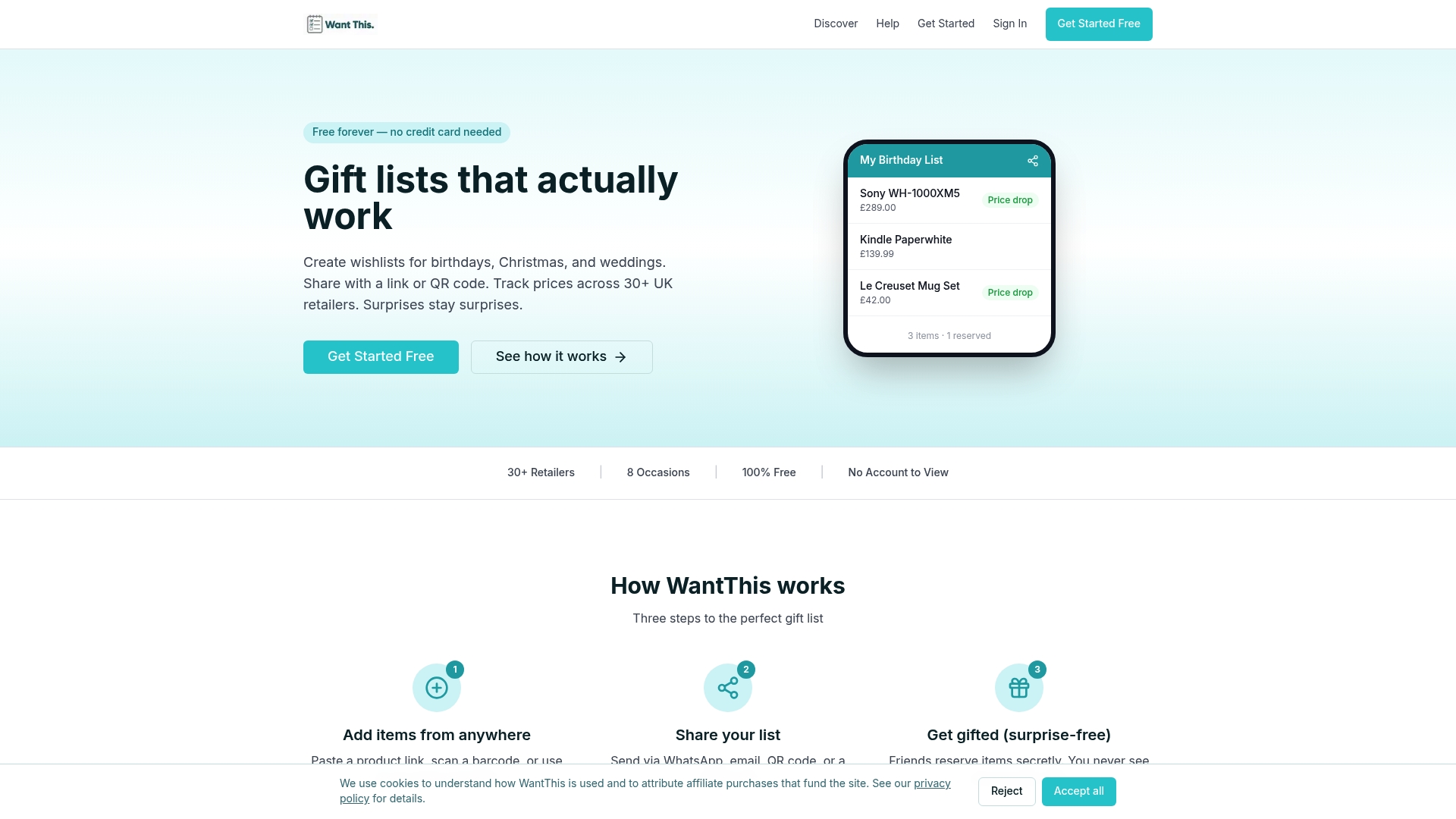
Guests can privately reserve an item or mark it as bought, so nobody ends up buying the same gift twice. Price tracking features also help guests decide when to buy. Such platforms are typically free to use, with no account needed just to browse a shared list.
- Paste a link from an online retailer and have details filled in automatically.
- Guests can reserve or mark items as bought privately to keep surprises intact.
- Price tracking and alerts can help guests choose when to buy.
- Lists are shareable by link for easy sharing.
A line like “We’ve put together a wishlist for anyone who would like to give us something: [link]” works well once your WantThis wedding gift list is ready to share. For more detail on setting one up, our wedding gift list guide for UK couples walks through the steps in full. You can start a free wishlist at WantThis whenever you’re ready.
FAQ
What is a simple way to word a wedding gift list request?
A short, optional-sounding line works best: “Should you wish to give a gift, our wishlist can be found at [link].” Keeping the tone soft and placing it on your wedding website rather than the invitation follows standard UK etiquette.
Where should wedding registry wording go on invitations?
Registry or wishlist details belong on a separate information card or your wedding website, not on the main invitation itself. Debretts’ guidance recommends setting this up at least three months before invitations are sent.
How do I ask for honeymoon money without sounding demanding?
Keep the request on your wedding website only, offer it as one option among a small handful, and phrase it with gratitude: “A contribution towards our honeymoon would be gratefully received.” Etiquette experts recommend limiting registry mentions to a few simple options.
Can I combine a charity donation request with a gift list?
Yes, many couples offer both: a short line naming the charity alongside a wishlist link gives guests a choice. Keeping both options on the website, rather than repeating them across invitations and info cards, keeps the tone light.
Is it acceptable to include a QR code linking to a wedding website on invitations?
Yes, there is no postal or legal restriction on this in the UK, and it has become a common way to point guests to a wedding website without printing a long web address. It works best on a separate details card rather than the main invitation.
Sources
- How to make a wedding list • Debretts
- An Etiquette Expert’s Three Tips For Handling Money On Your Registry