
Spend Smart, Not Awkwardly: UK Wedding Gift Etiquette, £50–£100 Guidance
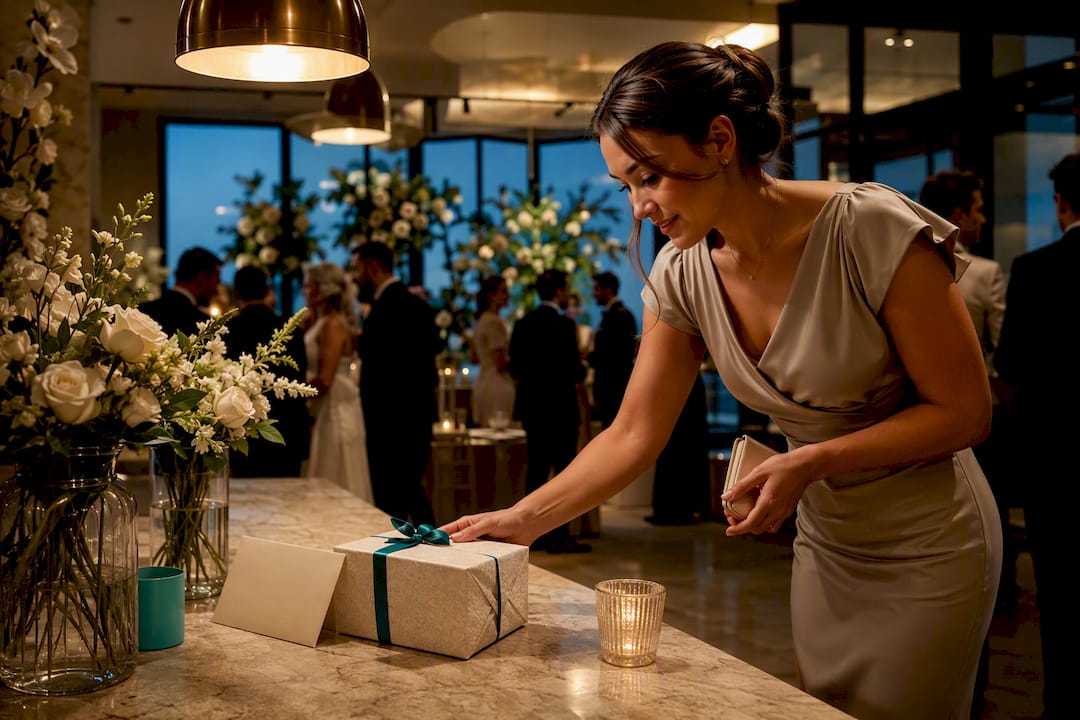
Follow the couple’s lead: if they’ve named a registry or cash fund, use it; if they haven’t said anything, cash in a card or an item from their gift list is always safe. Send bulky gifts ahead or bring cash on the day, and a tool like WantThis can help you check what’s already been bought so you’re not duplicating a toaster three other guests have already picked.
TL;DR:
- Sending gifts ahead or using a tracking platform like WantThis helps avoid duplicate presents and ensures the couple receives larger items smoothly.
- Gift amounts should reflect your relationship, with typical ranges from £50 to £100 for close friends or family, adjusted according to circumstances.
- Cash gifts should be labeled clearly, sent via secure methods like bank transfer or QR code, and not handed directly during the celebration to prevent loss.
- When in doubt, attendance and a heartfelt card outperform expensive, awkward gifts, especially for evening-only guests or those with financial constraints.
- Clearly communicating preferences and using online wishlists or registries minimizes misunderstandings and makes gift-giving more comfortable for guests.
Table of Contents
- Wedding gift etiquette UK: quick dos and don’ts checklist
- How much should you spend on a wedding gift in the UK?
- When and how to give wedding gifts
- Registries, cash funds and wording: what to expect and how to respond
- What are good wedding gifts in the UK by relationship and budget?
- How does group gifting work for weddings?
- What if you can’t afford a wedding gift or you’re an evening-only guest?
- How do you present cash as a wedding gift politely?
- When should couples send wedding thank-you notes?
- WantThis: a UK wishlist tool that helps guests and couples avoid gift problems
- Are there regional differences in UK wedding gift etiquette?
- Author perspective: why etiquette is shifting and why clarity matters
- Get your wedding gift list right with WantThis
- Sources
Wedding gift etiquette UK: quick dos and don’ts checklist
Before you agonise over spreadsheets and second guesses, run through the basics. Most gifting mishaps come from skipping one of these simple checks, not from picking the wrong colour of blender.
- Check the registry first. If the couple has a wedding list, buy from it rather than guessing at their taste.
- Respect “no gifts” requests. If the invitation says presence only, don’t turn up with a parcel anyway; it puts the couple in an awkward spot.
- Never print bank details on the main invite. Etiquette guidance is firm on this: payment details belong on a wedding website or a separate insert card, not the formal invitation itself, according to Easy Weddings.
- Label cash gifts clearly. Write your name and, if it’s not obvious, how you know the couple, on the card or the transfer reference.
- Use a secure card box or bank transfer where offered. Loose envelopes handed over at a busy reception have a habit of going astray.
The rest is really about amount and timing, which is where most of the genuine anxiety sits.
How much should you spend on a wedding gift in the UK?
There’s no legally binding number, but there is a widely used set of bands that most UK etiquette experts and wedding sites converge on. The honest answer to “how much to spend on a wedding gift UK” depends on how close you are to the couple and what role you’re playing on the day, not on some universal figure plucked from nowhere.
Pro Tip: If you’re stuck between two amounts in a band, round to whichever number makes you feel comfortable rather than guilty. A gift given resentfully isn’t a better gift.
Typical UK spending bands by relationship
| Relationship to the couple | Typical UK gift amount |
|---|---|
| Evening-only guest | a modest amount appropriate for the event |
| Acquaintance or work colleague | a modest to moderate amount depending on closeness |
| Friend | a moderate amount appropriate for friendship closeness |
| Close friend | a moderate to generous amount suitable for close friendship |
| Immediate family (parents, siblings) | a more generous amount reflective of family closeness |
These bands, reported across wedding gift etiquette guidance from Weddings Hub, aren’t rigid brackets so much as sensible starting points. YouGov polling found most Britons think £50 to £100 is appropriate for someone they’re very close to, with lower figures considered fine for acquaintances, which lines up neatly with what wedding etiquette columns have been advising for years.
Five factors that move you up or down the band
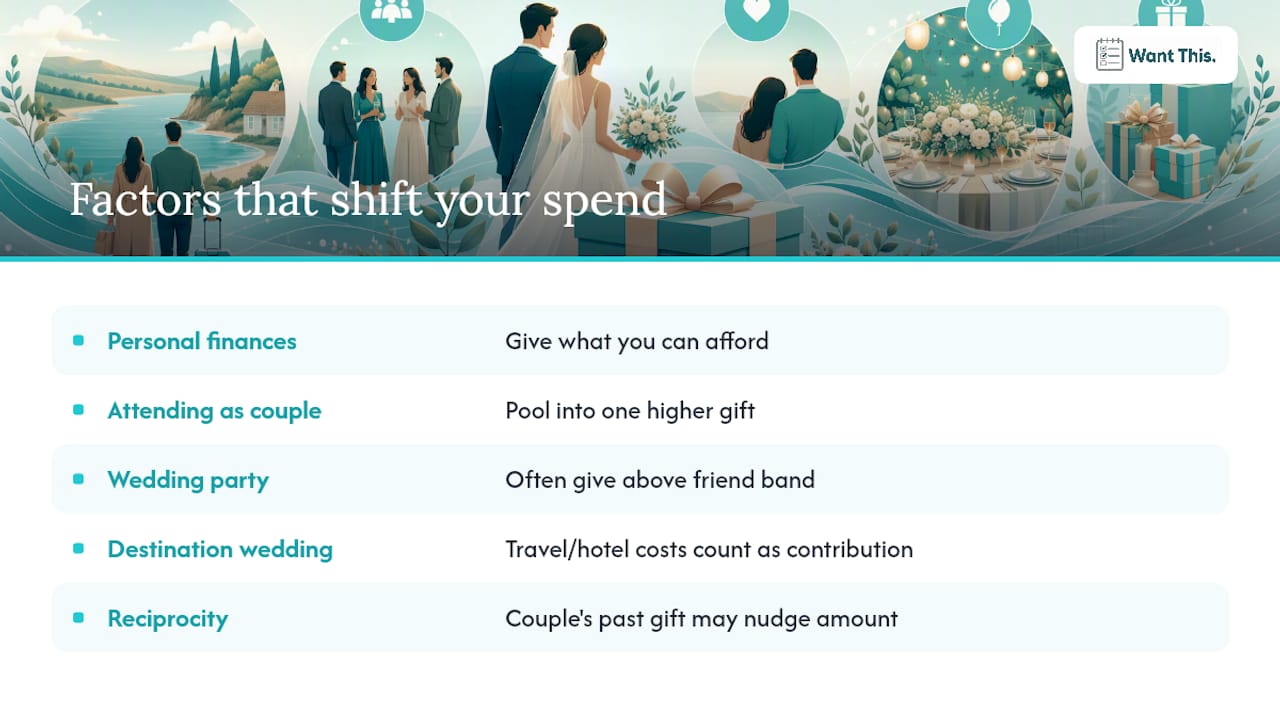
Your own financial position comes first. Telegraph and Debrett’s etiquette experts are consistent on this: give what you can genuinely afford, not what you think is expected. No couple worth attending wants a guest going into debt for a gravy boat.
Attending as a couple changes the maths. Two guests from one household typically pool into a single gift at the higher end of the band, rather than each giving separately, since you’re effectively representing one seat at one table.
Wedding party duties usually mean spending more. Bridesmaids, best men and ushers often give slightly above the standard friend band, partly because of the closer relationship and partly because tradition expects it.
Destination weddings reset the calculation entirely. Guests who’ve already paid for flights, hotels and time off work are not expected to also produce a lavish gift on top. As etiquette writer William Hanson notes, the cost of simply attending is itself a significant contribution, and couples marrying abroad shouldn’t expect guests to stretch further than that.
Reciprocity is a quiet factor too. If the couple gave generously at your own wedding, or you know you’ll likely need to reciprocate soon, that history can nudge your figure without anyone ever saying so out loud.
The plate-cost sanity check (use with caution)
A long-running rule of thumb says your gift should roughly cover the cost of your place at the wedding breakfast. It’s a useful gut check if you’re genuinely stuck, but etiquette experts are clear it’s a guideline, not an obligation. If you’re an evening-only guest who wasn’t at the meal, there’s no plate cost to cover at all; the Connections Entertainment guide to evening receptions is a useful primer on exactly what evening-only guests are and aren’t expected to contribute.
Practical method: pick a comfortable figure inside your relevant band, adjust slightly for the five factors above, and stop there. Overthinking the decimal points helps nobody.
When and how to give wedding gifts
Timing trips people up almost as often as amount does. Get the delivery method wrong and even a thoughtful gift can create a headache for the couple on their busiest day.
- Send bulky or valuable items ahead of time. A week or two before the wedding, deliver larger gifts directly to the couple’s home rather than the venue; this avoids the couple having to lug a stand mixer through a car park in their wedding outfit, as Weddings Hub advises.
- Use the gift table or card box if bringing something on the day. Most receptions have a designated spot for cards and small gifts; hand yours over there rather than carrying an envelope around all evening looking for the right moment.
- Avoid passing cash directly to the couple mid-celebration. It’s awkward for them and easy to misplace in a crowd.
- Bank transfers work well for cash gifts, provided you use a clear reference such as your surname and “wedding gift” so the couple can identify who sent what.
- QR codes on wedding websites are increasingly common and entirely acceptable; scan, contribute, and consider adding a short message through whatever platform the couple has set up.
Registry platforms and gift-list providers often hold larger purchased items for the couple and handle exchanges if duplicates slip through, according to Debrett’s guide to making a wedding list, which is one more reason sending ahead through the registry beats turning up with a parcel under your arm.
Registries, cash funds and wording: what to expect and how to respond
Couples get plenty of etiquette advice, and most of it boils down to one rule: don’t put gift details on the formal invitation. Easy Weddings is unambiguous that registry information belongs on a wedding website, a separate insert card, or is simply passed on by word of mouth through the wedding party. If you’ve received an invitation with bank details printed directly on it, that’s the exception, not the standard, and it’s worth checking the couple’s wedding website for the fuller picture regardless.
As a guest, your job is simple:
- If a registry exists, buy from it. That’s precisely what it’s there for, and it removes the guesswork on both sides.
- If a cash fund is named, treat it as a contribution towards something specific. Etiquette experts increasingly recommend couples frame these as savings towards a honeymoon or a home deposit rather than a flat cash demand, and Hitched’s guidance on giving money as a wedding gift backs this framing precisely because it makes guests more comfortable giving.
- If you’re genuinely unsure, ask someone in the wedding party. A quick word to a bridesmaid or the couple’s sibling is far less awkward than guessing wrong.
- A short, polite private message to the couple works too, particularly for close friends. “Is there anything you’d love, or should I just surprise you?” solves most dilemmas in one line.
Pro Tip: If a couple’s registry looks suspiciously empty a few weeks before the big day, don’t assume everything’s been bought. Good registry etiquette involves the couple topping up the list regularly, keeping roughly a third to 40% of items available throughout, according to Easy Weddings, so check back closer to the date rather than defaulting to cash out of frustration.
A shared list built through a platform like WantThis’s guide for couples setting up a gift list solves this from the couple’s side, since items can be added from any retailer and refreshed as things get bought, without ever needing to print a bank sort code on the invitation.
What are good wedding gifts in the UK by relationship and budget?
Off-registry gifts can absolutely land well, provided you avoid the two classic traps: generic novelty items and anything so personalised the couple can never regift or exchange it.
- Useful homeware remains the safest bet for most relationships: quality kitchenware, bedding, or something from a well-known UK homeware retailer tends to get used rather than shelved.
- Personalised keepsakes work best for close friends and family who know the couple’s taste well enough to get it right; a custom print of a shared memory beats a generic “Mr & Mrs” sign every time.
- Experiences and vouchers suit couples who’ve said they’d rather build memories than accumulate things; a cookery class, a spa afternoon, or a voucher towards their honeymoon activities all fit comfortably in the friend or acquaintance bands.
- Contributions to a specific fund (honeymoon, house deposit, garden furniture) work well when the couple has explicitly asked for this, and feel far more generous than a vague cash amount in an envelope.
Three rules for choosing off-registry: personalise where you genuinely can, skip anything overtly novelty or date-stamped (“Mr & Mrs 2026” mugs age badly the moment the marriage does), and never monogram something with the wedding date unless the couple specifically asked for it. Browsing WantThis’s gift guides by budget and occasion is a quick way to see what’s currently popular across price points if you want inspiration rather than a blank page.
If the couple has shared a list anywhere, it’s worth checking it through a platform like WantThis before you buy, simply to see what’s already been reserved by other guests and avoid the classic problem of three people turning up with the same casserole dish.
How does group gifting work for weddings?
Pooling money for one bigger gift, whether among friends or colleagues, works well when it’s organised properly and badly when it isn’t.
- Nominate one organiser to collect contributions, typically via bank transfer or PayPal, so there’s a single clear record of who’s paid.
- The organiser buys the gift once everyone’s contributed, rather than each person adding separately to a fund that might overshoot or undershoot the target.
- List every contributor’s name in the card, so the couple knows exactly who to thank; Weddings Hub notes this simple step avoids the awkward follow-up messages couples otherwise end up sending.
- Set a suggested contribution range upfront, typically £15 to £40 per person for a shared gift, so nobody feels pressured to match a colleague who’s offered more.
- Keep workplace collections opt-in and transparent. Circulate the ask once, don’t chase people repeatedly, and offer receipts if anyone wants confirmation their money reached the gift rather than someone’s lunch fund.
Group gifts tend to land better than solo cash contributions precisely because the couple receives one meaningful item rather than several small, disconnected ones.
What if you can’t afford a wedding gift or you’re an evening-only guest?
Turning up is genuinely enough. Etiquette experts are consistent that your attendance and a heartfelt card carry real weight, particularly for evening-only guests who weren’t expected to cover a meal in the first place.
- A card with a genuine, specific message often means more to a couple than a generic gift bought under financial strain.
- Small, thoughtful, low-cost gifts still count, homemade treats, a framed photo, or offering a practical skill like photography or driving them to the airport for the honeymoon.
- Sending something after the wedding is entirely acceptable if your finances tighten up around the date itself; nobody expects same-day delivery.
- If money’s genuinely tight, a brief private word to the couple (“we’re so happy for you, financially it’s a stretch right now but we’ll be there”) is far better than silence or overspending you’ll regret.
How do you present cash as a wedding gift politely?
Slip the cash inside a proper wedding card rather than a bare envelope, and always write your names and, if there’s any doubt, how the couple knows you. A short personal line, congratulating them or referencing a shared memory, makes a cash gift feel considered rather than transactional.
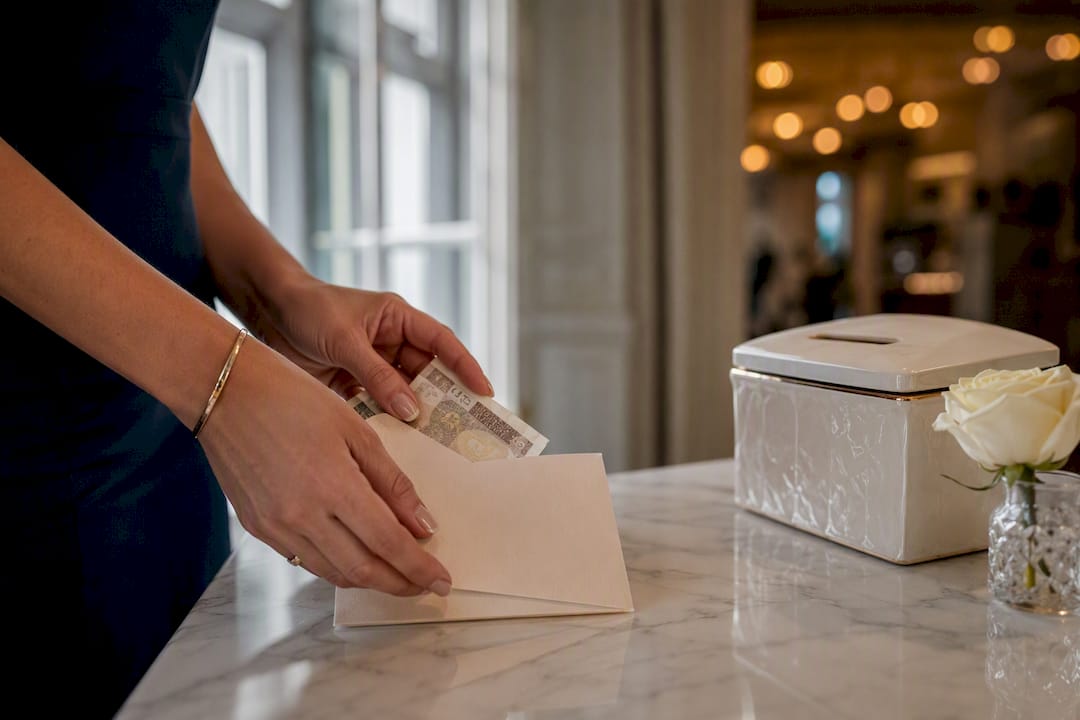
For bank transfers, use a clear reference such as your surname followed by “wedding,” so the payment doesn’t arrive as an anonymous mystery deposit. If the couple has set up a wishing well or similar collection point at the venue, check it’s genuinely secure, ideally supervised or lockable, before dropping cash into it. Avoid handing cash over publicly or making a show of the amount; the quiet, private moment of leaving a card at the designated table beats any grand gesture.
When should couples send wedding thank-you notes?
Couples should aim to send personal thank-you notes within six to eight weeks of the wedding, splitting the list between both partners so the task doesn’t fall entirely on one person during an already busy post-wedding period.
For cash gifts, mention the amount isn’t necessary, but a line about how it’ll be used (“we’re putting this towards our honeymoon in Portugal”) makes the thanks feel specific rather than templated. For physical gifts, name the item and, if you’ve already used it, say so; “we’ve already had three dinners off that lovely serving dish” lands far better than a generic thank-you.
WantThis: a UK wishlist tool that helps guests and couples avoid gift problems
Duplicate gifts and awkward guesswork are the two most common complaints in wedding gift etiquette UK forums, and both come down to poor information sharing. WantThis addresses this directly: couples build a shared wishlist by pasting product links from any online retailer, and guests can privately reserve or mark items as bought so nobody ends up with three identical toasters.
Because WantThis pulls prices and images automatically and tracks them across UK retailers, couples can also spot when a saved honeymoon-fund item drops in price, useful if several guests are pooling towards one big-ticket experience. A group of colleagues splitting the cost of a couple’s honeymoon activity, for instance, can reserve that single line item once the contribution’s confirmed, so nobody else duplicates the gesture. With browser extension and mobile app support, adding items while out shopping takes seconds rather than becoming its own chore.
Are there regional differences in UK wedding gift etiquette?
Broadly, the core principles of wedding gift etiquette UK guidance hold steady across England, Scotland, Wales and Northern Ireland: follow the couple’s stated preference, give within your means, and use a card or registry rather than guessing. That said, some local flavour persists.
Scottish weddings sometimes retain the tradition of a “poor-out” or small token gestures tied to older regional customs, though this has faded significantly outside more traditional or rural communities. In parts of Northern Ireland and Wales, extended family networks tend to be more involved in wedding costs generally, which can shift expectations slightly higher for close relatives compared with the broader England-wide averages.
Cultural background within multicultural UK communities also shapes gifting norms considerably. Guests from South Asian, Eastern European or other heritage backgrounds represented at a UK wedding may bring gifting customs, such as specific cash amounts tied to numerology, or gold jewellery as a traditional gift, from their own communities, and couples increasingly signal on their wedding websites if they’re happy to receive gifts in that spirit alongside standard UK conventions. When in doubt about a specific family or community’s customs, a quiet question to someone close to the couple remains the safest route, exactly as it does for any other point of gifting uncertainty.
Author perspective: why etiquette is shifting and why clarity matters
Wedding gift etiquette has moved faster in the last decade than most people realise. The shift from physical registries to cash funds and shared online wishlists isn’t a decline in tradition, it’s a rational response to couples who already own a kettle and would genuinely rather not receive a second one. Cash requests used to feel presumptuous; now, framed properly as a contribution towards a honeymoon or a house deposit, they’re simply more useful to the people receiving them.
What hasn’t changed, and what guests still underestimate, is how much clarity from the couple reduces anxiety on the guest side. Every awkward gifting dilemma I’ve seen dissected in etiquette columns traces back to ambiguity, no registry, no stated preference, no hint of what’s welcome. Couples who spell things out clearly, even briefly, do their guests a genuine kindness. Guests, in turn, should stop treating the amount as the measure of the relationship. A £30 gift from someone who turned up, celebrated properly, and wrote a heartfelt card outperforms a £150 gift dropped off with no card and no message. Presence and thoughtfulness still outrank the number on the cheque, whatever the spending bands suggest.
— Stuart
Get your wedding gift list right with WantThis
A practical alternative to a paper registry or a scattered group chat is to build one shared wishlist by pasting links from any UK retailer, and guests reserve items privately so surprises stay intact and nothing gets duplicated.
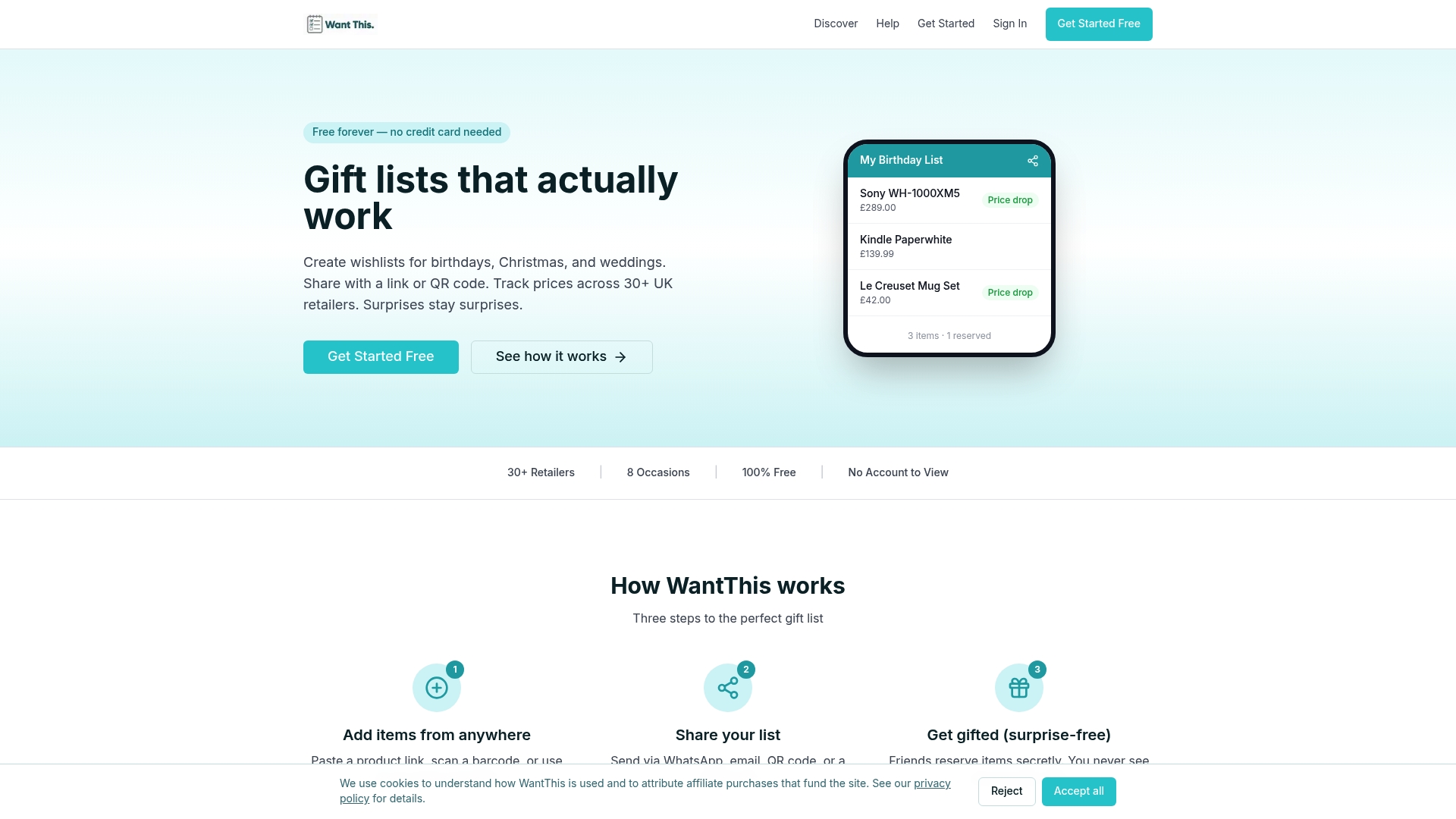
It works particularly well for group scenarios: friends pooling towards a honeymoon activity, or a family splitting the cost of a bigger household item, can each see the item’s real price, track it if it drops, and mark their share as contributed without a spreadsheet in sight. If you’re a couple planning a wedding gift list, or a guest hoping to check what’s already been reserved before you buy, setting up or browsing a list takes minutes and removes the guesswork on both sides.
Sources
- How much cash you should give at a wedding, according to etiquette experts - Telegraph
- How much should you spend on a wedding gift? - YouGov
- Wedding Gift Etiquette - Weddings Hub
- Seven points of gift registry etiquette - Easy Weddings