
How to Prevent Duplicate Gifts: A Practical UK Guide

The most reliable way to prevent duplicate gifts is to give everyone who buys for someone the same single place to look: one list of things the person actually wants, where each item is marked as taken the moment someone commits to it. A good memory, a group chat or a quiet word with your sister does not scale past two or three buyers. A shared gift list does, and on WantThis you can build one for free in a few minutes, add links from any online retailer and let friends and family reserve items privately, so nobody doubles up and the surprise stays intact.
This guide explains why duplicates happen, how to set up a list that stops them, how to coordinate without spoiling anything, and what to do if two identical presents still arrive.
- ✓Shared gift lists
- ✓Product links from different retailers
- ✓Private gift reservations
- ✓Mark gifts as bought
TL;DR
- Duplicates happen because several people buy for one person without seeing each other’s choices. The fix is a shared record, not a better memory.
- Put the wishes on one list, share it with everyone who might buy, and ask them to reserve before they pay.
- Private reservations and “bought” marks keep the surprise: the list shows what is taken without turning gift-giving into a chore.
- Recipients tend to prefer gifts from their own list, even though givers assume off-list gifts feel more thoughtful.
- If a duplicate still arrives, check the return rules, ask for a gift receipt, or pass it on.
Table of Contents
- Why duplicate gifts keep happening
- Why a better memory is not the answer
- What a duplicate-proof gift list needs
- How to prevent duplicate gifts: six steps
- How to coordinate without giving away the surprise
- What if someone has already bought the same gift?
- What to do if you receive duplicate gifts
- How wishlists also reduce waste
- Using WantThis to stop duplicates
- Our perspective
- FAQ
- Sources
Why duplicate gifts keep happening
Duplicates are rarely carelessness. They are what happens when several well-meaning people make the same sensible choice independently. The latest kettle, the bestselling novel, the Lego set the child has been talking about for weeks: the more obvious the gift, the more likely two people land on it.
Gifting habits make it worse. A 2019 TK Maxx survey of more than 2,000 British people, reported by Stylist, found that 75% of Brits gift on autopilot, buying much the same presents every year, and only 21% feel confident about their choices. When people buy on autopilot, they converge on the same safe options.
The same research team found Christmas is harder than an individual birthday because you are making several gift decisions at once. That is exactly the situation where duplicates multiply: grandparents, aunts, godparents and school friends all shopping in the same few weeks, none of them aware of the others.
Three situations cause most duplicates:
- Family occasions, such as Christmas, where many relatives buy for one child or one adult.
- Milestone events, such as weddings, baby showers and housewarmings, where guests pick from the same short list of obvious items.
- Hint-based gifting, where the recipient mentions something in passing and three people hear it.
Why a better memory is not the answer
The usual advice is to keep a note of what you have bought and tell the others. It works when two people are involved. With five or six buyers, someone is always out of the loop, someone forgets to reply, and someone buys at the last minute without checking.
The problem is structural. Each buyer needs to see, at the moment they choose, what has already been taken. That requires a shared list with a status on every item, which is why a gift list beats an email chain or a verbal agreement.
What a duplicate-proof gift list needs
Not every list does the job. Before you set one up, check it can do these five things:
- Hold products from any shop. Wants rarely sit in one retailer. If the list can only hold items from a single store, people will drift back to guessing.
- Let buyers reserve or mark as bought. This is the feature that actually prevents the clash.
- Keep reservations private from the recipient. Otherwise the surprise goes.
- Be easy to share. If buyers need to sign up for something complicated, many will not bother.
- Be quick to build. The person making the list should not need an evening to do it.
WantThis is designed around these points. You can add product links from different retailers into one list, and when you add a link we can import available product details to save you typing. Friends and family can privately reserve gifts or mark them as bought, which helps avoid duplicates while keeping surprises intact. Lists are free to create and share.
How to prevent duplicate gifts: six steps
The steps below work for a birthday, Christmas, a wedding or a baby shower. For a family-focused walkthrough, our guide to stopping duplicate gifts in six steps with a UK family gift list goes deeper.
1. Decide who the list is for and who will buy
Name the recipient and write down everyone likely to buy for them. For a child, that is parents, grandparents, aunts, uncles and often family friends. For a wedding, it is the full guest list. The people you forget to include are the ones who cause duplicates, so be generous with the invitation list.
Where it goes wrong: leaving out the occasional buyers, such as a godparent or a colleague, who then guess.
2. Gather real wishes, not guesses
A list is only useful if the items on it are things the person wants. You can ask directly, or learn indirectly. One approach is to ask casual questions in normal conversation rather than direct gift questions, which TinyHint suggests as a way to learn what someone wants without ruining a surprise. Another is to ask what they keep running out of, what has broken, what they already have and what to avoid, the kind of prompts a gift preference quiz uses.
If the recipient is making their own list, even better. For a birthday, our guide to registering for birthday gifts shows how to create and share one.
Where it goes wrong: building the list entirely from your own assumptions, so nobody wants to buy from it.
3. Add the items with links
Save each product with its link from the retailer’s page. On WantThis you can paste a link, use the browser extension or add items from the iOS and Android apps, and available product details are imported to help build the list. Our guide to making a UK wishlist in minutes covers the process.
Aim for a spread: a few small items, a few medium ones and one or two bigger ones. A list of only expensive things pushes buyers away; a list of only small things leads to a pile of near-identical bath bombs.
Where it goes wrong: adding vague entries such as “a jumper”. Buyers then pick their own, and two people can still choose similar ones. A specific link removes the ambiguity.
4. Share the list with every buyer
Send the link to everyone from step 1 in one go. If you are the recipient, send it to the people who ask what you want. If you are a coordinator, such as a parent organising a child’s list, send it to the whole family at once. Our overview of ways to share gift lists for any occasion covers the options.
Where it goes wrong: sharing with some people and relying on them to pass it on. Passing it on rarely happens.
5. Ask buyers to reserve before they pay
This is the habit that makes the whole system work. A gift reserved on the list is visibly taken for everyone else. Ask buyers to reserve first, then buy, and to mark it as bought afterwards. One sentence in the message does it: “Please reserve what you’re getting so we don’t double up.”

Where it goes wrong: buying first and reserving later. In that gap, someone else can reserve the same item.
6. Check the list before the big day
A week or two before the occasion, look at what is still unreserved and nudge anyone who has not yet chosen. If something is still free late on, you can point last-minute shoppers to a short, specific shortlist. Our last-minute gift ideas can help when time is tight.
Where it goes wrong: leaving gaps and then hoping. Unclaimed items are where a late panic buy turns into a duplicate.
How to coordinate without giving away the surprise
The worry people raise most is that a shared list ruins the surprise. It does not have to. A surprise is about the exact timing and the moment of unwrapping, not about whether the recipient has a rough idea of what they might get.
There is also solid evidence that lists serve the recipient. A 2011 study, cited by The Conversation, found that recipients strongly preferred gifts from their own registry list, while givers wrongly assumed that unsolicited, off-list gifts would seem more thoughtful. In other words, buying from the list is the more welcome choice, even if it feels less inventive.
The same article explains why this feels awkward: research identifies two goals, making the recipient happy, which mostly depends on giving them something they want, and strengthening the relationship, which depends on showing thoughtfulness. A list handles the first goal reliably. You handle the second with a handwritten card, a personal touch or good wrapping. For ideas, see our personalised gifts guide.
To keep surprises intact, follow three rules:
- Reserve privately. On WantThis, friends and family can reserve gifts or mark them as bought without that being a running commentary for the recipient.
- Keep the list broad. If it has plenty of options, the recipient cannot work out exactly what is coming.
- Add a few ideas the recipient has not seen. Browsing public wishlists and gift ideas on our wishlists page can spark options that go beyond the obvious.
For weddings and baby showers
Big occasions have more buyers, so the duplicate risk is higher. A list set up early, with a mix of price points, steers everyone to different gifts. Our couples’ guide to wishlists for weddings explains how to structure one so guests of all budgets can take part.
For Secret Santa
In a group exchange, duplicates are less common because each person buys for just one recipient. The risk shifts to something else: two people receiving the same type of gift or someone drawing their own name. Our Secret Santa organiser runs automatic name draws, and if each participant adds a short wishlist, the person who draws their name knows what to buy.
What if someone has already bought the same gift?
This happens even with a list, usually when someone buys without reserving. Act quickly, because the earlier you spot it the more options you have.
- Check the list first. If it shows the item as reserved or bought, you know it is taken before you pay. If you have already paid, find out who else has bought it.
- Contact the other buyer. A short, friendly message is enough: “I think we’ve both bought the same thing. Shall I switch mine?” Most people are glad to sort it out.
- Return or exchange yours if you can. If you have not yet given it, see the next section on returns. Bear in mind that online orders often have a cancellation window.
- Choose a different item from the list. Swap to something still unreserved. Because the list gives you several options, you do not have to start your search again.
- If it is too late, give it anyway with a gift receipt. A gift receipt lets the recipient exchange the item for an alternative or a credit note, which gives them more flexibility than a single unwanted present, as the BBC notes.
If you want a flexible fallback for an occasion where you cannot check a list, a voucher can work. Some people like printable gift voucher ideas as a card-based way to give a flexible present. The Conversation’s article suggests pairing a thoughtful card with a flexible gift card if you have no idea what someone wants. A voucher is also something to keep short-lived in mind: Which? advises that store vouchers often come with expiry dates and can become worthless if the retailer enters administration.
What to do if you receive duplicate gifts
If you are on the receiving end, you have four sensible options.
Return or exchange
The rules are less generous than many people assume. Under UK consumer law, as explained by LadBible, there is no legal right to a refund or exchange for a non-faulty item bought in store, so it is down to the shop’s own policy. Many retailers do accept returns of items in good condition for around a month, and some extend this over Christmas. For online purchases, the buyer has 14 days after delivery to cancel and a further 14 days to send the item back.
That last point matters: the legal right belongs to the buyer, not the recipient. So the practical route is a gift receipt from the giver, which is why it is worth asking for one when you buy.
Donate it
According to Which?, you could donate the gift to charity or sell it on a secondhand marketplace. If you plan to donate, check first that the charity, school or community group will take that kind of item.
Regift it with care
If you pass it on, the BBC’s advice is to remove any labels or notes addressed to someone else and inspect the item for broken seals or signs of wear. Keep a note of who gave you what, so the item never returns to the original giver.
Keep both
Some duplicates are useful: a second set of bedding, a spare charger, another mug. If it is something you use daily, a duplicate is no tragedy.
How wishlists also reduce waste
Duplicates are not just awkward, they are wasteful. Every unwanted present that is returned, binned or left in a cupboard represents money and resources spent for little benefit. A list that focuses buyers on things people will use is one of the simplest ways to cut that down. Our guide on how wishlists prevent waste for UK shoppers goes into this.
Using WantThis to stop duplicates
WantThis is a free UK wishlist and gift list platform. You can add items from any online retailer, organise them by occasion, such as birthdays, Christmas, weddings and baby showers, and share the list privately so friends and family can reserve gifts or mark them as bought. That is the mechanism that prevents the clash.
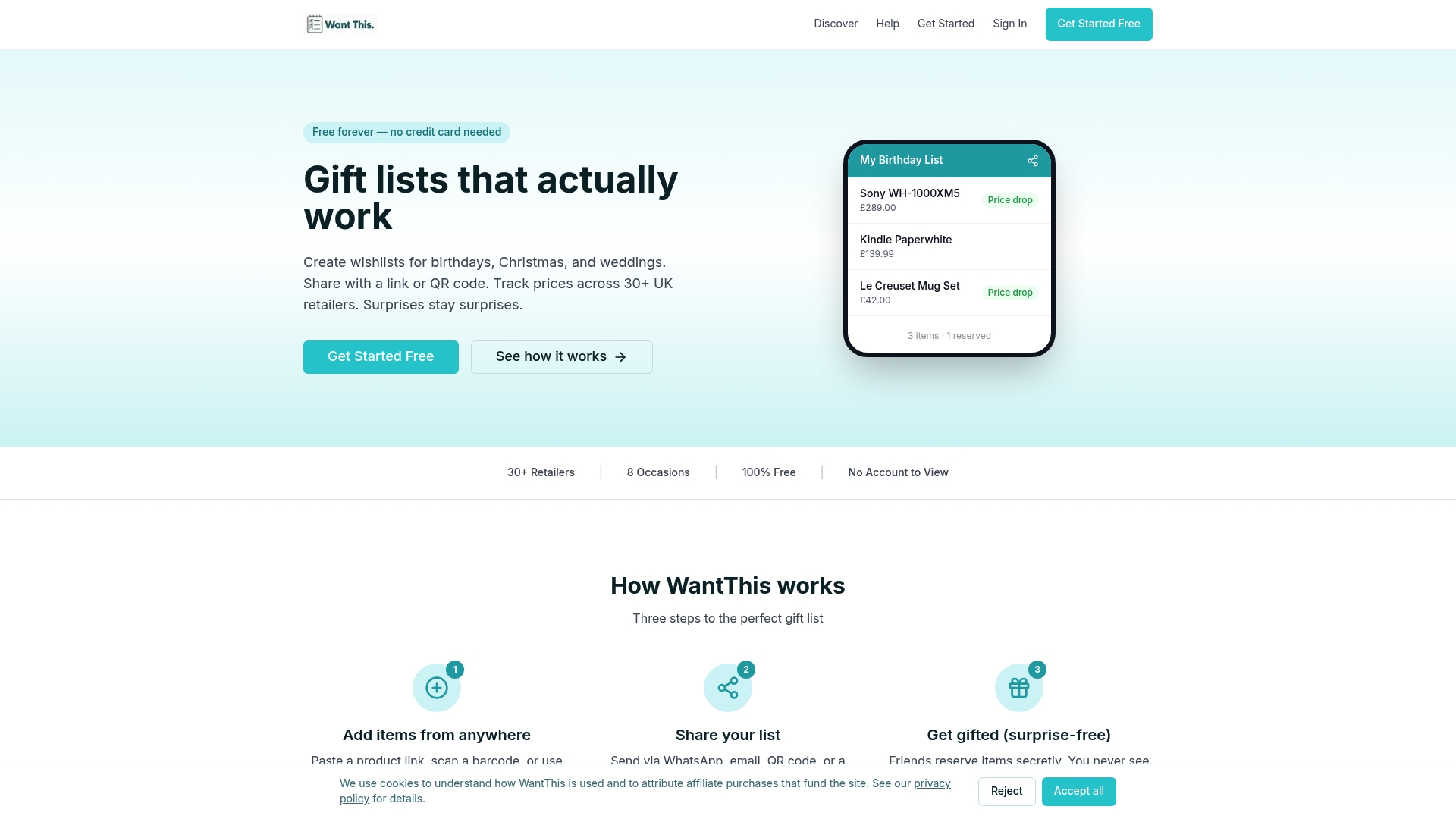
Alongside the sharing, we track price drops across more than 30 UK retailers, with alerts and price history, which helps when you are deciding whether to buy now or wait. Lists are available in your browser, through the browser extension and in the iOS and Android apps, so you can add something the moment you see it. Buyers follow the product link to the retailer to check the latest price and availability and to complete the purchase. Where affiliate links are used, we disclose them in our affiliate disclosure.
You can start a free gift list on WantThis or browse our gift ideas by category, from tech and home to books, fitness and experiences, to fill your first list. Our features page shows everything in one place.
Our perspective
Most advice on duplicate gifts treats it as a manners problem: tell people what you want, keep a note, ask around. In our experience of building a gift list platform, the real issue is information. The person buying simply cannot see what the others have done.
That is why we built WantThis around one shared list with private reservations. It brings products from different retailers together, so the list reflects what someone really wants rather than what one shop happens to stock. Friends and family can reserve or mark an item as bought, which keeps the surprise while removing the clash.
We also think lists should work for more than gifts you hope to receive. People use them to plan purchases for themselves too, from a room makeover to a wish for next month, and the same habit of saving links in one place makes both easier.
If you do one thing this year, make the list early and share it with everyone at once. It takes minutes, and it spares a lot of awkward returns.
Stuart
FAQ
What is the easiest way to avoid duplicate gifts?
Use one shared gift list with a way for buyers to reserve items. Everyone sees what is taken before they pay, so two people do not choose the same thing. Send the link to all likely buyers at the same time and ask them to reserve first, then buy.
Will a shared list spoil the surprise?
Not if reservations are private. A list tells people what the recipient would like, not exactly what they will receive or when. Research cited by The Conversation found recipients preferred gifts from their own list, so a list is more likely to please than disappoint.
How do I stop duplicates at a wedding or baby shower?
Set up the list early, include a spread of prices and share it with all guests together. Guests can reserve what they plan to give, and the rest of the list stays visible so latecomers can choose something different.
Can I return a duplicate gift?
It depends on the shop, as there is no general legal right to return a non-faulty item bought in store. Online purchases have a 14-day cancellation window after delivery, then 14 days to return. A gift receipt from the giver is the simplest route to an exchange or credit note.
Sources
- Thoughtful gifts for Christmas 2019, Stylist
- How to choose the right Christmas gift, The Conversation
- How to find out what someone wants as a gift, TinyHint
- Gift preference quiz, Imparted
- Which? on the UK’s most disappointing Christmas presents
- Returning Christmas gifts, LadBible
- What to do with unwanted gifts, BBC News