
Stop Chasing Money: 4 Simple Steps to Group Gifting for UK Organisers

The best first step is simple: pick one meaningful pooled gift or experience, then create a shared collection link so everyone can chip in without spreadsheets or awkward reminders. From there it’s four moves: agree the idea, set a target, share the link, fix a deadline. A dedicated online gift list tool works well to hold it all together.
TL;DR:
- Using a shared collection link and a single platform simplifies coordination and reduces errors for group gifts, especially beyond three to four contributors.
- Big-ticket items, experiences costing between £50 and £250, and subscriptions are most effective when pooled for occasions where the recipient values practical or time-based gifts.
- A suggested contribution range rather than a fixed amount encourages inclusivity, and tracking contributions ensures transparent, fair share distribution.
- Incorporating personal notes or videos from contributors enhances the gift’s emotional value, especially when delivered via digital cards or montages.
- Starting the process at least a week before the event, with clear communication and a fixed payment method, minimizes last-minute issues and delivery delays.
Table of Contents
- Group gifting ideas worth pooling for
- How to organise a group gift step by step
- Choosing how to collect the money
- Message templates and presentation that make it feel personal
- Occasion-based group gift ideas
- Why a wishlist beats guessing what to buy
- Keeping the group in the loop without chasing anyone
- Digital cards and group messages worth sending alongside the gift
- Coordinating delivery and the handover moment
- Handling different budgets and preferences fairly
- What to do when someone joins late or plans change
- What usually goes wrong, and three fixes that work
- Let an online gift list platform handle the coordination, not you
- Further reading
- FAQ
Group gifting ideas worth pooling for
The whole point of collective gift ideas is that they let a group afford something none of them could justify alone. That only works if you pick categories where pooling genuinely adds value, rather than just splitting a card three ways.
Big-ticket items work when the group is large enough to make a real dent in the price. Think espresso machines, quality luggage sets, a good camera, or a piece of furniture for a new home. These typically land in a price range generally considered affordable for a group, and the appeal is obvious: nobody buys themselves a decent stand mixer, but everyone’s glad to receive one.
Experiences suit occasions where the recipient already has enough stuff. Spa days, cookery classes, concert or match tickets, a weekend away, or a tasting experience all work well pooled, usually in the £50 to £250 range depending on group size. Experiences also sidestep the “will they even like it” problem, since many people appreciate time off rather than another object.
Subscriptions are the quiet winner for ongoing enjoyment: a year of a streaming service, a coffee or wine subscription, a magazine, or a meal kit. These tend to run £60 to £150 for a year and keep giving well past the occasion itself.
Personalised keepsakes suit sentimental milestones. A custom photo book, engraved jewellery, or a framed print with the group’s own touches usually sits between £40 and £120, and a personalised keepsake with a handwritten message often outperforms a purely expensive gift on sentimental value.
Choose an experience when the recipient values time over things, a big-ticket item when there’s a specific thing they’ve mentioned wanting, and a registry pick when you’d rather remove the guesswork entirely.
How to organise a group gift step by step
Running a group gift badly usually comes down to one thing: nobody owns the process. Here’s the checklist that fixes that.
- Confirm the recipient, the occasion, and a realistic total. A leaving do for six colleagues might target £60 to £100; a wedding gift from twenty guests could aim for £300 or more. Set the number before you ask anyone for money.
- Pick one collection method and stick to it. For anything beyond three or four people, a shared collection link beats a group chat full of “sent you £15!” messages. Write the invite in two lines: what you’re buying, why, and the link.
- Set a deadline with at least a week’s buffer before the actual event, to allow for order processing and delivery. Send one reminder three or four days before the deadline, not five reminders spread across the fortnight.
- Track contributions, confirm the total, then buy. If you’re short, top up quietly or trim the gift; if there’s a surplus, either round up to a nicer version or say clearly that leftover funds go towards a card and wrapping.
Pro Tip: Suggest a contribution band rather than a fixed fee, such as “whatever feels comfortable, most people are putting in £10 to £20.” Fixed asks make people who can’t match it drop out quietly; suggested ranges keep everyone included.
Choosing how to collect the money
The collection method shapes how awkward the whole process feels, and it’s worth choosing deliberately rather than defaulting to whichever app someone suggests first.
- Platform-based collections (a shared list or collection link) give you one place for everyone to see the goal, contribute privately, and leave a message. Wantthis’s sharing and price tracking features mean the organiser also sees when a saved item drops in price, useful when the total is still being gathered.
- Direct bank transfers or payment apps work fine for small, close-knit groups of three or four who already trust each other, but they get messy past that: someone forgets, someone’s transfer bounces, and the organiser ends up chasing amounts in a group chat where everyone can see who has and hasn’t paid.
- Gift cards and e-vouchers suit situations where the recipient’s preferences are genuinely unclear, or the group can’t agree on one idea. They’re flexible, but they lack the personal touch of a chosen present.
For groups of five or more, or where preferences are mixed, use a platform link. For a tight group of close friends, a direct transfer with one trusted collector is often simpler.
Message templates and presentation that make it feel personal
A pooled gift can feel impersonal if it arrives as just a box with no context. A short note from the group fixes that in seconds.
- Birthday: “Happy birthday! We all chipped in for something we hope you’ll actually use. Enjoy it!”
- Wedding: “Wishing you both a lifetime of happiness. This is from all of us, with love.”
- Baby shower: “Welcome to the world, little one. We can’t wait to meet you. With love from all of us.”
- Farewell: “You’ll be missed more than you know. We hope this reminds you of us every time you use it.”
Beyond the card, ask contributors to send a one-line note or a photo when they contribute. Compiled into a short video montage or a printed card insert, these add-ons often mean more than the present itself, since a platform that lets contributors attach a personal note turns a pooled purchase into something that feels considered rather than transactional. Decide upfront whether the gift is credited to “the whole team” or lists names individually, and consider small extras like proper wrapping or a handwritten card to lift the presentation beyond a plain delivery box.
Occasion-based group gift ideas
Different occasions call for different pooling strategies, and matching the idea to the moment matters more than the price tag.
Weddings suit big-ticket registry items or contributions towards a honeymoon fund, since guest lists are often large enough to fund something substantial. A wedding gift list gives every guest, however many are contributing, a clear sense of what’s still needed.
Birthdays work well with experiences or a single standout item, particularly for milestone ages like 30, 40 or 50, where a group of friends might pool towards something the person wouldn’t buy for themselves.
Baby showers favour practical big-ticket nursery items (prams, cots, car seats) alongside smaller personalised keepsakes, since new parents often have specific gear preferences that a registry captures better than guesswork.
Farewells and leaving dos suit smaller collections gathered quickly, often from a workplace or friend group, and work best as a single memorable item plus a card rather than a sprawling wishlist.
Work milestones, such as a retirement or a big promotion, sit somewhere between the two: colleagues often want to contribute something more substantial than a card, and a premium keepsake or piece of jewellery can mark the occasion properly when pooled across a whole team.
Why a wishlist beats guessing what to buy
Guessing is the single biggest cause of group-gift regret, and a shared wishlist removes it entirely. Instead of debating what someone might want, contributors see the actual items the recipient has already saved, complete with pricing.
This matters most for occasions where preferences genuinely diverge, such as weddings or house moves, where two guests buying the same item is a real risk without visibility. A shared list lets contributors mark an item as reserved so nobody duplicates it, and it works whether the group is pooling for one big item or splitting several smaller ones from the same list.

Practically, a registry-style list also removes the “does everyone agree on the gift” bottleneck. Rather than a group vote, the recipient effectively pre-approves every option, and the organiser’s job shrinks to picking which item fits the collected total. For managing several occasions at once, such as a friend with both a wedding and a baby on the way, separate lists per occasion keep contributions from getting muddled.
Keeping the group in the loop without chasing anyone
Most group-gift friction comes from unclear communication, not unwillingness to pay. People rarely ignore a request on purpose; they usually just don’t know what’s expected of them or by when.
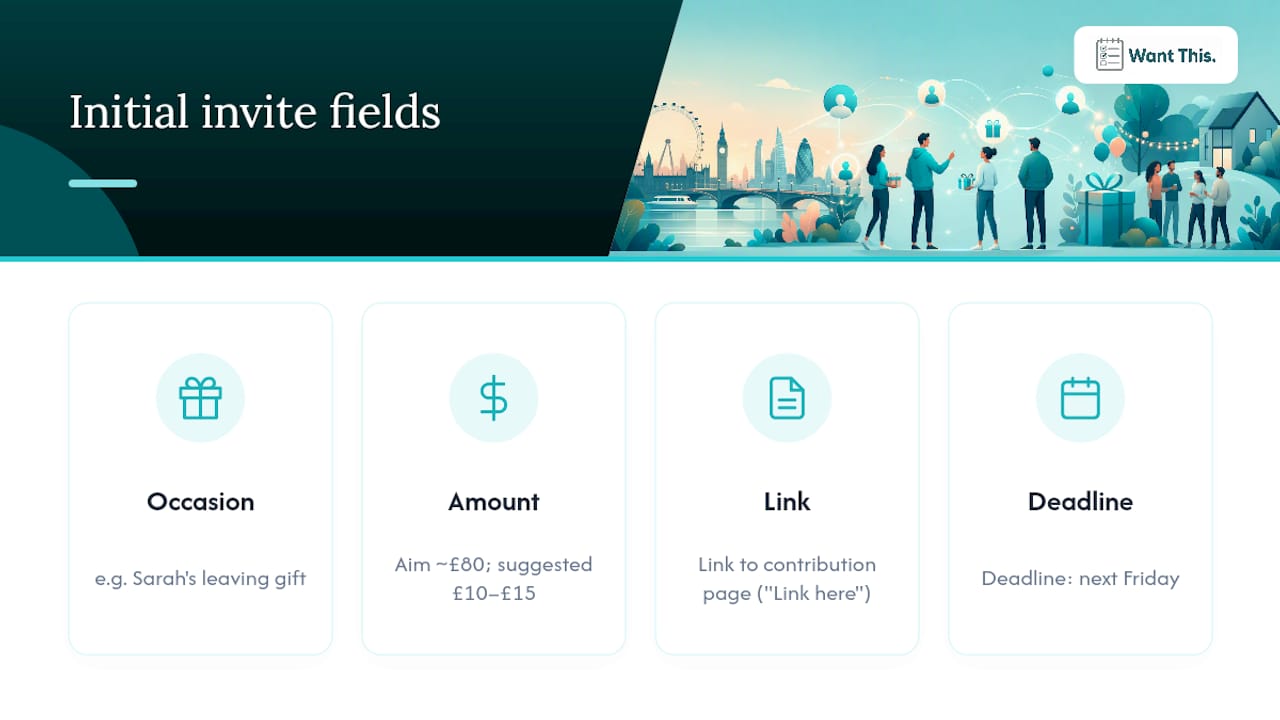
Send the initial invite as a single message with four pieces of information: the occasion, the target amount or suggested range, the link, and the deadline. Avoid vague phrasing like “let me know if you want to join in”, which puts the burden of asking back on the contributor. Instead, write something closer to: “We’re pooling for Sarah’s leaving gift, aiming for around £80 total, suggested contribution £10 to £15, deadline next Friday. Link here.”
One reminder close to the deadline is usually enough; more than that starts to feel like nagging. Keep the group updated once, near the end, with a simple “we’re at £65 of £80, thank you to everyone who’s contributed so far” message rather than repeated individual chases.
Digital cards and group messages worth sending alongside the gift
A pooled gift often lands better with a shared digital card than a physical one, particularly when contributors are spread across different locations or a remote team.
Group e-cards let everyone add a signature or short message without needing to be in the same room, which matters for distributed workplaces or friend groups scattered across the country. Keep individual messages short, one or two lines is plenty, so the card doesn’t become an unwieldy scroll for the recipient to read through.
For a more personal touch than a card alone, consider a short group video montage, where each contributor records a ten-second clip. These take more coordination but tend to be remembered far longer than the physical gift itself. If time is short, a single shared document or slide with everyone’s photo and a line each achieves a similar effect with far less editing.
Coordinating delivery and the handover moment
Delivery logistics get overlooked until the gift arrives at the wrong address, or three days after the party. Decide early who receives the parcel: the organiser, a trusted contributor near the recipient, or, for a surprise, someone who won’t spoil it by mentioning a delivery.
For anything shipped, order with enough lead time to allow for delays, ideally arriving at least two or three days before the occasion. If the gift is an experience booking, confirm the date works for the recipient’s calendar before finalising, particularly for things like restaurant bookings or activity slots that need advance notice.
For the handover itself, decide whether the whole group presents the gift together or one person hands it over on everyone’s behalf with a card listing all the names. Workplace gifts often work best delivered privately rather than in front of the whole office, especially for anything sentimental.
Handling different budgets and preferences fairly
Not everyone in a group can or wants to contribute the same amount, and pretending otherwise is where a lot of group gifts sour. A suggested contribution band, rather than a fixed ask, solves most of this quietly: state a rough range and let people choose within it without needing to explain why.
For groups with genuinely mixed budgets, such as a mix of students and working professionals, consider two suggested tiers rather than one figure, so nobody feels singled out for giving less. Never publish who gave what in a group chat or spreadsheet visible to all; that single habit causes more resentment than any actual shortfall in funds.
If preferences differ on what to buy rather than how much to spend, a shared wishlist sidesteps the argument entirely by letting the group choose from options the recipient has already indicated they’d like, rather than debating tastes among themselves.
What to do when someone joins late or plans change
Late joiners are common, and the fix is simple: keep the collection link open until the actual purchase deadline, not the original invite deadline. Anyone contributing after the total is reached can either top up a nicer version of the same gift or go towards a card, extra flowers, or a second smaller present.
If a contributor needs to drop out after committing, don’t chase them publicly. Quietly adjust the target or ask one or two others if they’re happy to cover the small gap; most people are.
For late changes to the plan itself, such as the recipient’s preferences shifting or the event date moving, communicate the update once to the whole group rather than letting it spread through side conversations, where details get garbled and people end up contributing towards the wrong thing.
What usually goes wrong, and three fixes that work
The most common failure isn’t a bad idea, it’s an organiser who picks three different payment methods and ends up chasing half the group individually. One collection link, agreed upfront, removes that entirely.
Three things consistently make group gifts go smoothly: use a single payment method rather than mixing bank transfers with cash with an app, suggest a contribution range instead of demanding a fixed amount, and set your internal deadline a week earlier than you think you need. That buffer absorbs the inevitable late payer without threatening delivery. Wantthis’s own guide to organised gifting reflects the same pattern across weddings, workplace collections and Secret Santa exchanges: the process matters more than the platform, but a good platform removes most of the friction from the process.
— Stuart
Let an online gift list platform handle the coordination, not you
Such a platform exists precisely for the moment this article has been building towards: turning a good group-gift idea into a finished purchase without group chat chaos. Create a shared list for the occasion, add the item or experience by pasting a link from any retailer, and share it privately so contributors can reserve their share and leave a note without duplicate purchases or spoiled surprises.
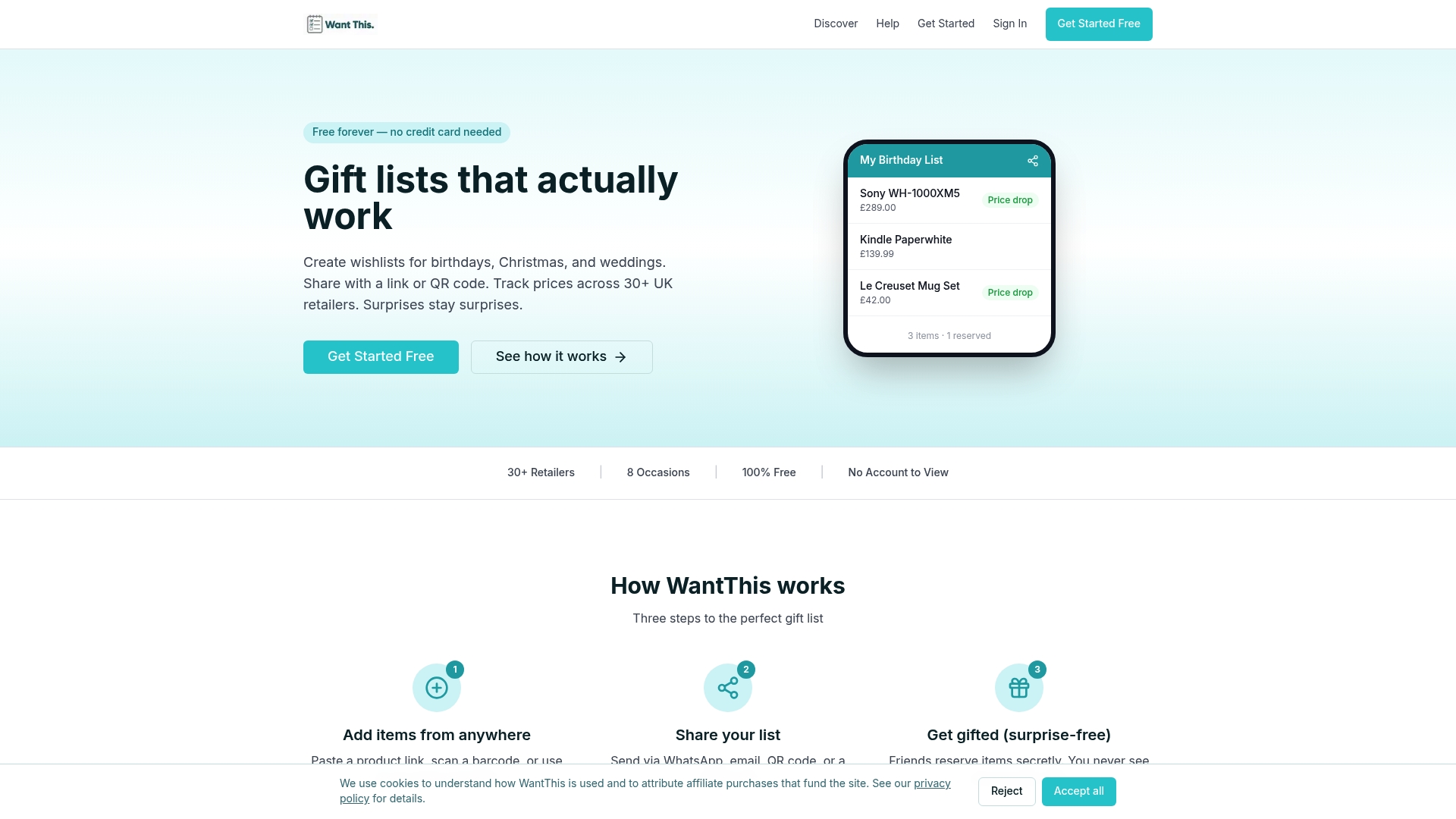
Price tracking on saved items means you’ll spot a drop before you buy, useful when a big-ticket pick shifts in cost while the collection is still open. For workplace exchanges, the Secret Santa organiser handles automatic draws so nobody has to manage names on paper. Start by creating a shared gift list for your next occasion and send the link to your group today.
Further reading
For the step-by-step on setting up shared collections, see the gift list collaboration guide. Browse gift ideas by category for more inspiration by occasion and budget.
FAQ
What are some good group gift ideas?
Pooled experiences (spa days, concert tickets), big-ticket items (kitchen appliances, luggage), subscriptions, and personalised keepsakes all work well because they let a group afford something more meaningful than individual gifts allow.
What is the 7-gift rule?
Definitions of this vary between families and aren’t a fixed standard, so it’s worth agreeing your own version with the group rather than assuming a universal rule everyone already follows.
What are some good group gifts for friends?
Experiences like a weekend away, a shared subscription, or a personalised keepsake tend to work best for friend groups, since they suit varied budgets when contributions are suggested rather than fixed.
What is a good gift for a group of coworkers?
A pooled experience voucher, a quality personalised item, or a contribution towards something the colleague has mentioned wanting all work well, and using a shared collection link like the one Wantthis offers keeps contributions private and avoids public pressure over amounts.