
UK Gift Trends 2026: 5 Shifts From More Stuff to Better Gifts

UK gift giving in 2026 is shaped by selective spending, meaningful and sustainable choices, and a shopping calendar that now peaks weeks earlier than it used to. Shoppers are buying fewer, better gifts rather than a larger pile of smaller ones, with experiences, local makers and screen-free toys all gaining ground. The practical takeaway is simple: plan earlier, choose with more intention, and use a shared wishlist to keep track of who wants what.
TL;DR:
- More than 70% of Black Friday shoppers used the event for Christmas gifts in 2026, making late November a key planned buying window.
- Order artisan and made to order gifts before the Black Friday rush, because limited runs may sell out and workshops may not restock.
- Match experience gifts to the relationship: a cookery class or afternoon tea suits a colleague, while a weekend break or spa day suits close family.
- Share a wishlist early and use private reservations, so family can claim gifts without revealing purchases to the recipient or duplicating someone else’s choice.
- Each person can give £3,000 yearly under the Inheritance Tax exemption, and carrying forward an unused previous year’s allowance permits up to £6,000.
Table of Contents
- The five standout trends shaping UK gifting in 2026
- Category spotlights: toys, experiences, tech, home and beauty
- When to buy in 2026: shopping windows and occasion timing
- Data snapshot: the figures behind the trends
- How to turn trends into actions
- Author perspective: applying the trends to everyday UK gifting
- Plan and coordinate your 2026 gifts with WantThis
- FAQ
- Sources
The five standout trends shaping UK gifting in 2026
Gift buying this year looks less like a dash around the shops and more like a considered shortlist. Several shifts are showing up across retail reporting and everyday shopping habits, and they tend to reinforce each other rather than compete.
Thoughtful, design-led gifting is one possible approach. Instead of several small stocking fillers, shoppers might opt for one well-chosen item: a premium throw, a curated hamper, or a single statement piece that looks and feels considered. The logic is straightforward. A gift that arrives in generic packaging and gets used twice carries less weight than one object that fits the recipient’s taste precisely.
Sustainability and circular gifting sit close behind. Repairable goods, traceable materials, second-hand finds and small-batch items are increasingly framed as gifts in their own right rather than compromises. A refurbished camera or a vintage watch can read as a deliberate choice rather than a budget one.
Experience-first gifting is particularly strong for milestone occasions. Cookery classes, concert tickets, spa afternoons and short breaks are replacing physical objects for anniversaries, significant birthdays and retirements, on the basis that a shared afternoon is harder to forget than another gadget.
Local and maker-led gifts are carving out real space on gift lists. Artisan ceramics, regionally woven textiles and small workshop goods appeal to buyers who want a story behind the item, not just a price tag. Small-batch wooden ornaments and decorations made from sustainably sourced hardwoods are a good example: each piece carries natural grain and texture that mass-produced versions cannot replicate, and buying one supports a maker rather than a factory line.
Screen-free and analogue toys round out the list, and this one has strong retailer backing. Press coverage from October 2026 points to retailers reporting renewed demand for hands-on toys, with major toy sellers listing predominantly screen-free items among their top predicted sellers for the season. Construction sets, wooden puzzles and traditional games are benefiting as parents look for alternatives to device-based entertainment.
What ties these together is a shift from quantity to intention. A handful of patterns summarise where that intention is going:
- Fewer gifts per person, but a higher budget share for the one that counts.
- A visible preference for items with a traceable origin, whether that is a maker’s name or a recycled material.
- Experiences treated as equal to, or better than, physical presents for adult milestones.
- Toys chosen for hands-on play rather than screen time, particularly for younger children.
- A willingness to pay more for something that will last, rather than less for something disposable.
Over 70% of Black Friday shoppers in 2026 used the event to buy Christmas gifts, according to Mintel’s analysis of UK seasonal retail behaviour, confirming that the shopping window itself has moved earlier and compressed into a shorter, busier peak. That timing shift matters for every trend above: a considered, maker-led gift takes longer to source than a last-minute online order, so the earlier peak rewards planning.
Category spotlights: toys, experiences, tech, home and beauty
Knowing the trends is one thing. Knowing what to actually put in a basket is another, so here is how each major gifting category is playing out this year.
Toys: hands-on play is back in favour
The toy aisle has tilted firmly towards creative and construction play. Building sets, wooden puzzles and traditional board games are the categories retailers keep highlighting, and the reasoning from press reporting in October 2026 is consistent: parents are actively seeking screen-free alternatives, and chains including specialist toy retailers report stronger sales of Lego, craft kits and playsets as a result.
For buyers, this makes the choice easier rather than harder. A good toy gift in 2026 tends to fall into one of three buckets: open-ended construction toys that scale with age, traditional games that work across a family gathering, or craft sets that produce something the child keeps. All three can offer lasting hands-on play, unlike a tablet game that may be deleted.
Experiences: matching the gift to the relationship
Experience gifts work best when the price band and the relationship line up. A short cookery class or an afternoon tea suits a colleague or a casual friend. A weekend break, a concert ticket pair, or a spa day suits a partner, a parent, or a close sibling marking a significant birthday. The appeal is that an experience cannot be duplicated accidentally, cannot clash with someone’s taste in the way a jumper can, and tends to be remembered longer than most physical objects, which is exactly why it fits the “meaningful” trend so neatly.

Tech: considered choices beat impulse buys
Tech gifting hasn’t disappeared, but the instinct has shifted from “latest gadget” to “genuinely useful object.” A well-designed charging stand, a quality pair of headphones, or a smart home accessory that solves an actual daily annoyance reads as more considered than a generic novelty device. The buyers getting this right tend to ask one question before purchasing: will this still be in use in twelve months? If the honest answer is no, it’s worth reconsidering.
Home and cosy: built to last, not just to wrap
Home gifts have leaned hard into longevity. Artisan throws, well-made mugs, and premium kitchen accessories are outperforming disposable decor, because a gift that wears in rather than wears out matches the broader shift towards fewer, better purchases. Our own roundup of home and kitchen gift picks covers this in more detail for anyone shopping for a housewarming or a Christmas list heavy on practical items.
Beauty and fragrance: sampling and niche houses
Beauty gifting in 2026 favours discovery over commitment. Sample sets let a recipient try several scents or skincare products without the pressure of a full-size bottle going unused, which suits both the budget-conscious and the sustainability-conscious buyer. Niche perfume houses offer another option for discovery-led gifts. Fragrance trend commentary from a London-based niche perfumer points to growing interest in discovery sets and small-batch, cruelty-free formulations, which fits the same pattern seen in toys and home goods: smaller runs, clearer provenance, less packaging waste.
A few quick anchors for category shopping this year:
- Toys: prioritise construction, craft and traditional play over screen-based devices.
- Experiences: match the price band to the closeness of the relationship, not the calendar date.
- Tech: choose one practical, well-made object over several impulse gadgets.
- Home: favour artisan or premium pieces designed to be used daily, not displayed once.
- Beauty: sample sets and niche fragrance houses suit gift-giving better than full-size, unfamiliar scents.
Pro Tip: When choosing between two similar gifts, pick the one with the better story, a maker’s name, a material, a reason it was made that way. Recipients remember stories longer than they remember products.
When to buy in 2026: shopping windows and occasion timing
The single biggest practical shift this year is timing. Mintel’s seasonal retail analysis found that the Christmas shopping window has compressed and now overlaps heavily with Black Friday, with the vast majority of Black Friday shoppers using the event specifically to buy Christmas presents. That suggests late November can function as a primary peak for festive buying, rather than a separate sales event ahead of it.
This has knock-on effects for anyone planning a maker-led or personalised gift, since small workshops and artisan sellers may have longer lead times than large retailers and limited runs can sell out before the big shopping weekend arrives.
A practical order of operations for 2026 gifting:
- Book experiences first. Popular dates for classes, dinners and short breaks can fill up early, especially around Christmas and Valentine’s Day.
- Order artisan and small-batch items early. Workshops producing limited runs of ceramics, textiles or wooden goods may not be able to restock before Christmas.
- Use the Black Friday window for planned, not impulsive, purchases. Treat it as the moment to buy items already on a list, since that’s how most shoppers are using it anyway.
- Leave standard retail items, electronics and mainstream toys until closer to the date, since stock and delivery windows for these are generally more reliable.
- For Secret Santa and office exchanges, confirm the draw and budget well before the exchange date, to leave enough time for delivery or in-person shopping.
Baby showers and weddings follow a different rhythm entirely, since they’re tied to a fixed date set months in advance rather than a seasonal peak. The main risk there isn’t running out of time, it’s duplicate gifts, which is where early coordination through a shared list matters more than shopping speed.
Returns and exchanges deserve a mention too. Return policies for personalised items and small-batch goods can differ from those for mass-market retail, so check the seller’s terms before buying. Buying earlier gives enough buffer to sort out a sizing or engraving issue before the occasion itself.
Data snapshot: the figures behind the trends
The shift towards fewer, better gifts and earlier shopping isn’t just a feeling, it shows up clearly in UK survey and retail data.
YouGov’s research into UK gift-giving habits found clear gender differences in who buys for whom and what they buy. Women are substantially more likely than men to buy gifts for friends, with 64% of women buying for friends compared with 37% of men. Category preferences differ too: men over-index on electronics, while women are more active buyers across categories including health and beauty.
On the tax side, Gov is worth knowing for anyone planning higher-value gifts, not just small presents. Each tax year, an individual can give away £3,000 free of Inheritance Tax under the annual exemption, and any unused allowance can be carried forward for one tax year, meaning up to £6,000 can be given tax-free in a single year if the previous year’s allowance went unused. Spouses and civil partners each have their own separate allowance, so a couple can combine exemptions for larger family gifts.
| Data point | Figure | Source |
|---|---|---|
| Black Friday shoppers who used the event for Christmas gifts in 2026 | Over 70% | Mintel |
| Women who buy gifts for friends | 64% | YouGov |
| Men who buy gifts for friends | 37% | YouGov |
| Annual IHT gift exemption, per individual | £3,000 | Gov |
| Maximum tax-free gift in one year with carry-forward | £6,000 | Gov |
Over 70% of Black Friday shoppers used the event to buy Christmas presents in 2026, according to Mintel’s retail analysis, which is the clearest evidence yet that the UK’s festive shopping peak has shifted earlier into late November.
For anyone planning several gifts across a year, the IHT allowance is a useful planning tool rather than a limit on ordinary present-giving. Everyday birthday and Christmas gifts don’t typically touch this allowance at all, but larger one-off gifts, such as contributing towards a house deposit or a wedding gift of significant value, are where the £3,000 exemption becomes genuinely relevant.
How to turn trends into actions
Knowing the trends only helps if it changes how you actually shop. Here’s how to put it into practice.
Prioritise the right discovery channels. Social platforms are good for spotting what’s trending, maker marketplaces and craft fairs are better for sourcing genuinely local or small-batch items, and curated gift lists work best when you want inspiration without scrolling through hundreds of unrelated products. Our own guide to discovering gift ideas online covers this in more depth.
Budget by occasion, not evenly. Given the shift towards fewer, better gifts, it makes sense to allocate a larger share of the annual gifting budget to milestone occasions, a significant birthday, an engagement, a retirement, and simplify everyday gifting with smaller, thoughtful tokens rather than stretching the same budget thin across every date on the calendar.
Avoid duplicate gifts by coordinating early. This is where most gifting friction actually happens: two people buying the same item, or a surprise being spoiled by an unintentional comment. Sharing a list in advance, with private reservation so the recipient can’t see what’s already been claimed, solves both problems at once. Where a specific product link isn’t available, such as for an experience or a made-to-order item, sharing a description or a preference works just as well.
Decide early whether to wait for Black Friday or buy sooner. For mainstream retail items, compare prices and decide whether waiting for a promotion suits your needs. For artisan, personalised or small-batch pieces, buying in October avoids the risk of a maker selling out before the big sales weekend even arrives. Our Black Friday gift deals guidance breaks this down further by category.
Small touches can add thoughtfulness without adding much cost. A handwritten note, considered packaging, or pairing a modest gift with an experience add-on, such as a coffee voucher or cinema ticket, can make it feel more personal than an expensive item wrapped without care.
- Use social media and maker marketplaces for discovery, curated lists for inspiration.
- Weight the budget towards milestone occasions and keep everyday gifts simple.
- Share lists early with private reservation to prevent duplicates and protect surprises.
- Buy artisan and small-batch items before the Black Friday rush; wait on mainstream retail items if the budget allows.
Pro Tip: Pairing a smaller gift with one thoughtful extra, such as a nice card or a small experience voucher, can make the gift feel especially considered.
Author perspective: applying the trends to everyday UK gifting
The trend worth taking seriously this year isn’t sustainability or experiences on their own, it’s the underlying shift away from quantity. Buying three adequate gifts because that’s what’s always been done costs more money and thought than buying one genuinely well-chosen item, and recipients tend to notice the difference immediately.
What I’d encourage anyone to do differently in 2026 is treat the compressed shopping calendar as a planning problem, not a shopping problem. Mintel’s data shows that many Black Friday shoppers use the event to buy Christmas gifts. Gifts that need more lead time, such as personalised items or those from a small maker, may be worth sorting first. Everything else can wait.
The other shift worth making is coordination. Most duplicate or mismatched gifts happen because nobody asked, or because preferences were only shared verbally and forgotten. A shared list fixes that quietly, without taking any of the thought out of the choosing.
— Stuart
Plan and coordinate your 2026 gifts with WantThis
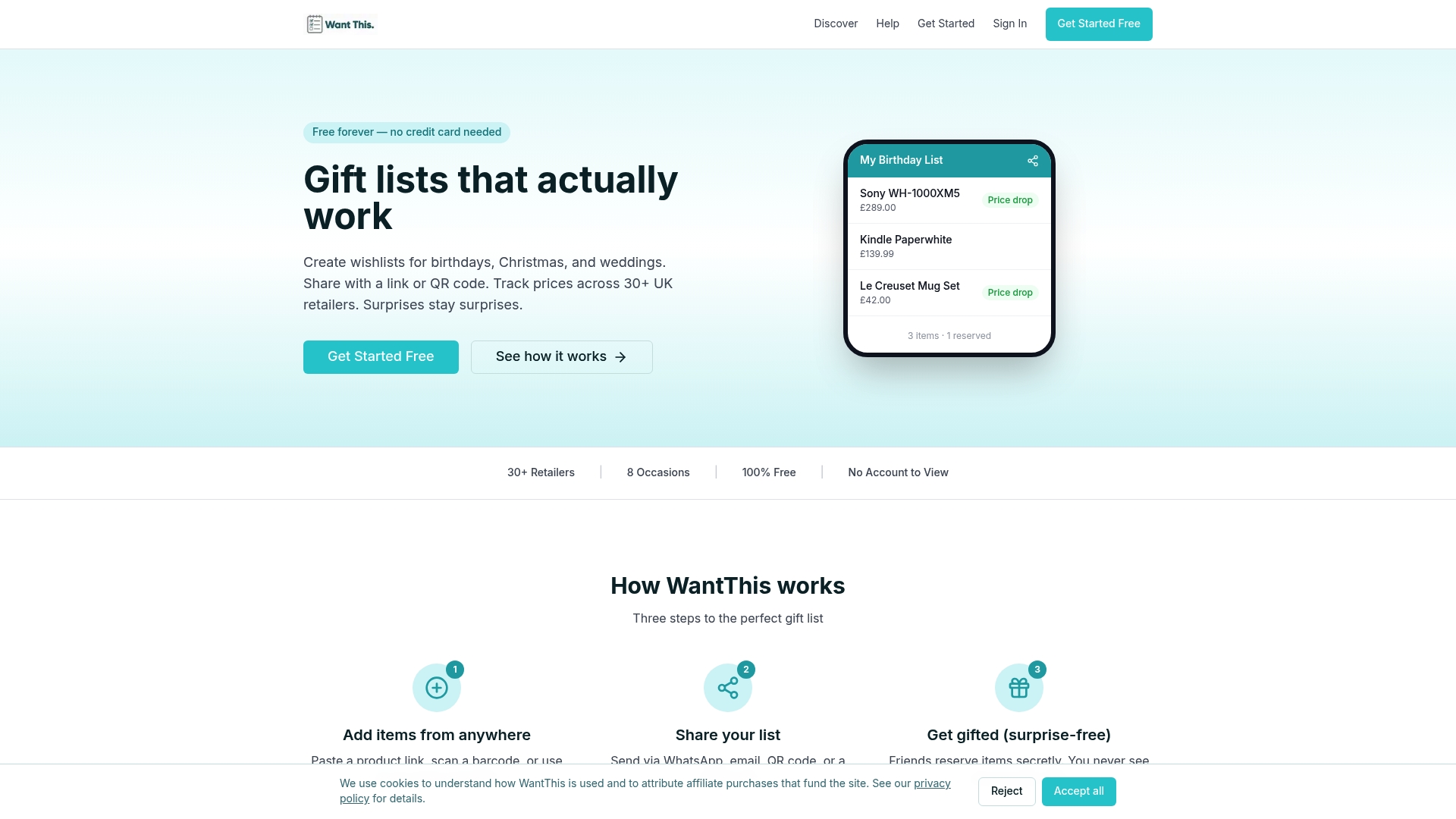
Fewer, better gifts and an earlier shopping calendar both reward a bit of coordination, and that’s exactly what we built WantThis to handle. We let you create a wishlist from any online retailer, just paste a product link and we pull in the title, image and current price automatically, then organise everything by occasion so Christmas, birthdays and weddings don’t get muddled together.
Because fewer higher-value gifts mean duplicate purchases sting more, we built private reservation into every shared list: friends and family can mark something as bought without the recipient seeing, so surprises stay intact. We also track price drops across UK retailers, which is handy when deciding whether to wait for a promotion or buy an item before it sells out, and our Secret Santa organiser runs the whole draw automatically, useful for office exchanges squeezed into a tighter December.
- Create and share wishlists across any retailer, organised by occasion.
- Reserve gifts privately so nobody buys the same thing twice.
- Track price drops across UK retailers to time purchases well.
- Run a Secret Santa exchange with an automatic draw.
- Add items on the go with our browser extension or iOS and Android apps.
Browse gift ideas by category or start a free wishlist.
FAQ
What are the hottest gifts for 2026?
Screen-free toys, experience-based presents and local or maker-led items are the standout categories this year. Retailer reporting from October 2026 points to construction sets and traditional play topping toy predictions, while sustainable and artisan goods are gaining ground across home and beauty categories.
What is the biggest gift trend of 2026?
The clearest trend is a move towards fewer, more considered gifts rather than a larger quantity of smaller ones. This shows up across categories, from screen-free toys replacing multiple small gadgets to single artisan pieces replacing several generic stocking fillers.
What is the gifting allowance for 2026 in the UK?
Each individual can give away £3,000 per tax year free of Inheritance Tax under the annual exemption, and any unused allowance can be carried forward for one tax year, allowing up to £6,000 in a single year. This mainly matters for larger one-off gifts rather than everyday birthday or Christmas presents.
What is the hottest gift right now?
Hands-on, screen-free toys are leading demand heading into the 2026 festive season, with major retailers reporting stronger sales of construction sets, craft kits and traditional games. Alongside toys, experience gifts and small-batch artisan items are also seeing strong interest for adult gifting.
How can I avoid buying duplicate gifts this year?
Sharing a wishlist with private reservation lets friends and family mark an item as bought without the recipient seeing, which prevents duplicates and keeps surprises intact. Coordinating early, rather than shopping independently close to the occasion, is the most reliable way to avoid overlap.