
UK Gift Deal Stacking: 14-Day Refund Rights and the Checkout Order

The fastest safe stack runs in one order: buy a cashback-eligible e-gift card through a tracked portal, pay with it at checkout, add a retailer voucher code, then confirm the cashback has registered. Check the retailer accepts gift cards alongside codes, and know your refund rights under the Consumer Rights Act 2015. Below we cover methods, a worked example, UK tools and a checklist.
TL;DR:
- Buy the electronic gift card through a cashback portal first, then apply a retailer code at checkout and use the card only if terms allow.
- Keep the cashback session in a fresh tab, disable ad blockers, avoid basket reloads, and confirm tracking; some retailers exclude gift card payments.
- Test the code and gift card together in the basket, because retailers may exclude gift card payments, sale items, or certain categories from promotions.
- The Consumer Rights Act gives online buyers 14 calendar days to cancel, but gift card payments may be refunded as gift card value, not cash.
- Avoid buying large gift card balances far ahead: retailers are not required to protect prepayments, and vouchers may not be honored during insolvency.
Table of Contents
- What is deal stacking and which rules apply in the UK?
- Which stacking methods can you use today?
- How can a gift stack up in practice?
- What do retailer rules, gift-card terms and refunds mean for your stack?
- Which UK tools and sites help you find and track stacking opportunities?
- What should you check before you pay?
- Could UK rules on deal stacking change?
- How do you stack deals on multi-item or group gifts?
- What simple habits save money over time?
- How can WantThis help you capture stacked deals without duplicate gifts?
- FAQ
- Sources
What is deal stacking and which rules apply in the UK?
Deal stacking means combining several separate savings on one purchase: voucher codes, gift cards, cashback and loyalty reductions. Each layer is small. Together they can take a surprising amount off a gift.
The order matters because some savings are bought before you shop and others are applied at the till. Gift cards and cashback sessions come first. Codes and loyalty discounts come at checkout.
Your legal footing is simpler than most people assume. Under the Consumer Rights Act 2015, online shoppers get a 14-calendar-day cooling-off period, and a refund should normally go back in the form of the original payment. That detail matters for stacks, because a refund on a gift-card-funded purchase may not return as cash.
Before you start, check these retailer terms:
- Gift-card expiry date and whether part-used balances survive
- Minimum spend for a voucher code to work
- Excluded categories, such as sale items or electronics
- Whether a code can be used with another code or with gift-card payment
Which stacking methods can you use today?
Most UK stacks come down to a handful of repeatable moves. Work through them in this order and skip any step the retailer does not allow.
- Buy the e-gift card first. Look for discounted cards or cards that earn cashback when bought through a portal. Quidco, for example, says you can earn cashback on digital gift cards before you spend them.
- Open your cashback session properly. Click through from the portal in a fresh browser tab, with ad blockers off, and do not leave to compare prices mid-checkout.
- Pay with the gift card, then add a code. Many retailers let you apply a gift card as partial payment and still enter a promo code. Test this in the basket before committing.
- Layer a loyalty or club voucher where the terms allow it. Some retailers block loyalty money-off alongside a code, so read the small print.
- Watch the deal communities. The HotUKDeals gifts tag is where boosted gift-card promotions and retailer-specific stacking tips tend to surface first. Wowcher is another place to look for time-limited gift offers.
Experience vouchers and digital-only vouchers need extra care. They often carry fixed dates, non-refundable terms and no part-payment option, so stacking on top of them is usually limited to cashback.
Pro Tip: Do the price check before you open the cashback session, not after. Our guide to comparing prices online shows how to confirm a deal is genuinely good first.
How can a gift stack up in practice?
Say you want a £120 gift. These figures are illustrative, not market data.
- Buy the e-gift card through the portal. Confirm the cashback session shows as tracked before you pay.
- Go to the retailer and add the gift to your basket. Enter the retailer code first. That reduces the basket total.
- Apply the e-gift card as payment. After the card’s £20 value, you pay £88 by card.
- Complete the purchase and keep screenshots of the basket, the code and the cashback confirmation.
The total value gained depends on the offers and assumes each works as described.
Watch for these pitfalls:
- Some retailers exclude gift-card payment from code eligibility
- Certain categories pay no cashback, or only on the card-paid portion
- A second tab or a basket reload can break cashback tracking
What do retailer rules, gift-card terms and refunds mean for your stack?
A stack can lose value in the small print, so check these points before you rely on one.
The Consumer Rights Act 2015 gives online buyers the cooling-off right, but refunds follow the original payment method. If part of your payment was a gift card, expect the refund to follow the same path, not land as cash on your bank card.
Vouchers carry another risk. The Law Commission’s report, Consumer Prepayments on Retailer Insolvency, found that gift vouchers often appear in major retail insolvencies and that retailers are not obliged to ring-fence prepayments.
Gift vouchers may or may not be honoured when a retailer enters administration, depending on the administrators’ decisions.
In practice, that means you should avoid buying large gift cards far ahead of use. Practical checks:
- Note the expiry date and whether part-used balances remain valid
- Confirm whether the voucher can be exchanged for cash (usually it cannot)
- Ask what happens to balances if the retailer changes ownership
- Keep receipts and screenshots, because they support a chargeback claim if something goes wrong
Which UK tools and sites help you find and track stacking opportunities?
A few reliable UK sites cover most of the work, and a good routine uses several together.
- Cashback portals. Quidco pays cashback on purchases at thousands of retailers, and confirmed cashback can be withdrawn to a bank account or PayPal, or swapped for gift cards.
- Deal communities. HotUKDeals members post time-limited discounts and gift-card promotions, and the comments often reveal whether a code stacks.
- Curated offers. The Wowcher UK gift deals page collects hampers, personalised gifts and experiences, with redemption terms shown on each deal.
- Retailer gift cards. John Lewis presents e-gift cards as a dependable last-minute option, while Le Creuset e-gift cards are valid for 36 months and cannot be exchanged for cash.
- Our price tracking. We let you save items and watch price drops through our price tracking feature, so you know when a stack is worth starting.
What should you check before you pay?
Run through this short list at checkout. It takes only a moment and helps protect the value you have built.
- Confirm the retailer accepts gift cards alongside promo codes
- Check whether the voucher stacks with any sale price or loyalty discount
- Open the cashback portal and confirm the session is tracked
- Note the expiry date and the returns policy
- Screenshot every confirmation page
Pro Tip: Time the purchase around a cashback boost or a retailer flash sale. A brief rate rise on a portal can be worth more than a second code.
Keep records for at least the refund window. If a return or dispute follows, those screenshots are your proof. For big-sale windows, our Black Friday gift deals guide shows how to plan around the dates.
Could UK rules on deal stacking change?
There is no UK law that specifically governs deal stacking, so retailers set their own terms and change them often. That is the main thing to understand: the rules you rely on today are mostly contractual, not statutory.
Two areas are worth watching. The first is voucher protection. The Law Commission’s findings on retailer insolvency show the gap in how prepayments are treated, and any future reform would affect how safe it is to buy gift cards well ahead of use. Nothing we have seen confirms a change is imminent, so treat this as a risk to manage rather than a coming fix.
The second is how retailers treat codes, cashback and gift-card payment together. Terms can tighten without notice, for example by excluding gift-card payments from promotions or by narrowing which categories earn cashback. Refund rules under the Consumer Rights Act 2015 stay the baseline, but they do not guarantee a promotion will keep stacking.
What you can do is simple. Re-read the terms each time you plan a stack, since a combination that worked last Christmas may not work now. Avoid parking large sums on a single retailer’s card. Keep proof of every step, and prefer smaller, nearer-term gift-card purchases. If you want a sense of how the big seasonal sales shape retailer behaviour, our Black Friday guide is a useful companion.
How do you stack deals on multi-item or group gifts?
Group gifts and multi-item baskets give you more room to stack, because the spend is larger and the thresholds are easier to reach. The trick is to plan the basket before you touch a discount.
Start by pooling the whole list. A single basket often clears a minimum-spend threshold that separate small orders would miss, which can unlock a code that otherwise would not apply. Then check whether the code excludes any item, because one excluded product can drop the basket below the threshold.
For group gifting, decide who buys. One person making one purchase keeps the cashback tracking clean and the refund route simple. Others can reimburse them, and any gift cards held by the group can be applied as part payment at checkout.
A shared list also stops duplicates, which is the most common way group gifting wastes money. Our sharing feature lets friends and family see what is wanted and reserve it privately, so nobody buys the same item twice.
Finally, consider splitting the basket by retailer when one site is stronger on cashback and another on codes. Just remember that each separate order needs its own tracked session, and each has its own return window under the Consumer Rights Act 2015.

What simple habits save money over time?
The best savings I have seen come from boring routines, not clever one-off stacks. The shoppers who do well keep a list, watch prices for a while, and buy when a few small offers happen to line up. The ones who get burned usually rush on the last weekend before an occasion, grab a gift card they never check, and lose the cashback because the session did not track.
A wishlist with price tracking removes most of that panic. When you already know what is wanted and what it normally costs, a stack is a bonus rather than a scramble. That is why we built price drop alerts and shared lists into WantThis.
— Stuart
How can WantThis help you capture stacked deals without duplicate gifts?
We make the stacking workflow easier to manage. Save any item from any retailer to a list, and our price tracking covers retailers across the UK, so you see drops before you commit. Share the list and a buyer can privately reserve an item, which keeps surprises intact and avoids duplicates. We also run a Secret Santa organiser with an automatic draw for group occasions.
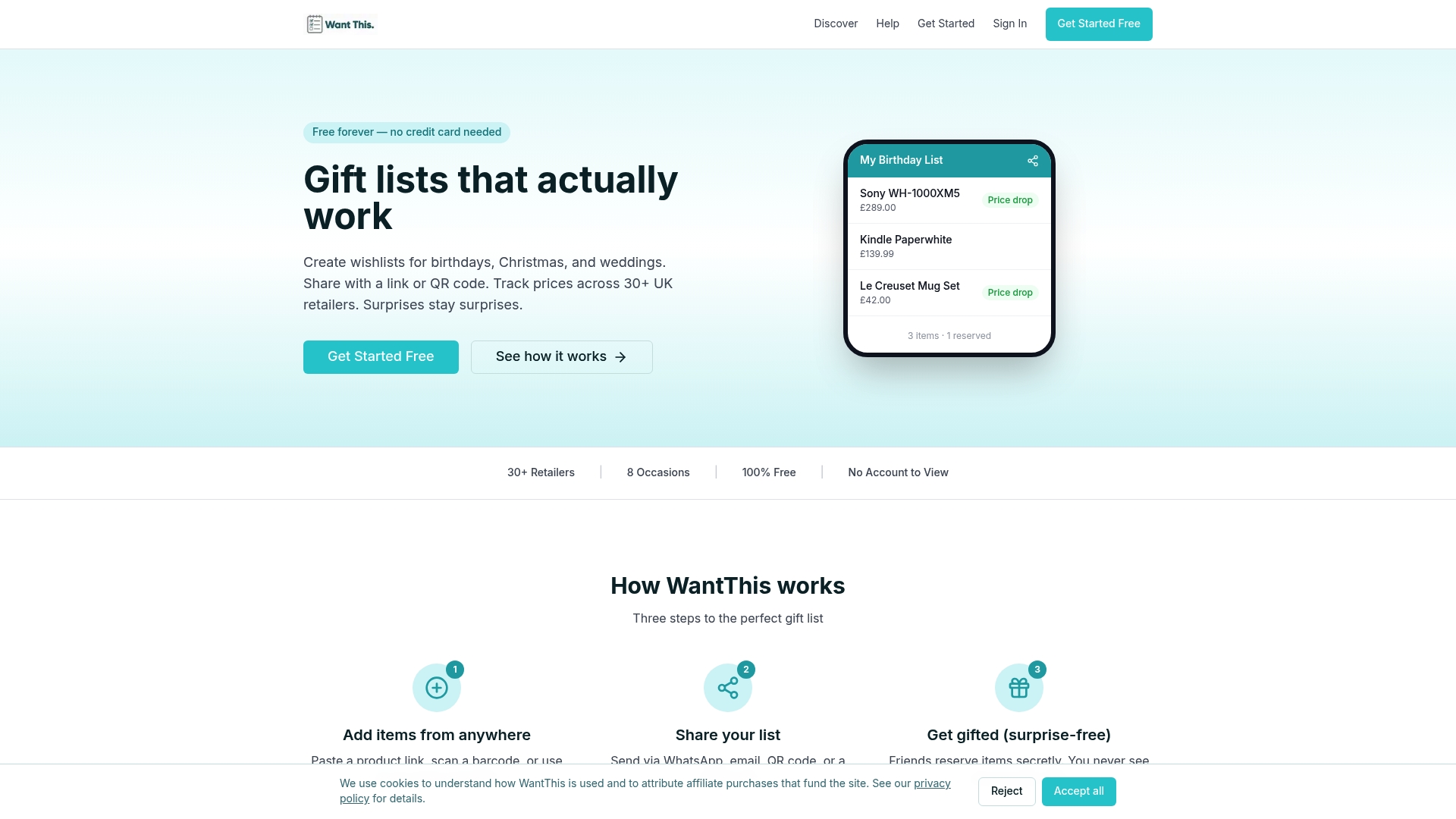
Start with a free list on our gifts page, save the items you are watching, and let the price alerts tell you when to stack.
FAQ
What are some good last-minute gifts in the UK?
E-gift cards are the quickest option because they arrive instantly by email. John Lewis highlights e-gift cards as a reliable last-minute choice. Our last-minute gifts guide has more ideas.
What is the best discount site in the UK?
It depends on what you need. Quidco suits cashback, HotUKDeals suits community-found codes and promotions, and Wowcher suits time-limited gift and experience deals. Many shoppers use two or three together.
Can I stack a gift card with a promo code?
Often yes, but it depends on the retailer. Test it in the basket before you commit, and read the terms, because some retailers exclude gift-card payment from code eligibility.
How can I send a gift to someone in the UK?
Buy from a retailer that delivers to the recipient’s address, or send an e-gift card by email. A shared wishlist helps you pick something wanted, and our guide to marking a gift as bought keeps others from duplicating it.
Sources
- Consumer Rights Act 2015 - Explanatory Notes
- Consumer Prepayments on Retailer Insolvency
- Cashback on the UK’s Top Brands | Quidco
- Gifts Deals ➡️ Get Cheapest Price, Sales | Hotukdeals