
Web wishlist made easy for shoppers and gift coordinators

The simplest way to collect gifts or shopping finds from multiple online shops is a universal web wishlist. Rather than juggling five retailer accounts, use one tool that pulls in items from anywhere. Here’s how to start right now:
- Sign up to a universal wishlist service like WantThis
- Paste your first product link and watch the title, image and price appear automatically
- Share the list link with friends or family so they can reserve items
Expect three things from a good one: reserving to dodge duplicate gifts, price tracking so you know when to buy, and one link that works for every occasion.
Key Takeaways
A universal web wishlist beats single-store lists for most shoppers because it captures items from any retailer through one shareable link with built-in reserve controls.
| Point | Details |
|---|---|
| Choose universal over single-store | Pick a multi-store wishlist unless you genuinely only shop with one retailer. |
| Prioritise fast adding | Whatever makes adding an item near-instant removes the friction that makes people abandon lists. |
| Enable reservations before sharing | Turn on mark-as-bought controls so gift-buyers avoid duplicating purchases. |
| Check permissions before installing | Review any browser extension’s requested permissions against the platform’s privacy policy. |
| WantThis handles the full workflow | WantThis auto-fetches title, image and price from pasted links, tracks prices across hundreds of UK retailers, and supports sharing, reservations and Secret Santa draws. |
Table of Contents
- What is a web wishlist?
- Universal wishlist or single-store list — which one?
- What tools can you use to build a multi-store wishlist?
- How do multi-store wishlist tools capture prices and images?
- How to make a web wishlist step by step
- How do you share a gift list without ruining the surprise?
- What goes wrong with web wishlists (and how to fix it)?
- How does WantThis handle a web wishlist?
- What conventional wishlist advice gets wrong
- Get your gift list sorted with WantThis
- Sources
What is a web wishlist?
A web wishlist, sometimes called a universal or multi-store wishlist, lets you save items from any online shop into a single list instead of being locked into one retailer’s own wishlist tool. You paste a product link, or click a browser extension, and the item lands in your list with its picture and price attached.
This matters because nobody shops at just one store. A birthday list might mix a book from one retailer, trainers from another, and a candle from a small independent shop. Weddings work the same way: couples often want items from several retailers rather than being tied to one department store’s registry. Baby showers, Secret Santa exchanges and personal “save for later” shopping lists all follow the same pattern.
The practical benefits stack up quickly:
- One link to share, instead of five different retailer accounts
- Reserving or marking items as bought, so gifts don’t get duplicated
- Price alerts that flag drops on saved items
- Access from your phone, laptop or tablet, kept in sync
Universal wishlist or single-store list — which one?
If you shop across multiple retailers, a universal wishlist wins. If you genuinely only ever buy from one shop, that retailer’s own wishlist tool will do the job.
Universal wishlist strengths:
- Works across any retailer, no account‑hopping
- One link to share for every occasion
- Consistent reserve/mark‑as‑bought controls
Single-store list strengths:
- Sometimes tighter integration with that retailer’s stock and delivery data
- No need to paste links manually
Universal wishlist weaknesses:
- Depends on the tool correctly reading each retailer’s page
- Occasional price or image mismatches on trickier sites
Many shoppers run a hybrid: a retailer’s own registry for one big-ticket item, and a universal list for everything else.
What tools can you use to build a multi-store wishlist?
Several methods exist, and they vary a lot in convenience. Here’s the rundown:
- Browser extension — click a button while browsing and the item saves instantly, image and price included.
- Bookmarklet or paste-a-link service — copy the product URL and drop it into your wishlist; the service fetches the details.
- Mobile app — save items while shopping on your phone, syncing with your desktop list.
- Email or chat save — forward a link to yourself, though this rarely captures images or prices automatically.
- Spreadsheet — fully manual, reliable for control freaks, but nobody wants to type in prices by hand.
When choosing, run through a short checklist: does it work across the retailers you actually use, how easy is adding an item, does it grab the right image and price most of the time, can people reserve items without seeing what everyone else has claimed, and what permissions does it ask for?
Pro Tip: Pick a service that makes adding items quick on both your phone and your laptop. You’ll add items in the moment you spot them, whether that’s mid-scroll on your phone or browsing on a laptop at your desk.

How do multi-store wishlist tools capture prices and images?
The mechanism is simple in principle: you paste a product link, or click an extension while on a retailer’s page, and the tool reads the page to pull out a title, main image and price.
Most tools do this by reading Open Graph tags and structured data embedded in the page’s HTML, the same metadata Facebook or Twitter use to build link previews. When that data is missing or badly formatted, some tools fall back to a screenshot or a generic placeholder image.
Prices sometimes drift from what you see live on the retailer’s site. Dynamic pricing, regional variations, and stock-dependent pricing all cause mismatches.
Not every site plays nicely. Some retailers actively block automated readers from grabbing their page data, others hide the real price behind a login or a cart step, and any link can quietly rot if the retailer removes the product later.
- Sites with anti-scraping protections may reject a saved link entirely
- Paywalled or members-only pricing rarely comes through correctly
- Flash sales and limited-time prices can be gone by the time someone clicks through
How to make a web wishlist step by step
Building your first universal wishlist takes minutes, not hours. Here’s the process.
- Create your list. Sign up to a universal wishlist service and give your first list a clear name.
- Add your first items. Paste a product link from any retailer and the title, image and price should populate automatically. This works the same way on your phone.
- Organise by occasion and priority. Group items under headings like “Birthday”, “Christmas” or “House move”, and note a few top picks so gift-buyers know where to start.
- Add notes next to items. A quick line about size, colour or preference saves everyone a return trip to the shop.
- Enable sharing. Generate a shareable link and send it to family or friends rather than emailing individual product URLs.
- Turn on reservations. Let invitees mark an item as reserved or bought, invisible to the list owner, so surprises stay intact and nobody buys the same thing twice.
- Test the link yourself. Open it in a private browser window before sending it out, to check it loads properly and shows what you expect.
Pro Tip: Ask gift-buyers to reserve an item the moment they decide to buy it, not after. A list that shows five reservations at once looks less useful than one updated the day it happens.
Once the list is live, treat it as a living document rather than a one-off task. Remove items once you’ve bought them elsewhere, and delete anything that’s gone out of stock so nobody wastes a trip.
How do you share a gift list without ruining the surprise?
Sharing well means controlling who sees what and who can touch the list. A few rules keep it tidy:
- Check what permissions any browser extension requests before installing it, and read the platform’s privacy policy if you’re unsure what it can access.
- Use a private, unlisted link rather than a public one if you’d rather strangers didn’t stumble on your list.
- Limit editing rights to people you trust; reservation should be visible only to the person who made it, never to the list owner.
- Agree a rough deadline for reservations, especially around Christmas, so nobody buys at the last minute and finds everything gone.
- Offer a fallback for cash contributions when someone would rather chip in than buy a specific item.
A short message works better than a long one: “Here’s my list for the wedding — feel free to reserve anything so we don’t end up with three toasters: [link].”
What goes wrong with web wishlists (and how to fix it)?
Even reliable tools trip up occasionally. Here’s the fast-fix list:
- Wrong image or price — edit the item manually; most services let you swap the picture or type in the correct price.
- Link won’t save — try switching methods; if the browser extension fails, paste the URL directly instead.
- Site blocks automatic reading — some retailers actively prevent this; add the item manually with a screenshot or description.
- Duplicate gifts arrive anyway — this usually means reservations weren’t checked; remind buyers to mark items as claimed.
- Share link broken — regenerate it rather than troubleshooting the old one.
If a fix doesn’t stick after a couple of tries, contact the platform’s support team, or simply swap in an alternative purchase link for that item.
How does WantThis handle a web wishlist?
The feature set is built around everyday gift-giving:
- Add items by pasting a link from any online retailer, scanning a barcode or entering them manually
- Price tracking with alerts and price history across more than 30 UK retailers
- Sharing with reserve or mark-as-bought controls so gifts stay a surprise
- A Secret Santa organiser with an automatic name draw for group exchanges
- Organisation by occasion, from birthdays to baby showers
Getting started takes three steps: create a free account, add your first item by pasting a link, and share the list with whoever’s buying. WantThis discloses its affiliate relationships openly, including links to Amazon, and covers a broad spread of categories from electronics to home and kitchen. Price tracking across 30-plus UK retailers means you’ll know whether that saved item is worth buying today or waiting for a drop.
What conventional wishlist advice gets wrong
Most guides to wishlists focus on picking “the prettiest app” or listing every feature a tool has, as if more buttons automatically means a better experience. That misses the actual friction point: getting people to use the list once it exists.
A wishlist only works if the person buying the gift trusts that reserving an item actually hides it from other buyers, and if adding items takes seconds rather than minutes. Retailer-specific wishlists fail on the first count because half your family won’t have an account with that particular shop. Spreadsheets fail on the second, because nobody wants to type in a price by hand while stood in a shop queue.
The genuinely underrated feature isn’t price tracking, useful as it is. It’s fast adding, because it removes the single biggest reason people abandon a wishlist: friction at the moment of adding an item. If saving something takes longer than the thought of buying it, the list stops growing. Prioritise a tool that makes adding items nearly instant, then worry about the extras.

Get your gift list sorted with WantThis
WantThis gives you one place to collect gifts from any UK retailer, without asking you to sign up to five separate wishlist tools first. Paste a link, get the title, image and price automatically, then share the list and let people quietly reserve what they’re buying.
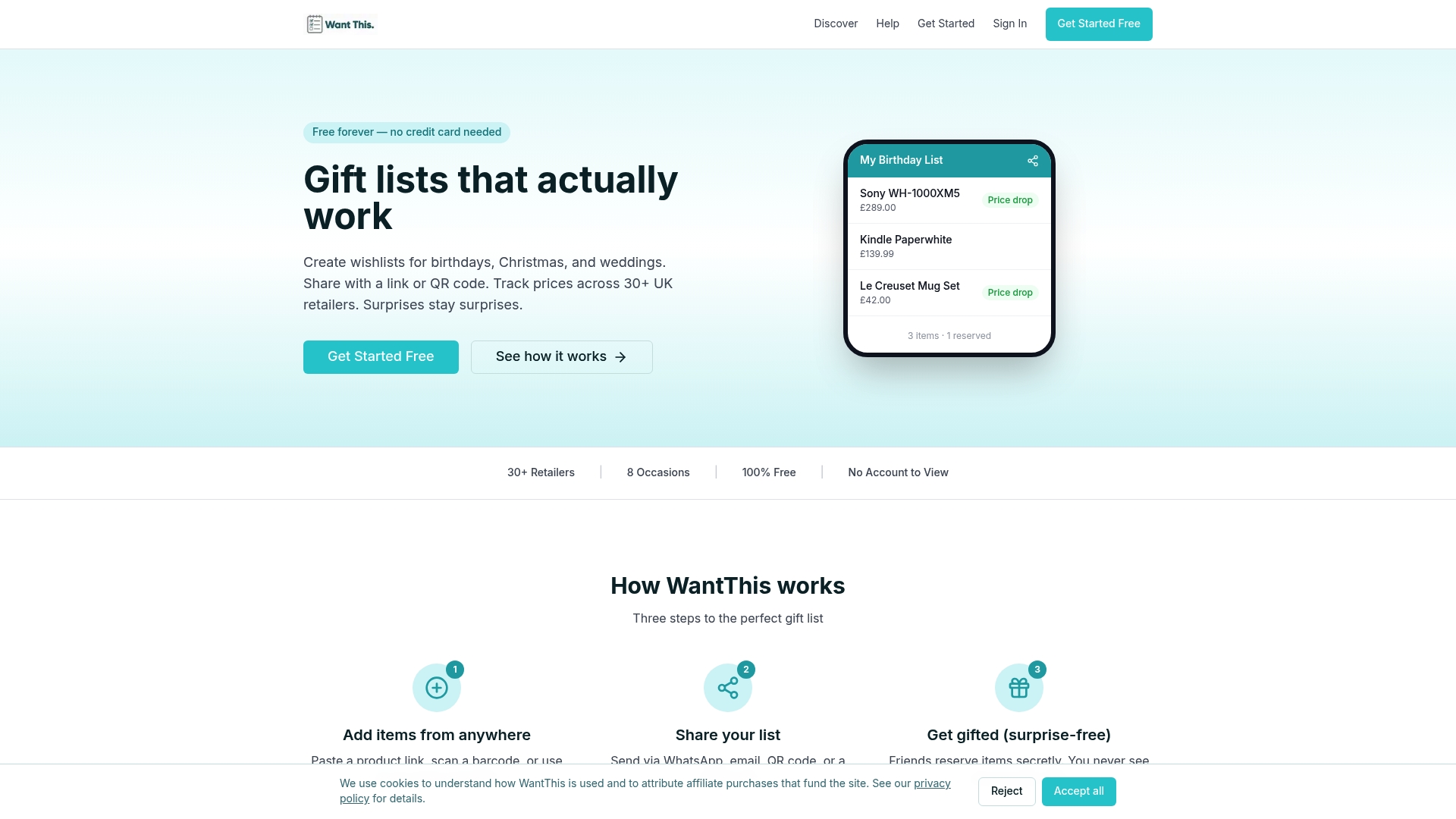
That’s the practical difference: no juggling accounts, no guessing whether someone already bought the candle. Price alerts flag drops across more than 30 UK retailers, so a saved item doesn’t sit there at full price when a discount lands the following week. If you’re organising a group gift or an office exchange, the Secret Santa organiser handles the draw automatically, no spreadsheet required.
Head to WantThis and create your first list. Add an item from any shop, then send the link to whoever’s buying, and let the reservations do the rest.
Sources
- Google privacy policy