
Secret Santa Ideas: 3 Office Gift Types That Rarely Miss

For an office Secret Santa, pick a consumable, a useful everyday item or a kindly funny small gift that fits the organiser’s budget, and wrap it with a one-line note. These three lanes rarely miss, whatever you know about your recipient. Our experience with Secret Santa organisers suggests the gifts that land best are simple, budgeted and nicely presented.
TL;DR:
- Treat the office’s stated figure as a ceiling; overspending can make colleagues feel they gave too little, while two modest items can feel more considered.
- Keep gifts for bosses professional and modest: choose a quality notebook, food hamper, coffee shop voucher, or charity donation, and avoid clothing or fragrance.
- Skip alcohol unless you know the recipient drinks, and avoid strong scents, political or religious gifts, appearance jokes, and inside jokes that exclude colleagues.
- Set the budget and exchange date before signups; collect three interest prompts, confirm remote addresses before drawing names, and order mailed gifts a week ahead.
- When employers fund seasonal gifts, those costing £50 or less per employee may qualify for exemption unless they are cash, cash vouchers, or performance rewards.
Table of Contents
- 1. Office-safe Secret Santa ideas by category
- 2. Secret Santa ideas by budget tier
- 3. What to get a boss or senior colleague
- 4. What not to give and Secret Santa etiquette
- 5. How WantThis takes the guesswork out of organising
- 6. Tips for organising and running the Secret Santa draw smoothly
- 7. Using tech tools and apps to manage the draw and wishlists
- 8. Handling gift exchanges in remote or hybrid offices
- 9. Creative themes to make the exchange more engaging
- 10. Why a short note matters more than you’d think
- Try our Secret Santa organiser and shared wishlists
- FAQ
- Sources
1. Office-safe Secret Santa ideas by category
The safest gifts fall into a handful of categories, and each one works even when you know almost nothing about the person who pulled your name.
Consumables disappear after the holidays, so there’s no risk of someone keeping a gift they don’t like on a shelf forever. A single-origin chocolate bar, a speciality tea sampler or a small box of good biscuits all work well. Pair any of these with a tag that says something like “thought you’d enjoy this with your afternoon coffee” and the gift feels considered rather than grabbed off a shelf.
Useful everyday items earn their place on a desk. A quality pocket notebook, a reusable coffee cup or a set of decent pens all tick the box of something people will actually use. These work best when they’re well-made rather than branded or novelty, since a slightly nicer version of something ordinary reads as thoughtful.
Kindly funny gifts add a bit of warmth to the exchange without veering into risky territory. A gentle novelty mug with an office in-joke that everyone shares, a desk toy or a lighthearted book are safer bets than anything that singles someone out. The test is simple: if the joke only works because of someone’s personal habits or appearance, skip it.
Wellness-adjacent gifts have become reliable fallbacks. Hand cream, a scented candle in a mild fragrance, or a small box of herbal tea all suit colleagues you don’t know well, provided you avoid anything with a strong or divisive scent.
Low-waste and practical picks appeal to colleagues who’d rather not add more clutter to their home. A beeswax wrap set, a bar of soap in nice packaging or a reusable tote bag all fit this lane without needing to know much about the recipient.
Practical gift guides consistently point to the same conclusion: consumables, useful items and kindly funny gifts are the highest-success options for office exchanges, and they work precisely because they avoid the guesswork that makes Secret Santa stressful in the first place, according to one office-approved gift guide.

For presentation, keep it simple: decent wrapping paper, a ribbon if you have one, and a handwritten tag with a single line explaining the thought behind the gift. That one line does more work than an expensive upgrade ever will.
If you genuinely know nothing about your recipient, lean on consumables first, useful items second, and only reach for “kindly funny” if you’ve seen them laugh at the same kind of jokes as everyone else in the room.
2. Secret Santa ideas by budget tier
Most offices set a fixed figure rather than a range, and sticking to it matters more than the gift itself. Going over the limit can make colleagues feel they under-gifted, even when that was never the intention, so treat the stated budget as a ceiling rather than a suggestion.
- Under £10: a bar of single-origin chocolate, a pack of good biscuits, a small scented candle, a novelty mug, a pocket notebook, a bag of speciality coffee, a mini puzzle book, or a cheerful pair of socks. Browse more gifts under £10 if you want a readymade shortlist.
- Under £20: a tea or coffee sampler set, a reusable coffee cup with a nice finish, a small desk plant, a quality hand cream set, a lightweight book by a popular author, or a board game for two. Our under-£20 picks cover this tier in more depth.
- £20 to £30: a modest hamper of snacks, a nicer notebook and pen set, a cosy blanket scarf, a set of good glassware, or a small kitchen gadget like a milk frother.
- Up to £50: a quality desk organiser set, a premium food and drink hamper, a soft throw blanket, or a small experience voucher such as a cinema pass for two.
Pro Tip: Combine two small items from the same tier (a chocolate bar and a nice mug, say) rather than buying one mid-range item. It reads as more considered than a single purchase at the same total cost.
If your committee sets a budget of £15, stay close to it. Spending £35 on a colleague when everyone else is giving £15 gifts puts other participants in an awkward spot, and it isn’t a kindness, it’s a mismatch.
3. What to get a boss or senior colleague
Gifts for a boss need to stay tasteful and a little more neutral than gifts for peers, since the power dynamic changes what feels comfortable on both sides.
- A premium notebook or a fine pen suits almost any senior colleague and reads as professional rather than personal.
- A tasteful food hamper with good quality teas, coffees or biscuits works well if you’re unsure of personal taste.
- A small experience voucher, such as a coffee shop gift card, keeps things neutral while still feeling like a genuine gift.
- A donation to a charity in their name is a safe option for colleagues who already have everything they need on their desk.
Keep the value modest and in line with the stated office budget, wrap it simply, and avoid anything overly personal, like clothing or fragrance. A small personal touch, such as mentioning a hobby you know they enjoy in the note, is fine as long as the gift itself stays professional.
4. What not to give and Secret Santa etiquette
A handful of categories cause more awkwardness than any gift is worth, so it’s worth ruling them out before you start browsing.
- Religious or political items, even ones meant as a joke, can alienate colleagues and have no place in an office exchange.
- Comments on someone’s appearance, weight or habits, even wrapped in a gift, tend to land badly.
- Strong fragrances are a common source of regifting, since scent preference varies enormously.
- Alcohol is only appropriate if you know for certain the recipient drinks and has no cultural or personal reason to avoid it.
- In-jokes that only half the office understands can make the recipient feel singled out rather than included.
On the practical side, agree a single budget figure rather than a range, collect three quick interest prompts from each participant (for example “coffee, plants, crime novels”), wrap every gift, add a one-line note, and confirm postal addresses early for anyone working remotely. Practical guides on running an exchange consistently recommend fixing one number rather than a range, since it removes the pressure of feeling out-gifted, according to one gift guide.
If your employer is covering the cost of gifts, there’s a UK tax detail worth knowing: under HMRC’s trivial benefits rules, a seasonal gift can be exempt from tax if it costs £50 or less per employee, isn’t cash or a cash voucher, and isn’t given in recognition of particular work. Gifts above £50 become fully taxable on the whole amount, not just the excess, according to Gov. HMRC’s internal manual adds that the cost is assessed per employee and that a gift tied to performance or service won’t qualify, which is useful to know if your company is the one footing the bill rather than colleagues buying for each other, as set out in EIM21865.
5. How WantThis takes the guesswork out of organising
Most of the stress in a Secret Santa exchange comes from not knowing what to buy, not from the gift itself. Our Secret Santa organiser is built around a short checklist that removes that uncertainty before anyone starts shopping.
- Set a single, fixed budget figure for the whole group rather than a range.
- Collect three short interest prompts from each participant so nobody is buying blind.
- Set a clear deadline, ideally a couple of days before the exchange, to avoid last-minute panic buying.
- Run the automatic draw so no one has to manage names on paper or risk someone seeing who they’ve drawn.
Shared wishlists let each participant list items they’d genuinely like, and our reservation feature marks an item as claimed once someone’s bought it, so two people never duplicate the same gift. Price tracking across UK retailers can help when trying to land a gift within a specific tier, as it lets you see when something drops into budget before you buy.
6. Tips for organising and running the Secret Santa draw smoothly
A smooth draw comes down to timing and clarity more than anything else. Set the budget and the exchange date before you ask anyone to sign up, so nobody commits without knowing what’s expected of them.
Collect names in one place, ideally with an opt-in deadline a week or so before the draw, to avoid chasing stragglers after names have already been assigned. Once everyone’s in, run the draw electronically rather than on paper. A physical hat draw risks someone seeing who drew whom, which spoils the surprise for the whole office, not just one person.
Share the rules alongside the draw result: the budget figure, the exchange date, and a reminder that gifts should stay within the three safe lanes of consumable, useful or kindly funny. If anyone has dietary restrictions or allergies relevant to consumable gifts, it’s worth flagging this when names go out rather than leaving givers to guess.
Finally, build in a short buffer between the deadline for buying and the actual exchange day. Deliveries slip, especially in December, and a two-day cushion means a late parcel doesn’t leave anyone empty-handed on the day.
7. Using tech tools and apps to manage the draw and wishlists
Spreadsheets and paper slips work for small teams, but they get unwieldy once an office grows past a dozen people or spans multiple locations. A dedicated app removes the manual admin: names go in, the system handles pairings, and nobody has to worry about an accidental email reply revealing who’s got whom.
A Secret Santa organiser can handle the draw automatically once everyone’s added, and it pairs naturally with shared wishlists, so participants can list a few items they’d actually like rather than leaving their Secret Santa guessing. That matters more than it sounds: a wishlist with three or four options gives the giver a shortlist within budget, rather than a blank page.
Price tracking is a smaller but genuinely useful feature here too. If someone’s wishlist item is slightly above the group’s budget, tracking its price means you can catch it on a markdown rather than ruling it out completely. Price tracking, combined with reservations, which mark an item as claimed the moment someone buys it, makes duplicate gifts far less likely, even in a large office pulling from the same handful of wishlists.
8. Handling gift exchanges in remote or hybrid offices
Remote and hybrid teams add a logistical layer that in-office exchanges don’t have to think about: physical addresses. Before the draw happens, confirm each participant’s current postal address, since home addresses change more often than people remember to update, and a gift sent to an old flat is a gift that never arrives.
Build in extra delivery time for anyone not coming into the office. A gift that needs to reach someone’s home by post should be ordered at least a week before the exchange date, rather than the two or three days that might suffice for an in-office handover.
For the exchange itself, a video call works well for hybrid teams who still want the reveal moment, even if gifts were posted ahead of time. Some offices stagger this: gifts arrive by a set date, and everyone opens them together on a call, which keeps the shared moment even when the office itself is empty that day.
If your team is fully remote, consider digital gift cards or vouchers as a fallback for anyone whose address wasn’t collected in time. It’s a weaker version of the physical exchange, but it beats leaving someone out entirely because logistics didn’t line up.

9. Creative themes to make the exchange more engaging
A theme gives everyone a shared starting point, which often makes shopping faster rather than more complicated. “Under a fiver and from a charity shop” forces creativity and keeps spending low, while “something from your hometown” gives colleagues a personal angle without requiring any prior knowledge of the recipient.
A “white elephant” twist, where gifts can be swapped or stolen once during the reveal, adds a bit of game energy to what’s otherwise a quiet exchange of wrapped boxes. This works particularly well for teams that already enjoy a bit of friendly competition.
Themed categories such as “self-care,” “desk upgrade” or “snack attack” narrow the field without boxing anyone into a single product type, which keeps the exchange from feeling repetitive year after year. Whatever theme you pick, state it alongside the budget when the draw goes out, so nobody buys outside the spirit of the exchange by accident.
10. Why a short note matters more than you’d think
The best gift I ever received in an office exchange was a £6 bag of coffee with a sticky note that said “saw you eyeing the new blend in the kitchen last week.” It cost almost nothing, but it felt like someone had actually paid attention.
That’s the whole lesson: a one-line note tells the recipient you thought about them specifically, not just about ticking off a gift exchange. Spend your effort there before you spend it on the price tag.
— Stuart
Try our Secret Santa organiser and shared wishlists
Running an office exchange gets easier when the admin is handled for you. Our free Secret Santa organiser takes care of the name draw, while shared wishlists mean nobody has to guess what a colleague actually wants.
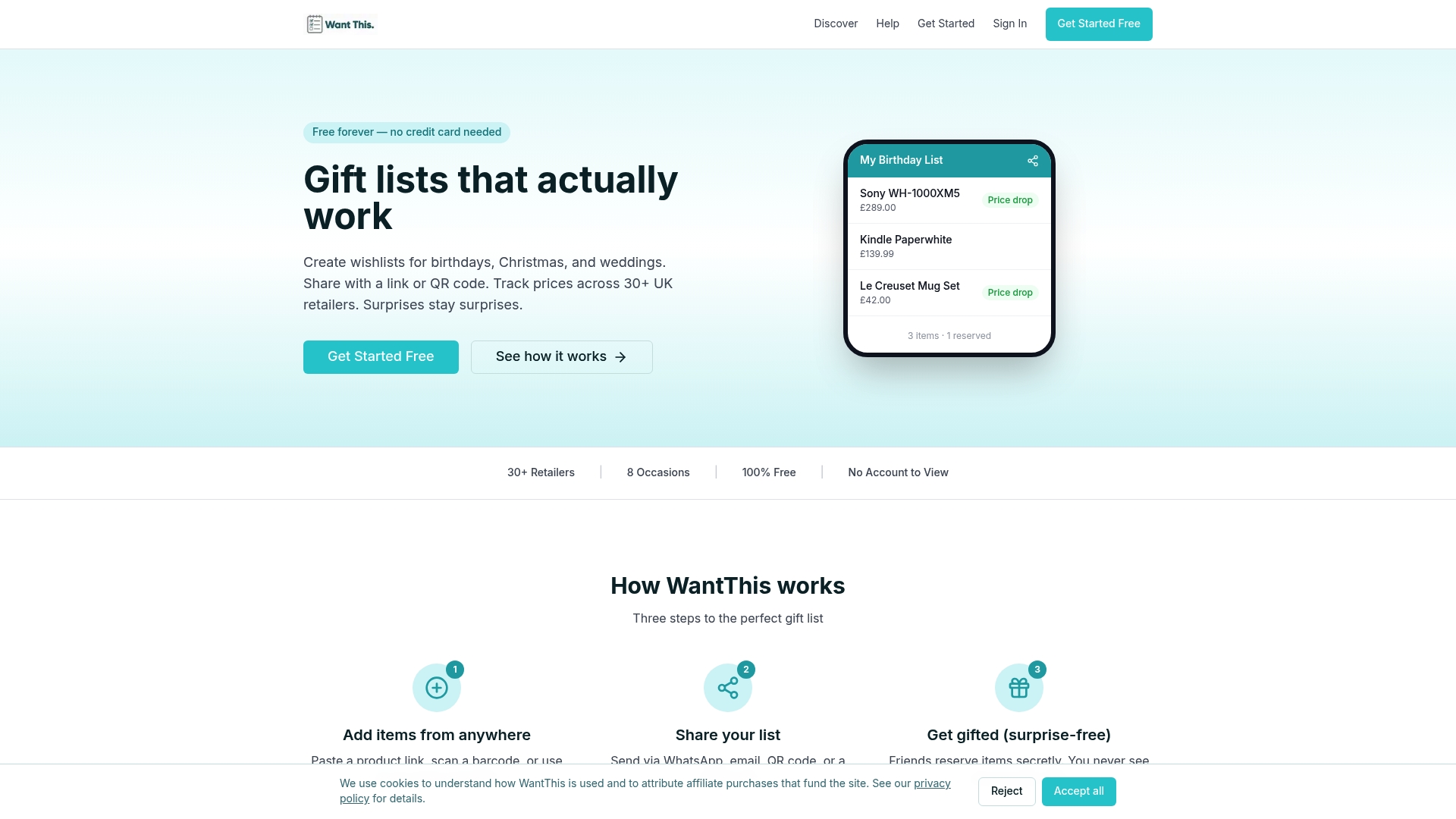
- Automatic draw, so no one risks seeing who they’ve been paired with.
- Shareable wishlists that give gift ideas straight from the recipient.
- Reservations that stop two people buying the same thing.
- Features that help you stay within budget.
Start your office exchange on WantThis and skip the spreadsheet altogether.
FAQ
What are some good Secret Santa gift ideas?
Consumables like chocolate or tea, useful items like notebooks or reusable cups, and kindly funny gifts such as a lighthearted mug all work well for office exchanges. These three lanes consistently perform best because they don’t require detailed knowledge of the recipient, according to one office gift guide.
What is the 7 gift rule for Christmas?
The “7 gift rule” is a family gift-giving framework (something you want, need, wear, read, plus a few variations) rather than an office Secret Santa convention. It isn’t typically applied to workplace exchanges, which usually run on a single fixed budget instead.
What do Gen Z want as gifts?
There’s no single verified ranking of Gen Z gift preferences to point to, so it’s safer to focus on what works broadly for office exchanges: practical, well-made everyday items and consumables tend to suit most age groups equally well.
What are good office gifts for coworkers?
Quality consumables, practical desk items and kindly funny novelties all suit coworkers you don’t know especially well. Pairing the gift with simple wrapping and a one-line note consistently makes a modest gift feel more thoughtful, according to practical gift-giving guidance.
How much should I spend on an office Secret Santa gift?
Stick to whatever figure your office committee sets rather than choosing your own amount. If your employer is funding the gifts directly, a seasonal gift of £50 or less per employee can qualify for HMRC’s trivial benefits exemption, provided it isn’t cash and isn’t tied to performance, according to GOV.UK.
Sources
- Gov
- 50 Secret Santa Gift Ideas for Coworkers (2026): The Office-Approved Gift Guide
- Office Secret Santa Gifts: Ideas, Budget & Etiquette