
Common Secret Santa problems (and how to fix them)

TL;DR:
- Setting clear rules and using a shared wishlist prevent most Secret Santa problems before they start.
- Making participation voluntary and nominating a deputy help manage dropouts and maintain smooth exchanges.
The quickest way to stop most Secret Santa problems is simple: set a clear budget, allow people to opt out, share a wishlist link, and name a deputy for last-minute gaps. Last-minute dropouts and participants forgetting to buy gifts happen often enough to justify planning for substitutions and reminders. The Equality Act 2010 adds a legal dimension for workplace organisers that is easy to overlook. Three actions you can take right now:
- Set a budget (£5, £10, or £20 are the most common limits) and state it in writing before names are drawn.
- Share a wishlist link so givers have clear guidance and duplicates are avoided.
- Nominate a deputy organiser to handle reassignments if someone drops out.
Table of Contents
- What are the most common Secret Santa problems?
- Workplace Secret Santa and the Equality Act 2010
- How do you set fair rules for a Secret Santa?
- How do wishlists and organiser tools prevent Secret Santa problems?
- What should you do when things go wrong?
- Ready-to-use templates for organisers
- GDPR basics for Secret Santa organisers in the UK
- Timeline and budget examples at a glance
- Key takeaways
- The part most organisers skip until it’s too late
- Wantthis makes Secret Santa straightforward
- Useful sources
What are the most common Secret Santa problems?
The usual issues fall into a predictable pattern, and each has a straightforward prevention principle.
| Problem | Prevention principle |
|---|---|
| Dropouts | Set an RSVP deadline; nominate a deputy for reassignments |
| Missed deadlines | Send two reminders; build a buffer week before the exchange |
| Duplicate gifts | Require wishlist links before the draw |
| Budget mismatch | State the limit in writing; suggest a price range, not just a cap |
| Offensive gifts | Publish a short banned-category list; keep participation voluntary |
| Anonymity spoiled | Use an automatic draw tool; avoid group chats for match notifications |
| Awkward pairings | Use a digital organiser with exclusion rules |
| Late shipping | Set a buy-by date at least one week before the exchange |
Before confirming participants, run through this quick checklist: RSVP received, budget acknowledged, wishlist link provided, opt-out option communicated. That single pass catches most issues before they start.
Pro Tip: Use a short opt-in form (name, email, wishlist link, opt-out reason) rather than a group chat thread. It keeps data tidy and gives you a clear record if anything goes wrong later.
Workplace Secret Santa and the Equality Act 2010
The main legal risk for workplace organisers is a gift that offends based on a protected characteristic. Under the Equality Act 2010, characteristics including race, religion, sex, and disability are protected, and an inappropriate gift can trigger a formal grievance or, in serious cases, an Employment Tribunal claim. Gifts that mock someone’s faith, make assumptions about gender, or reference a physical condition are the clearest examples to avoid.
Workplace morale research shows that mandatory events produce mixed reactions, and employees often perceive the removal of a tradition as a loss of benefit. The practical answer is to make participation genuinely voluntary from the start, so neither joining nor opting out carries any social penalty.
HR guidance recommends four concrete steps: written rules circulated before the draw, voluntary participation stated explicitly, a named organiser who manages the draw and chases late gifts, and a clear reporting route for anyone who receives an upsetting present. Reported misconduct cases in public services show how quickly an inappropriate gift can escalate to disciplinary action when no process exists.
Pro Tip: For mixed or unknown groups, steer participants toward neutral, consumable gifts (food, candles, stationery) and encourage wishlists. It removes guesswork and keeps the exchange inclusive.
How do you set fair rules for a Secret Santa?
Clear written rules prevent most misunderstandings before they happen. State the budget, RSVP date, draw method, and gifting date in a single message sent to everyone at the same time.
Budget examples and what they typically buy:
- £5: novelty items, DIY treats, festive chocolates
- £10: books, small homewares, gift ideas under £10
- £20: premium small gifts, shared group contributions, experience vouchers
Family groups tend to be more flexible on categories; workplace groups benefit from stricter neutral-gift rules.
Step-by-step organiser timeline:
| Weeks before exchange | Action |
|---|---|
| 4–6 weeks | Send invite with budget, RSVP deadline, opt-out option |
| 3–4 weeks | Close RSVP; run the draw; share matches privately |
| 2–3 weeks | Send buying reminder; share wishlist links |
| 1 week | Final reminder; confirm delivery addresses |
| Exchange day | Collect and distribute gifts; thank participants |
Sample rules to paste into your invite:
- Participation is voluntary; no pressure to join.
- Budget limit: [state amount]; please stick to it.
- No gag gifts, intimate items, or anything referencing personal characteristics.
- Add at least one wishlist item before the draw closes.
- If you drop out after the draw, notify the organiser immediately for reassignment.
How do wishlists and organiser tools prevent Secret Santa problems?
A shared wishlist combined with an automatic draw cuts duplication, speeds up matching, and removes the awkward guessing that causes most gift exchange challenges. The workflow is short:
- Collect wishlist links from every participant before the draw.
- Run an automatic draw using a digital organiser (Wantthis has a free one at wantthis.co.uk/secret-santa).
- Share matches privately, never via a group chat.
- Send a buying reminder two weeks before the exchange.
- Update assignments immediately if someone drops out.
Wantthis is built for exactly this workflow. The Secret Santa organiser handles the automatic draw, participants can add items from any UK retailer, and shareable wishlist links mean givers always have something concrete to work from. Price tracking helps buyers stay within budget, and the iOS, Android, and browser extension options make adding items quick while shopping online.
On privacy: Wantthis collects minimal data for the draw. For your own records, store only names, email addresses, and wishlist links, and delete them once the exchange is complete.
Pro Tip: Ask every participant to add three wishlist items at different price points. It gives givers a choice, keeps budget parity natural, and reduces the chance of an awkward mismatch.
What should you do when things go wrong?
Dropout after the draw: Reassign their match to the deputy organiser or pool contributions for a group gift. Message template: “[Name] has had to step out. I’ve reassigned their match and will be in touch shortly with your updated pairing.”

Duplicate gifts: Offer a swap between recipients or suggest a small top-up gift to balance value. Keep the conversation private.
Offended recipient: Remove the gift from the exchange quietly. In a workplace, follow the employer’s grievance policy and document the incident. Message template: “I’m sorry this happened. I’m looking into it and will follow up with you directly.”
Late shipping: Set a digital gift card as a fallback before the exchange date. Offer to reimburse postage if a delay was caused by organiser error. For future exchanges, set the buy-by date at least one week before the event.
Ready-to-use templates for organisers
Invite (email, Slack, or WhatsApp): “We’re running a Secret Santa this year! Budget: [£X]. RSVP by [date] — participation is completely optional. Please add at least one item to your wishlist before [date]. Draw results will be shared privately. To opt out, just reply to this message.”
Reminder (one week before buy-by date): “Friendly reminder: please buy your Secret Santa gift by [date]. Check your match’s wishlist for ideas. Questions? Message me directly.”
Dropout notice to remaining participants: “A small change to the draw — I’ll be in touch individually with any updated pairings. Nothing to worry about.”
Opt-out wording (for the organiser to include in the invite): “No obligation to join — just let me know privately and I’ll remove you from the list.”
- Send the invite via the channel your group uses most (email for workplaces, WhatsApp for families).
- Send reminders at two weeks and one week before the buy-by date.
- Use direct messages, not group threads, for match notifications and sensitive updates.
GDPR basics for Secret Santa organisers in the UK
Keep data minimal: collect only names, email addresses, and wishlist links. Do not ask for home addresses, phone numbers, or any sensitive personal information unless it is strictly necessary for delivery.
GDPR-aligned steps for UK organisers:
- Tell participants why you are holding their data and how long you will keep it.
- Store the participant list securely (a password-protected spreadsheet or a platform like Wantthis, not an open group chat).
- Limit access to the organiser and deputy only.
- Delete all records within a reasonable period after the exchange, typically within 30 days.
If a workplace is collecting participant data centrally, check employer policy or get HR sign-off before storing a list. Using a platform that handles data on your behalf (rather than a personal spreadsheet) reduces your own compliance burden.
Timeline and budget examples at a glance
One-line answer: Choose your gifting date, then work backwards. Allow 4–6 weeks for groups of ten or more; 2–3 weeks is enough for small family groups.
| Weeks before exchange | Action |
|---|---|
| 6 weeks | Send invite; open RSVP |
| 4 weeks | Close RSVP; run draw; share matches |
| 3 weeks | Buying reminder; wishlist links circulated |
| 1 week | Final nudge; confirm logistics |
| Exchange day | Gift distribution |
Budget guide:
- £5: novelty, DIY, or festive food items — good for large family groups
- £10: books, small homewares, beauty treats
- £20: premium small gifts or a shared contribution
Workplace exchanges generally benefit from stricter neutral-gift guidance and a lower cap. Family groups can be more relaxed, though a stated limit still prevents the awkwardness caused by value disparity and budget confusion.
Key takeaways
Setting clear rules, keeping participation voluntary, and using a shared wishlist stops the majority of Secret Santa gift exchange challenges before they start.
| Point | Details |
|---|---|
| Set rules in writing | State budget, RSVP date, draw method, and gifting date in one message. |
| Keep participation voluntary | Mandatory events risk resentment; a genuine opt-out protects morale and reduces legal exposure. |
| Use wishlists | Shared wishlist links prevent duplicates and help givers stay within budget. |
| Nominate a deputy | Around 10% of exchanges see a dropout; a named deputy handles reassignments without disruption. |
| Wantthis for the draw | Wantthis’s free Secret Santa organiser handles the automatic draw, wishlist sharing, and price tracking for UK groups. |
The part most organisers skip until it’s too late
The conventional wisdom on Secret Santa is that the problems are about gifts: wrong price, wrong taste, wrong timing. Having looked at how these exchanges actually go wrong, the real issue is almost always process, not presents.
The organiser who sends one message in a group chat, draws names manually, and hopes for the best is setting up a situation where a dropout causes chaos, a duplicate goes unnoticed, and an uncomfortable gift has no clear route for resolution. None of that is about the gifts themselves.
The single most effective change is not a better gift guide. It is a written process: a clear invite with an opt-out, an automatic draw, wishlist links collected before matching, and a named person to call if something goes wrong. That structure takes about twenty minutes to set up and prevents the vast majority of issues that make Secret Santa feel like a chore rather than a celebration.
The wishlist step is the one most organisers underestimate. Asking participants to add three items at different price points is not just convenient for givers. It signals to everyone that the exchange is organised, fair, and worth taking seriously.
Wantthis makes Secret Santa straightforward
Wantthis is a free UK Secret Santa organiser that handles the draw automatically and gives every participant a shareable wishlist. The concrete difference from a manual process: no duplicate gifts, no awkward guessing, and no group-chat chaos when someone drops out.
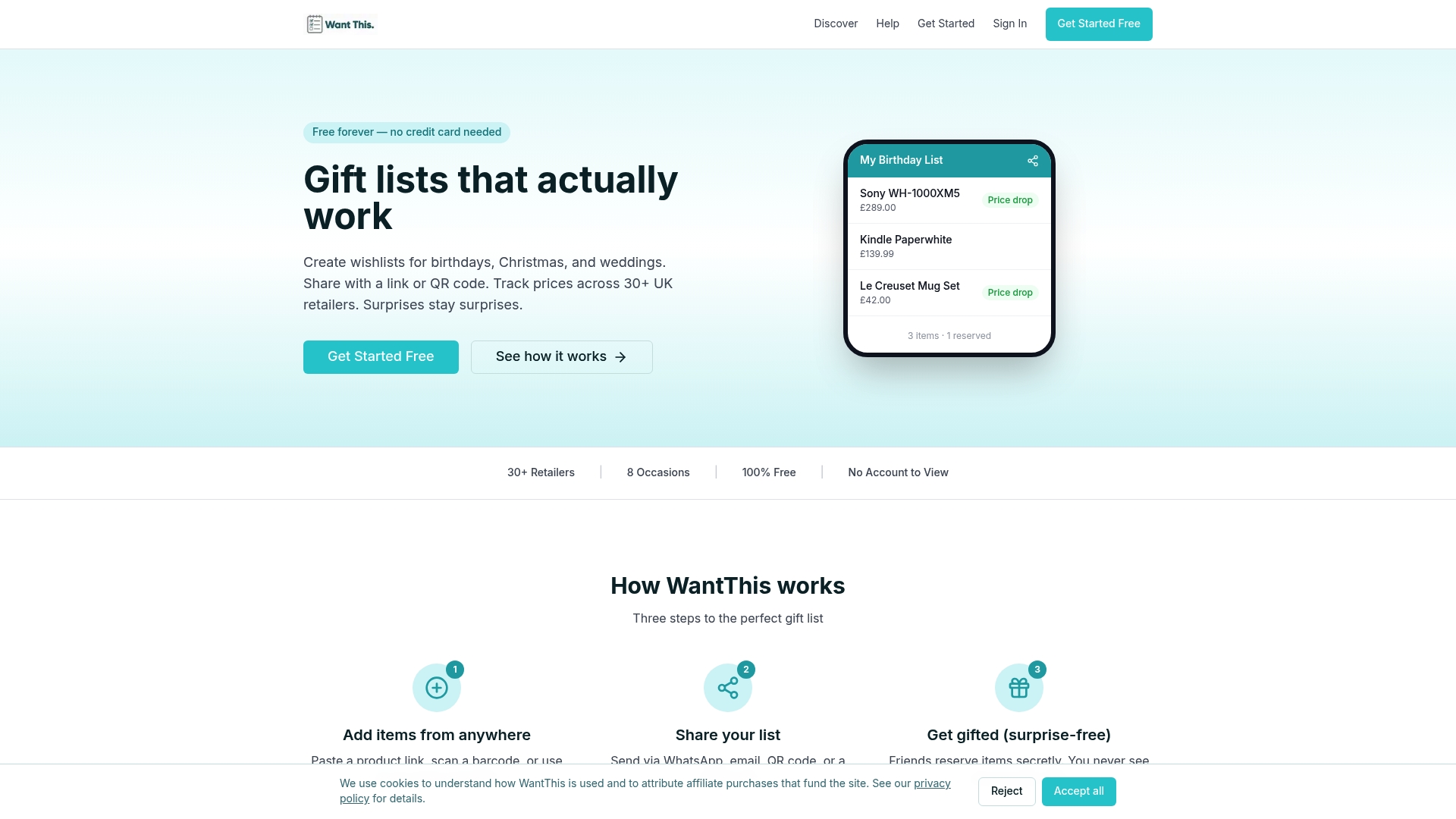
The features map directly to the problems covered in this guide. The automatic draw keeps matches private. Participants add items from any UK retailer to their wishlist, with prices pulled in automatically so givers can see at a glance what fits the budget. Price tracking alerts buyers when a saved item drops in price. The iOS, Android, and browser extension options mean adding items takes seconds while shopping online.
Data handling is minimal by design: Wantthis collects only what is needed for the draw, and you can delete your list once the exchange is done.
Set up your free Secret Santa draw on Wantthis, or browse gift ideas by budget if you need inspiration before the draw closes.
Useful sources
| Source | Why it matters |
|---|---|
| Equality Act 2010 guidance — WorkNest | UK employment law context for workplace Secret Santa; protected characteristics and HR risk |
| Secret Santa HR issues — Wirehouse ES | Practical employment law guide covering disciplinary risk and organiser responsibilities |
| Secret Santa HR issues — Coppice HR | Step-by-step HR recommendations: written rules, voluntary participation, nominated organiser |
| Nobody Likes Doing Secret Santa at Work — The Cut | Workplace morale research on mandatory events and the risk of backlash |
| Common Secret Santa mistakes — Nat Bio Group | Practical overview of frequent pitfalls: budget confusion, late buying, anonymity failures |
| Secret Santa rules guide — WhoIsMcAfee | Dropout and participation statistics; practical draw and rules guidance |
| Wantthis Secret Santa organiser | Free UK Secret Santa organiser with automatic draw and shareable wishlists |