
Gift List Etiquette in the UK: A Plain Guide for Hosts and Guests

Good gift list etiquette in the UK comes down to one idea: a list is a set of helpful suggestions, never a demand. Share it quietly, keep it kind to every budget, let guests choose freely, and thank everyone properly. Do that and a list saves your guests guesswork instead of adding pressure. WantThis is a free UK wishlist and gift list platform where you can build a list from any online retailer and share it privately, so friends and family can reserve gifts without duplicates or spoiled surprises.
Below you will find the unwritten rules for hosts, for guests, and for the awkward moments in between: cash, tight budgets, wording and thank-yous.
TL;DR
- Treat a gift list as suggestions. Share it when someone asks or in a low-key place, never on the invitation itself.
- Offer a real spread of prices, with plenty of options around £20 to £50 and a few bigger items guests can split.
- Guests should give what they can afford. A typical UK cash wedding gift sits around £50 to £150, according to a Debrett’s adviser, and nobody should stretch beyond their comfort zone.
- Use a private list with reservations so two people never buy the same thing.
- Thank every giver personally, ideally within three months of the occasion.
Table of Contents
- When is it appropriate to make a gift list?
- How to share your list without pressure
- What to write: wording that feels warm
- Build a list that suits every budget
- Avoiding duplicates and keeping surprises
- If you are the guest: using a list gracefully
- Cash gifts: how much and how to give it
- Saying thank you properly
- Common etiquette questions, answered quickly
- Build your list with WantThis
- Our view: lists are about making kindness easier
- FAQ
- Sources
When is it appropriate to make a gift list?
Gift lists are welcome where gifts are already expected or traditional: weddings, baby showers, significant birthdays, Christmas and housewarmings that guests have asked about. The more the occasion is about receiving presents, the more natural a list feels.
Weddings are the clearest case. UK guidance suggests having the list ready by the time invitations go out, which is roughly three months before the wedding, and leaving it open for a few weeks afterwards because some guests buy late. If you are planning one, our wedding gift list guide for UK couples walks through the options, and why couples need wedding lists explains what a list does for you and your guests.
Birthdays and Christmas are more relaxed. A list is perfectly normal among family and close friends who ask “what would you like?” every year. It is the answer to that question, not an announcement.
Housewarmings need more care. The Emily Post Institute, a US etiquette authority, says a housewarming host should not set up a registry or post a wish list, because gifts are not required. If guests ask what you would like, it is fine to suggest a few things. The same logic applies to any occasion where gifts are a bonus rather than the point: keep the list ready, and share it only when asked.
How to share your list without pressure
The main rule is where the list does not go. Etiquette convention in the UK holds that gift list details do not belong on the main wedding invitation. Bride Guide UK suggests mentioning the list on a wedding website, in a small separate insert, or by word of mouth through close family if guests ask.
The Emily Post Institute is even firmer, calling it a never with no exceptions, since putting registry details on an invitation tacks a gift request onto what should be a gesture of warmth. That is an American source, but the instinct is just as British: invite first, mention gifts only if someone wants to know.
A few practical ways to share a list well:
- Put it on a wedding website or in a separate note, not the invitation.
- Tell a parent, sibling or close friend the list exists, so they can answer when guests ask.
- Send a private link to people who have asked, rather than posting it publicly in a group chat.
- Make it clear the list is optional. Registries are suggestions, not a checklist that has to be completed, as Emily Post puts it.
For everyday occasions such as birthdays, a private share link sent to the people who ask is all you need. On WantThis, lists can be shared privately, so only those you send the link to see it.
What to write: wording that feels warm
Good wording puts the guest first and the gift second. It says the person matters more than the present, then offers the list as a convenience.
UK stationers and wedding guides suggest lines along these lines. Wonder Wedding Stationery offers examples such as saying your presence is the greatest gift, and adding that if guests wish to give a gift, you have a list at a named place. It also suggests a line for honeymoon contributions and one for couples who want no gifts at all.
Bride Guide UK recommends similar low-pressure phrasing: say that having guests there is what matters most, and that a small list is there if they would like to give something. For a cash or honeymoon fund, it advises framing the request around what the money is for rather than the money itself.
Here is a template you can adapt for any occasion:
Having you with us is what matters most. If you’d like to give something, we’ve put a few ideas together here: [link]. Please don’t feel you need to.
If you would rather receive no gifts, say so directly and kindly. Our guide to no-gifts wording for UK weddings has copyable lines and suggestions on where to share them.
Build a list that suits every budget
A list made only of expensive items is the commonest way a gift list goes wrong. It leaves guests choosing between overspending and arriving empty-handed.
Bride Guide UK recommends a real spread of prices: plenty of items around £20 to £50, a good number in the middle, and a few larger pieces that several people could club together for. It points out that a list made entirely of £200 items puts guests in an awkward position.
The Emily Post Institute gives the same advice from the US: include inexpensive items and ways to contribute toward a bigger gift without buying it outright, so nobody feels priced out.
A simple way to check your list:
| Price band | Share of list (a sensible guide) | Examples |
|---|---|---|
| Under £20 | A handful | Cookbook, candles, a nice tea towel set |
| £20 to £50 | The largest group | Kitchen gadgets, bedding, board games |
| £50 to £100 | A good number | Small appliances, quality cookware |
| Over £100 | A few | Items for group contributions |
The bands are our illustration of the principle above, not a fixed rule. What matters is that every guest finds something comfortable.
Because WantThis lets you add products from any online retailer, you can mix a £12 book from one shop with a £90 kettle from another in one list. You follow each product link to the retailer for the latest price and availability. For inspiration, you can browse gift ideas by category or our home and kitchen gifts picks.
Leave room for guests who like to choose their own. A list is a starting point. If someone wants to give something that is not on it, that is a kindness, not a breach of etiquette.
Avoiding duplicates and keeping surprises
The practical heart of gift list etiquette is coordination. Nobody wants to unwrap three identical toasters, and nobody wants to be the guest who bought one.
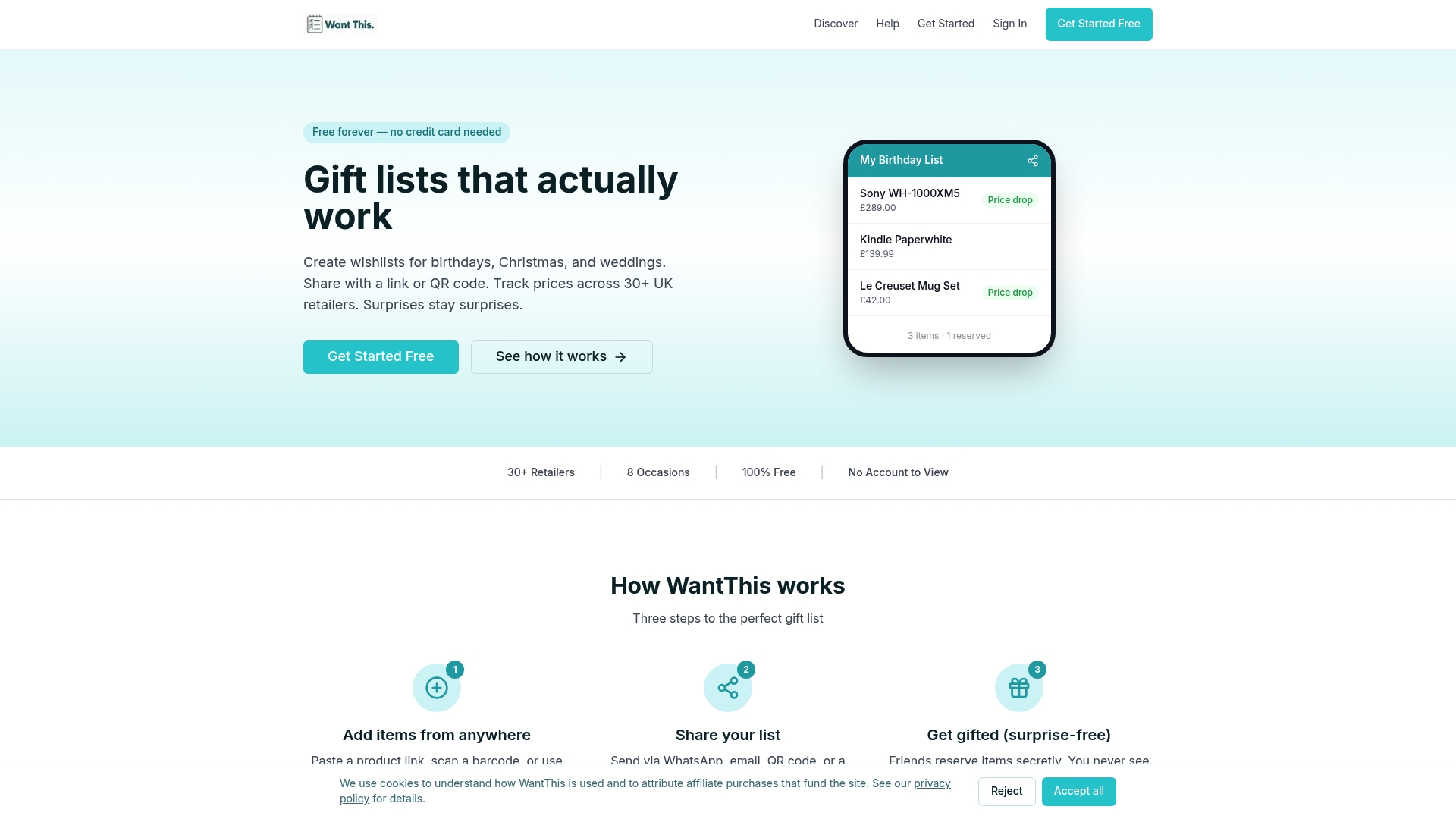
A list works best when guests can see what has already been taken without the recipient knowing who bought what. On WantThis, friends and family can privately reserve a gift or mark it as bought, which helps avoid duplicates while keeping surprises intact. The list owner sees the list, and the surprise of who gave what stays with the giver.
Some good habits for hosts:
- Add items before you share. A list with only five things runs out quickly and ends up pushing guests towards the same few presents.
- Keep it current. Remove anything you have since been given or bought.
- Do not chase. Do not check who has reserved what and then nudge people.
- Leave it open a while after the event. Some guests buy late, as UK guidance notes.
For couples, how couples coordinate wedding gifts covers the practicalities, and types of wedding gift registries compares the formats you can choose between.
If you are the guest: using a list gracefully
Guests have etiquette too, and it is mostly about being relaxed.
You do not have to buy from the list. It is a guide to what the couple or host would like. If you know something they would love more, or you want to give your own present, that is fine.
Budget comes first. Debrett’s etiquette adviser Liz Wyse told The Telegraph that guests should give what they can afford and never feel pressured beyond their comfort zone. She added that it is fine to give less for a destination wedding or if attending has already cost a lot.
If you cannot afford much, say it with warmth. AJ Bell’s Sarah Coles, quoted in the same article, suggests guests who cannot afford to attend should thank the couple, explain their situation and arrange a cut-price celebration later.
Reserve what you buy. If the list lets you mark an item as bought, do it straight away. That is the single most helpful thing a guest can do.
Go in with others. Group gifts let a larger item come from several people, and a joint gift means everyone contributes at a level they are comfortable with.
Cash gifts: how much and how to give it
Some couples ask for money towards a honeymoon or a home. If a couple explicitly asks for cash, experts quoted by the Daily Mail say that request should take priority. A respectful compromise for a guest who prefers a tangible present is to choose something clearly wanted, for example from a list if one exists, or to add a small meaningful item alongside the cash.
On amounts, Liz Wyse told The Telegraph that a typical UK cash wedding gift falls in the range of £50 to £150. The Daily Mail’s guide quotes experts suggesting around £60 per person or £100 as a couple for family or close friends, and £30 if you are not close. It also gives an informal minimum of around £50 for a colleague or distant connection, and £150 or more for very close family and friends. These are guides published in 2026, not rules, and they vary with your relationship, region and means.

As a guest, you can also contribute to a fund and say so. The Emily Post Institute suggests that if you send money towards a honeymoon or home fund, a short card mentioning the contribution makes it feel personal.
For a closer look at the numbers, see our UK wedding gift etiquette and £50 to £100 guidance.
Saying thank you properly
A list makes it easy to know who gave what, but the thank-you is still your job.
The Emily Post Institute says all wedding guest thank-you notes should be written within three months of receiving the gift or of the wedding date, and that the popular idea of a year’s grace is a myth. It also suggests writing notes as gifts arrive, or in batches, for example five a night. Its guidance is American, but the three-month habit works well for any UK occasion.
A good note is short and specific. Emily Post’s thank-you note structure runs like this:
- A greeting.
- A first sentence thanking the person for the specific gift.
- A second sentence with a personal thought about the gift or the effort behind it.
- An optional line looking ahead, such as seeing them soon.
- A final thank-you and a sign-off that suits your relationship.
If you opened the present in front of the giver, a spoken thank-you is enough. Otherwise, handwritten notes are warmer and more personal than an email or call. Generic copy-and-paste messages do not do justice to the gift.
For weddings, Bride Guide UK adds two practical tips. Provide a card box at the reception and ask someone trustworthy to look after gifts and cards at the end of the night, because cards with cash or cheques do occasionally go missing. Then keep a record of who gave what. Keeping that record is easy when a list already shows what was reserved and bought.

Common etiquette questions, answered quickly
Can I put the list link on the invitation? For weddings, convention says no. Use a website, insert or word of mouth.
Is it rude to ask for money? Not if it is done gently and framed around what the money is for. Many UK couples do it. Make it an option and not the only one.
Should I include very expensive items? A few, for group giving. Not many.
What if someone buys something off the list? Thank them just as warmly. The list was a guide.
Do I need a list for a birthday? Only if people ask what you want. A private list sent on request is the polite middle ground.
Build your list with WantThis
A good gift list is easy to share, kind to every budget and simple for guests to use. WantThis is free to use, and it is designed for exactly this. You can add products from different retailers, organise lists by occasion such as birthdays, Christmas, weddings and baby showers, and share them privately so friends and family can reserve gifts without ruining surprises. A browser extension and iOS and Android apps let you add things as you spot them, and price tracking across 30+ UK retailers comes with alerts and price history.
You can start a free list on WantThis in minutes, or look at our wedding gift list as a starting point for couples.
When guests click through to a retailer from a shared list, the price and availability are checked at the retailer’s own page, and where we use affiliate links, we disclose them. If you are organising a group exchange at Christmas, our Secret Santa organiser handles the name draw automatically.
Our view: lists are about making kindness easier
We built WantThis because most gift awkwardness comes from the same few problems: guests do not know what to buy, two people buy the same thing, and hosts feel uneasy about asking.
A list solves all three if it is done with a light touch. Our view is that the best lists are free to use, private by default, and flexible enough to hold a £10 book and a larger group gift side by side. They should work for the things people would love to receive and for purchases they are planning themselves, from a birthday wish to a room makeover.
That is why we focus on bringing products from different UK retailers into one place, with private reservations so surprises survive. Etiquette is mostly about being thoughtful, and a good list lets guests be thoughtful without having to guess.
If you are unsure where to begin, start small, add a spread of prices, share it only with the people who ask, and say thank you well. The rest takes care of itself.
Stuart
FAQ
Is it rude to ask for gifts with a gift list?
No, as long as the list is optional and shared discreetly. Share it when guests ask or through a website or word of mouth, and make it clear that presence matters more than presents. Keeping it off a wedding invitation is the main convention to follow.
How many items should a gift list have?
Enough that guests have real choice, and more than the number of guests when possible, so later buyers are not left with scraps. Aim for a spread of prices with plenty of items around £20 to £50, a good number in the middle and a few larger items for group gifts.
Do guests have to buy something from the list?
No. A list is a set of suggestions. If you would rather give something personal or cannot afford the listed items, a smaller gift, a card or a joint present is perfectly acceptable. Give what you can comfortably afford.
How soon should I send thank-you notes?
Aim for within three months of receiving the gift or the occasion, as the Emily Post Institute advises. Writing notes as gifts arrive, or a few each evening, stops them piling up. Mention the specific gift and what it means to you.
Can I use a gift list for Secret Santa?
Yes. A list helps the person who draws your name choose something you will like. Our Secret Santa organiser draws names automatically, and each person can keep a list ready for their giver.
Sources
- Gift Lists, Explained, Bride Guide UK
- All About Registries, Emily Post
- Etiquette Today: All About Hosting Gifts, Emily Post Institute
- How to Word Your Gift Wish on Wedding Invites, Wonder Wedding Stationery
- How much cash you actually need to give at a wedding, The Telegraph
- The ultimate guide to wedding guest etiquette, Daily Mail
- Etiquette Today: Wedding Gifts, Emily Post Institute
- Etiquette Today: Wedding Thank Yous, Emily Post Institute
- Complete Guide to Writing Thank You Notes, Emily Post