
Types of Wedding Gift Registries: A UK Couple’s Guide

A wedding gift registry is a curated list of gifts that couples share with guests to simplify shopping and prevent duplicate purchases. Understanding the types of wedding gift registries available helps you build a list that reflects your lifestyle, suits your guests, and makes the whole process easier for everyone involved. Modern registries go far beyond a single department store list. They now include cash funds, experience contributions, charitable donations, and universal platforms that pull items from any retailer into one shareable link.
What are the main types of wedding gift registries?
Gift lists are structured, event-specific tools designed to track purchases in real time, prevent duplicates, and coordinate the guest experience. That makes them fundamentally different from a personal wishlist, which is built for private use and lacks the coordination features guests need.
The six main registry types are:
- Retail or product registries. The most traditional format. You choose items from one store’s catalogue, and guests buy directly from that retailer. This works well when you have a specific brand preference or want a tightly curated selection.
- Universal registries. You add items from any online retailer into a single list with one shareable link. Guests see everything in one place regardless of where each item is sold.
- Cash and honeymoon funds. Guests contribute money toward a specific goal, such as a honeymoon, a home deposit, or a renovation project. Cash funds let couples collect contributions for experiences or financial milestones, making gift-giving flexible and personal.
- Experience registries. Instead of physical items, couples list experiences they want to share, such as a cooking class, a spa day, or a weekend trip. Guests fund part or all of the experience.
- Charitable donation registries. Couples direct gifts toward a cause they care about. Guests donate to a nominated charity in the couple’s name.
- Hybrid or all-in-one registries. These combine product lists, cash funds, and experience contributions in a single registry. Modern registries often combine physical gifts, cash funds, and experience contributions to reflect how couples actually live.
Pro Tip: Build your registry with at least three price points. Include a handful of items under £30, a solid selection between £30 and £100, and a few larger items guests can contribute to as a group.
How different gift registries handle guest convenience and duplicate prevention

Guest convenience is the single biggest factor that separates a well-built registry from a frustrating one. A registry that is hard to navigate or prone to duplicate purchases creates stress for guests and embarrassment for couples.
The features that matter most are:
- Real-time purchase tracking. When a guest buys an item, the registry marks it immediately. Other guests see it is taken and move on to something else. A proper gift list prevents duplicate gifts through real-time updates, which basic wishlists cannot do.
- Private reservation. Some platforms let guests reserve an item without marking it as bought. This protects the surprise while still preventing two people from buying the same thing.
- Single shareable link. Universal registries consolidate everything into one URL. Guests do not need to visit five different retailer websites to find something in their budget.
- Group gifting. Guests can pool contributions toward a higher-value item or a cash fund. This is especially useful for colleagues or extended family who want to give together.
- Flexible delivery options. The best registries let guests ship directly to the couple or arrange collection. This matters for destination weddings or guests who live far away.
Universal registries prevent duplicate gifts and offer group gifting and multi-store support, which makes them a stronger choice than informal lists for most couples. That combination of features means guests spend less time worrying and more time celebrating.
Cash and experience funds vs. traditional product registries
The debate between cash funds and product lists comes down to one question: what does your household actually need? Couples who already live together often have the basics covered. Registering for another set of towels or a third toaster serves no one.
Benefits of cash and experience funds:
- Guests understand the purpose when funds are framed clearly. A “honeymoon fund” or “house deposit fund” feels personal and purposeful rather than a generic money grab.
- Couples get exactly what they need without the hassle of returns or exchanges.
- Experience funds create memories rather than clutter. A cooking class or a weekend away is something couples talk about for years.
- Registry trends show a focus on life-stage appropriate gifts, with couples upgrading to quality items or funding experiences rather than collecting household basics.
Drawbacks to consider:
- Some guests, particularly older relatives, feel uncomfortable giving cash. They want to hand over something tangible.
- Experience registries require trust that the couple will actually book the activity.
- Cash funds can feel impersonal if the purpose is not explained clearly on the registry page.
Pro Tip: Combine a short product list with a cash fund. Give guests who prefer a physical gift something to choose, and give everyone else the option to contribute to your honeymoon or home. This approach covers both preferences without compromise.
A combined approach is the most inclusive choice for UK weddings with mixed guest demographics. Older guests tend to gravitate toward the product list, while friends and younger family members often prefer contributing to a fund.
Universal vs. single-store registries: which suits your wedding?
A universal gift registry allows adding items from multiple stores into one list with one shareable link. Guests shop from a single page regardless of which retailer stocks each item. That simplicity is the core advantage.
| Feature | Universal registry | Single-store registry |
|---|---|---|
| Retailer choice | Any store | One store only |
| Guest experience | One link, all items | May require multiple visits |
| Cash fund support | Usually included | Rarely included |
| Brand loyalty perks | None | Possible (discounts, completion offers) |
| Setup complexity | Slightly more effort | Simpler initial setup |
| Best for | Couples wanting variety | Couples loyal to one brand |
Universal registries are preferred for flexibility and guest ease, while single-store registries appeal to couples who want specific brand advantages. Single-store registries sometimes come with a completion discount, letting couples buy remaining items at a reduced price after the wedding. That perk is worth factoring in if you have expensive items left over.
For most UK couples, a universal registry is the stronger choice. It removes friction for guests and gives you the freedom to add items from any retailer, from a kitchen appliance on John Lewis to a book on Amazon.
Situational recommendations: choosing the right registry for your circumstances
The right registry type depends on your living situation, your guests, and the style of your wedding. There is no single correct answer.
Couples already living together should skip the basics entirely. Focus on quality upgrades, experiences, and cash funds. Registering for high-thread-count bedding, a quality coffee machine, or a contribution toward a home renovation makes far more sense than duplicating what you already own.
Destination weddings create a specific challenge. Guests travelling abroad have limited luggage space and may not want to ship gifts internationally. A cash fund or experience registry removes that problem entirely. Guests contribute online before the wedding, and the couple uses the funds however they choose.
Guest demographics matter more than couples expect. A wedding with a large proportion of older guests benefits from a clear product list alongside any cash fund. Guests who are less comfortable with digital platforms need a simple, familiar option.
Budget-conscious registry planning means including items at every price point. Not every guest can spend £100 or more. A registry with items starting at £15 to £20 gives everyone a comfortable entry point and increases the chance that every item gets purchased.
Blending multiple registry types is the most practical approach for most couples. A product list covers guests who want to give something physical. A cash fund covers guests who prefer flexibility. An experience contribution covers guests who want to give something memorable. Offering all three removes the awkwardness of guests not knowing what to do.
WantThis supports this blended approach by letting couples build a wedding gift list that pulls items from any UK retailer, making it easy to mix product picks with a link to a separate honeymoon or cash fund page if you have one.
Key takeaways
The most effective wedding registry combines a product list, a cash fund, and at least one experience contribution to serve guests of all ages and budgets.
| Point | Details |
|---|---|
| Registry types vary widely | Options include product lists, universal registries, cash funds, experience funds, and charitable registries. |
| Real-time tracking prevents duplicates | Choose a platform with live purchase updates so guests never buy the same item twice. |
| Cash funds need clear framing | Label funds with a specific purpose, like a honeymoon or home deposit, to make guests comfortable contributing. |
| Universal registries suit most couples | One shareable link covering multiple retailers reduces friction for guests and gives couples more choice. |
| Match registry type to life stage | Couples already living together benefit most from quality upgrades, experiences, and purposeful cash funds. |
What couples most often get wrong about wedding registries
Most couples spend hours debating which items to add and almost no time thinking about how their guests will actually use the registry. That is the wrong priority.
The registry experience from the guest’s side is what determines whether gifts get bought. A confusing layout, a broken link, or a list with no items under £50 means guests give up and send a card with cash. That is fine, but it defeats the purpose of building a registry at all.
The shift toward hybrid registries is the best thing to happen to wedding gift lists in a generation. Combining a short product list with a clearly labelled cash fund tends to mean fewer awkward conversations about what to give. The product list gives guests something tangible to point to. The fund gives them flexibility.
The most common mistake is registering for too many items in a single high price bracket. Guests feel pressure when every option costs £150 or more. A registry that includes genuinely useful items at £20 to £30 is not a lesser registry. It is a thoughtful one. Guests who feel comfortable with their choice are more likely to give generously, not less.
Build your wedding gift list with WantThis
Planning a wedding gift list does not need to be complicated. WantThis is a free UK platform that lets you paste a product link from any online retailer and automatically pulls in the title, image, and current price. You can organise items into lists, track price drops, and share your list with a single link.
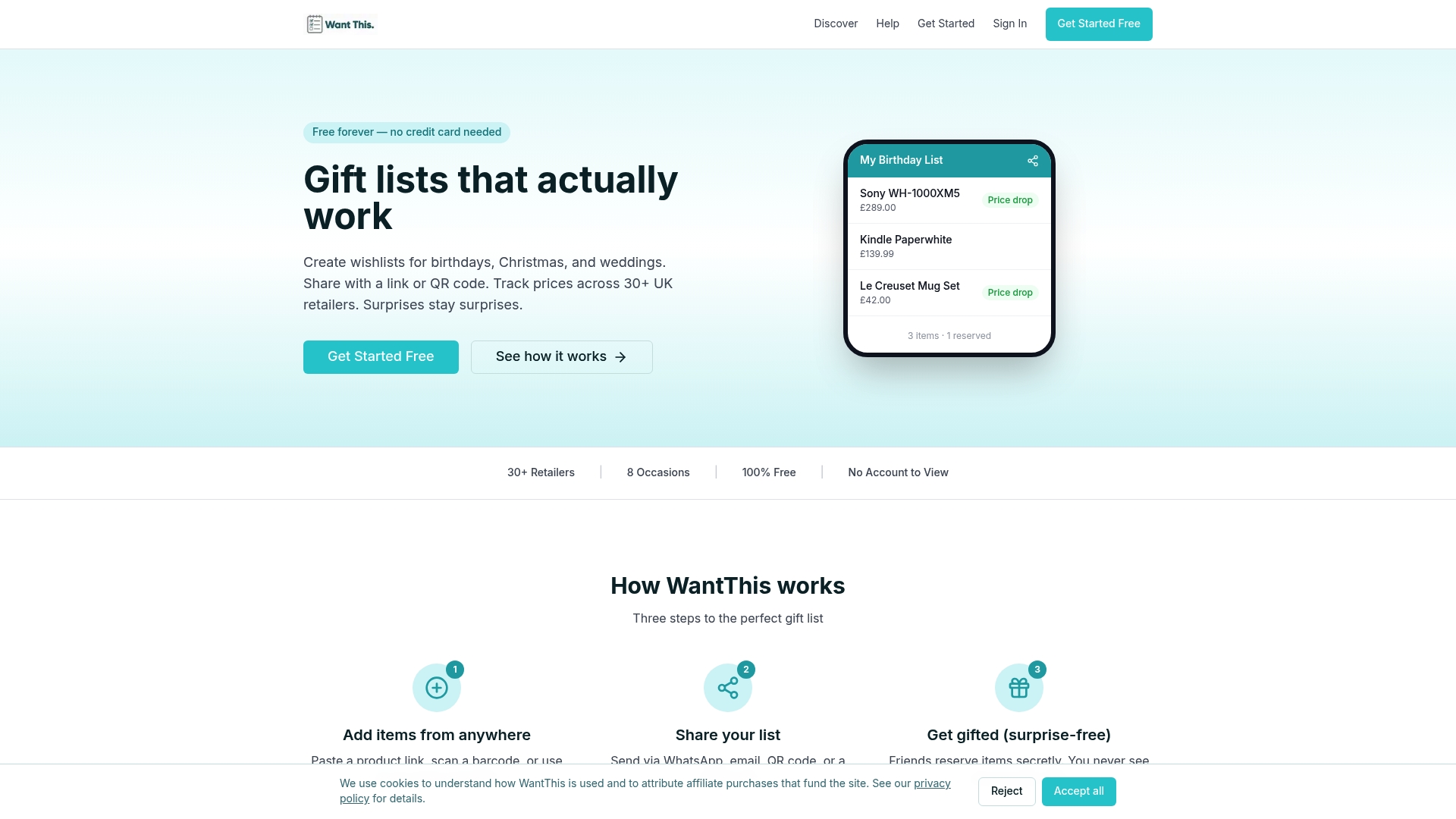
Guests can privately reserve or mark items as bought, so surprises stay intact and duplicates are avoided. The sharing features make it easy to send your list to family and friends across any channel. Whether you want a traditional product list, a blended registry, or a mix of both, WantThis gives you the tools to build it for free.
FAQ
What is a wedding gift registry?
A wedding gift registry is a curated list of gifts that couples share with guests before the wedding. It tracks purchases in real time to prevent duplicate gifts and simplify shopping for everyone invited.
What types of wedding gift registries are most popular in the UK?
Universal registries, traditional product lists, and cash or honeymoon funds are the most common choices for UK couples. Many couples now combine all three to accommodate guests with different giving preferences.
How does a universal registry differ from a single-store registry?
A universal registry lets couples add items from any retailer into one shareable list, while a single-store registry limits choices to one brand or retailer. Universal registries offer more flexibility for both couples and guests.
Is it acceptable to ask for cash as a wedding gift?
Cash funds are widely accepted and increasingly common. Guests respond best when the fund has a clear purpose, such as a honeymoon, a home deposit, or a specific experience the couple has named.
What is the difference between a gift list and a wishlist?
A gift list is event-focused and built for guest coordination, with real-time purchase tracking and duplicate prevention. A wishlist is a personal tool for saving items and lacks the coordination features that make a registry useful for guests.