
Wedding Registry vs Wishlist in the UK: Which Is Better?

For most UK couples, a wishlist is the better fit. A wedding registry ties you to one shop’s range, while a wishlist lets you gather gifts from any UK retailer in one shareable list. You can add the sofa cushions, the good knives and the honeymoon experience side by side. Guests reserve privately, so nobody buys the same thing twice. With WantThis, building that list is free.
This guide explains the difference in plain terms. It also compares the two options on what matters, covers what guests tend to spend, and shows how to set up and share a list without it feeling awkward.
TL;DR
- A traditional wedding registry is a gift list held by a single retailer or list service. A wishlist collects products from as many shops as you like.
- Most couples already live together, so the classic homeware shopping list fits fewer weddings than it once did. A flexible list lets you ask for what you will actually use.
- Guests typically think £76–£100 is right for a close friend or relative and £26–£50 for someone less close, so a list with a spread of prices suits everyone.
- Share your list through your wedding website and word of mouth rather than printing it on the invitation.
- Our free WantThis lists let guests reserve gifts privately, which avoids duplicates and keeps surprises intact.
Table of Contents
- What is the difference between a wedding registry and a wishlist?
- Are wedding registries still the norm in the UK?
- Why a wishlist suits most UK couples
- How to set up a wedding wishlist step by step
- What to look for in a list, whichever type you choose
- Sharing your list without awkwardness
- What guests need from your list
- Worked example: a £1,000-ish spread
- Get started with our free list
- Our perspective
- FAQ
- Sources
What is the difference between a wedding registry and a wishlist?
A wedding registry is the traditional route. You choose a retailer or a dedicated list service, pick items from its catalogue, and guests buy from that same catalogue. The shop tracks what has been bought so items are ticked off.
A wishlist works the other way round. Instead of starting from a shop, you start from your own ideas. You paste in product links from different retailers, and the list sits in one place. Guests follow each link to the retailer to check the latest price and availability and complete the purchase there.
Both do the same basic job: they tell guests what you would like, and stop two people turning up with the same toaster. The practical differences come down to range, flexibility, and how much control you keep.
| Single-retailer wedding registry | Wishlist across retailers | |
|---|---|---|
| Where items come from | One shop or list service catalogue | Any online retailer |
| Mixing shops | Not possible within the list | Built in |
| Items outside the catalogue | Limited to what the provider offers | Add any product with a link |
| Price range | Depends on the catalogue | You choose items at every price point |
| Avoiding duplicates | Handled inside that shop | Private reservations on the shared list |
| Use after the wedding | Usually tied to the occasion | Reuse for birthdays, Christmas, house projects |
| Cost to set up | Varies by provider | Free with WantThis |
Are wedding registries still the norm in the UK?
Less than you might think. In YouGov’s Big Survey on Weddings, only 36% of marriage-positive Britons said they would create a wedding registry, while roughly half (48–52%) said they would not. That suggests many couples want a more personal way to share gift ideas than a catalogue from one shop.
Life before the wedding has changed too. Metro reports that more than nine in ten couples who married in 2021–2022 were already living together, which reduces the need for a traditional homeware shopping list. You probably own a kettle already. What you may want is a better mattress, a coffee machine upgrade, a garden bench, or a contribution towards a trip.
A wishlist handles that variety easily. A registry limited to one catalogue often cannot.

Why a wishlist suits most UK couples
One list, any retailer
The biggest advantage is range. You might want bedding from one retailer, a cast-iron casserole from another, a book you have been eyeing and a day-trip experience. On a wishlist these sit together in one list. Guests do not need to create accounts in several places or work out which shop holds which item.
Gifts at every budget
Guests spend very differently. In YouGov’s survey on guest behaviour, the median spend people thought appropriate was £76–£100 for someone close and £26–£50 for someone less close. The same survey found 21% thought a gift for someone close should not exceed £50, while 30% considered spending more than £100 reasonable. Metro’s coverage adds that 9% would go over £200 for close friends.
That is a wide range, and your list should reflect it. A sensible mix might be:
- A handful of smaller items, such as a quality tea towel set, a book or a candle, for evening guests and colleagues.
- A middle band of useful items for friends and family.
- A few bigger gifts that groups of relatives can choose, such as an appliance or a piece of furniture.
Because a wishlist is not limited to one catalogue, you can fill every band without compromise. Our guide to UK wedding gift etiquette and the £50–£100 range goes further on how guests decide.
Privacy and surprises
On a WantThis list, friends and family can privately reserve gifts or mark them as bought. You see that your list is filling up without spoiling what is coming, and guests see what is already taken. That stops duplicates while keeping the surprise.

Price tracking
WantThis can track price drops across 30+ UK retailers, with alerts and price history. If you are adding bigger items to your own list, or planning purchases for the home you are building together, that helps you decide whether to buy now or wait. Guests always follow the product link to the retailer to see the latest price before they buy.
A list that keeps working
A wedding registry is usually built for one occasion. A wishlist carries on. After the wedding, the same account can hold a room-makeover list, a birthday list, a Christmas list and a baby shower list when the time comes. You can also use our Secret Santa organiser with the same friends and family at Christmas.
How to set up a wedding wishlist step by step
The process is simple, and most couples finish a first draft in an evening.
- Decide what the list is for. Start by sorting your wants into three groups: things for the home, experiences or honeymoon extras, and small treats. Aim for more items than guests, so people have a choice.
- Create the list. Sign up for free and start a new list for your wedding. Our wedding gift list page shows the layout couples use.
- Add products from any retailer. Paste product links from different shops. When you add a link, WantThis can import available product details such as the name and image, which saves typing. The browser extension and the iOS and Android apps let you save items as you browse.
- Spread the prices. Check your list covers small, medium and larger gifts, using the YouGov ranges above as a guide.
- Keep it tidy. Group items by room or type so guests can scan quickly. Remove anything you have since bought yourselves.
- Share the link. Use the sharing features to send your list privately to the people you choose.
- Let reservations do the work. Guests reserve or mark an item as bought. You do not need to chase anyone.
For a longer walk-through, see our wedding gift list guide for UK couples and our piece on how couples coordinate wedding gifts.
What to look for in a list, whichever type you choose
When couples compare options, these are the features that make the biggest day-to-day difference:
- Range of shops. The more retailers you can draw from, the closer the list is to what you really want.
- Private reservations. Guests should be able to claim an item without you seeing who chose what before the day.
- Easy sharing. One link that works on a phone, without guests having to sign up to see it.
- Price visibility. Guests like to see prices at a glance so they can pick within budget.
- Mobile access. Most guests will open your list on their phone.
- Life after the wedding. A list you can reuse is better value for your time.
A wishlist on WantThis covers these points: lists from any retailer, private reservations, shareable links, price tracking and apps. Our overview of the types of wedding gift registries explains the other routes in more detail if you want to see them laid out.
Sharing your list without awkwardness
The list is only useful if guests find it, and the etiquette matters more than the tool. The Telegraph’s guide to giving cash at weddings quotes etiquette experts saying that word of mouth through friends and family is considered the most polite way to spread the word about a registry. A tactful note under the “gifts” tab of your wedding website is the most straightforward written option, while a blunt request for money still jars.
In practice:
- Put the link on your wedding website, under a gifts page, rather than on the invitation itself.
- Tell your parents, wedding party and closest friends so that they can answer when guests ask.
- Keep the wording warm and optional. Say your presence matters most and that a list exists for anyone who would like one.
- If you want contributions towards a honeymoon or a project, say what it will fund. The Telegraph’s experts advise being upfront about what the money is for.
If you would rather not receive gifts at all, we have copyable wording for a no-gifts wedding. For a gentle script for the list itself, see how to ask for gifts politely.
Cash, experiences and honeymoon funds
Many couples want a mix. Metro reports that just over two-thirds of Brits feel comfortable with a couple asking for cash rather than a physical present, and fewer than a quarter think it tacky. A wishlist makes a blended approach natural: include physical products and experiences, and mention on your wedding website if a contribution towards a trip would be welcome. Guests who prefer something to unwrap still have plenty to choose from.
What guests need from your list
Think of the person opening it on their phone on a Tuesday evening. They want to know three things quickly: what you would like, what it costs, and whether someone else has already bought it. They do not want to register anywhere, or hunt across several websites.
A clear list therefore:
- Shows a good number of items in each price band.
- Includes a few group gifts for relatives who want to pool money.
- Uses direct product links so the guest lands on the right page.
- Updates when items are reserved, so there are no clashes.
Guests follow each product link to the retailer, where they check the latest price and availability and finish the purchase. Where we use affiliate links, we disclose them.
Worked example: a £1,000-ish spread
Imagine a couple with around 80 guests, about 30 of them close friends and family and 50 evening guests. A balanced list of 40 items might look like this:
| Band | Number of items | Who it suits |
|---|---|---|
| Under £30 | 12 | Evening guests, colleagues |
| £30–£75 | 14 | Friends, wider family |
| £76–£100 | 8 | Close friends and relatives |
| Over £100 | 6 | Groups, parents, godparents |
The bands follow the YouGov spending views above. The total of the list matters less than the spread: every guest should find something that feels right for them without having to apologise for their budget.
Get started with our free list
WantThis is a free UK wishlist and gift list platform. You can bring together product links from different retailers, organise them into a wedding list, share it privately and let guests reserve gifts without spoiling surprises. You can also browse gift ideas by category and wedding gifts for couples for inspiration.
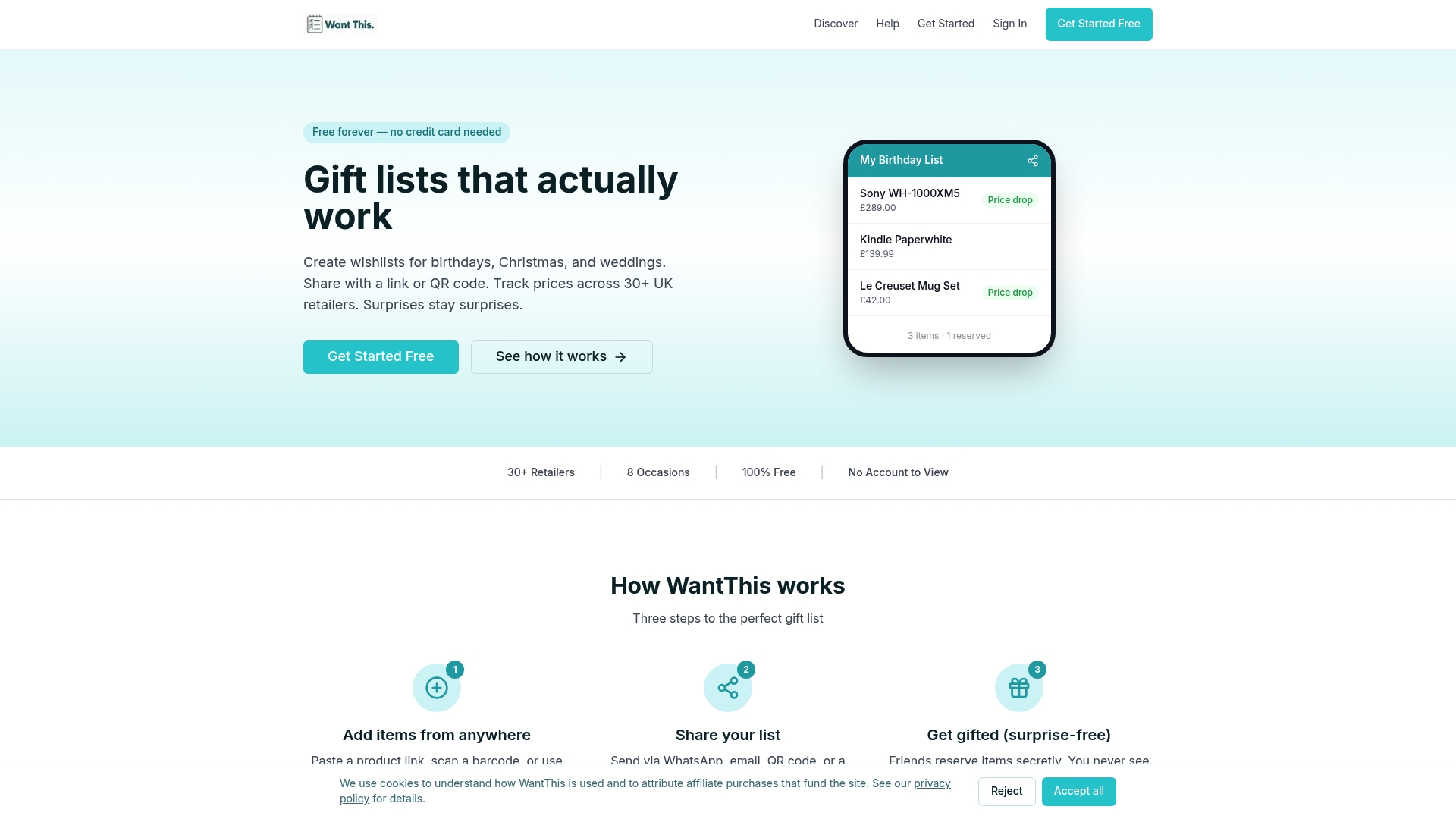
Start your list on WantThis and add your first few items today. If you want to see how others lay theirs out first, browse public wishlists by topic.
Our perspective
We built WantThis because gift lists should follow what people want, not the catalogue of one shop. A wedding is the clearest example. Couples have different homes, different tastes and guests with very different budgets, and a single list that spans every retailer fits that reality far better.
The part we care about most is the guest experience. A guest who can open one link, see the price, reserve privately and click through to the retailer is far more likely to pick something you will love. That is why we focus on private reservations, clear product details and easy sharing.
Our advice to couples: start with a wishlist, fill it across every price band, share it through your wedding website and the people closest to you, and keep it going for birthdays and Christmas afterwards. It is free, and it keeps working long after the confetti.
Stuart
FAQ
Is a wedding wishlist the same as a wedding registry?
They do the same job but work differently. A registry is usually a list held by one retailer or list service from its own catalogue. A wishlist collects product links from any retailer into one list that you share yourself. Most couples find the wishlist gives them more choice.
Can guests buy from a wishlist without spoiling the surprise?
Yes. On WantThis, friends and family can privately reserve gifts or mark them as bought. That avoids duplicates and keeps the surprise, and guests follow the product link to the retailer to complete the purchase.
How much should I expect guests to spend?
YouGov’s survey found the median amount people consider appropriate is £76–£100 for someone close and £26–£50 for someone less close. A list with items across those ranges, plus a few larger group gifts, suits most guest lists.
When should I share my wedding list?
Share it once your wedding website is ready, and tell close family and the wedding party so they can pass it on. Etiquette experts quoted by the Telegraph see word of mouth and a gifts page on your wedding website as the most tactful routes, rather than putting it on the invitation.
Can I use the same list after the wedding?
Yes. A WantThis account can hold several lists, so you can keep one for home projects, birthdays, Christmas or a future baby shower, and you can run a Secret Santa draw with the same people.
Sources
- The YouGov Big Survey on Weddings: How would Britons plan their wedding
- The YouGov Big Survey on Weddings: How should guests behave at a wedding
- Metro: the amount Brits think you should spend on a wedding gift
- The Telegraph: how much cash you actually need to give at a wedding