
Cash Gift Wording UK: What to Write in Cards, Notes and Requests

The best cash gift wording does three things: it says what the money is for, adds one warm line about the person, and leaves the amount off the page. Whether you are giving, asking or saying thank you, a few plain sentences are enough. Below you will find lines you can copy for weddings, birthdays, Christmas and thank-you notes, plus a clear explanation of how a gifted deposit letter differs from a card message.
TL;DR
- Say what the money is for, even if the answer is “nothing in particular”, and add one personal line. Leave the amount out.
- Never apologise for giving cash. Present it with confidence and put it inside a proper card.
- To ask for money, use a wedding website, an insert card or word of mouth, never the invitation itself.
- A gifted deposit letter is a lender document, not a greeting. It follows its own rules.
- When you say thank you, name what the money is going towards.
Table of Contents
- The basic formula for cash gift wording
- Wording for weddings
- Wording for birthdays, christenings and other occasions
- How to ask for money politely
- Wording for a gifted house deposit
- Is a cash gift taxable?
- How to say thank you for a cash gift
- Our perspective
- Make gift-giving easier with a shared list
- Choosing between cash and a gift
- FAQ
- Sources
The basic formula for cash gift wording
Most good messages follow the same three-part shape. Once you know it, you can write one for any occasion in under a minute.
- The purpose. Tell them what the money is meant to become: a holiday, a new coat, a night out, a contribution to the house. If there is no purpose, say so cheerfully: “to spend on something you’d never buy yourself.”
- The personal line. One sentence that could only go to this person. A shared memory, a hope for the year ahead, a joke only the two of you get.
- The warm close. Keep it short: “Enjoy every penny”, “Congratulations, both of you”, “Happy birthday, with love.”
The amount does not need to appear. The recipient will see it when they open the card, and writing it down can make a gift feel like a transaction. Keeping the figure private also saves anyone embarrassment when cards are opened in front of others.
A second rule: do not apologise. Phrases such as “I know it’s only money” or “sorry, couldn’t think of anything” make the gift feel smaller than it is. Money is a practical, flexible present, and most people are glad to receive it.
A third, practical one: handwrite the message if you can, and fold notes inside the card rather than leaving them loose. A bank transfer deserves a message too. Put a line in the payment reference or send a short text so it does not arrive as an anonymous number.
Wording for weddings
Cash in a card is the long-standing norm at UK weddings, and the message matters more than the figure. If you are unsure how much to give, our guide to UK wedding gift etiquette and the £50 to £100 range walks through the usual thinking.
Short messages for the card
- “Wishing you a lifetime of happiness. Please put this towards something special for your first year together.”
- “With all our love on your wedding day. This is for a very good dinner on your honeymoon.”
- “Congratulations, Sam and Alex. A little something towards your new home and everything that goes in it.”
- “To the happy couple: we hope this helps make a few of your plans come true.”
Notice that none of these name an amount, and all of them link the money to the couple’s future. That is the thread that turns a note into a gift.
Wording for a specific purpose
Guests often know the couple is saving for something particular. Naming it shows you listened.
- Honeymoon: “For the honeymoon fund, and specifically for one lovely meal you’d never normally book. Congratulations, both of you.”
- House deposit: “Towards the keys to your first home. We can’t wait to visit.”
- Home improvements: “For the sofa you’ve been eyeing up. Have a wonderful wedding day.”
- Experiences: “For a day out together, on us. Fill it with something you’ll remember.”
A house-deposit gift to a married couple works as a card message like any other. If a mortgage lender needs proof it is a gift, that is a separate document, covered further down.
Wording for birthdays, christenings and other occasions
Birthday and christening cards follow the same formula, adjusted for tone.
Birthdays
- “Happy birthday! Go and buy something delightfully unnecessary.”
- “Happy 30th. This is towards the trip we’ve been talking about for ten years.”
- “For the new camera. Happy birthday, and send us the first photo.”
Children and teenagers
- “Happy 10th birthday! This is for you to spend or save, but we’d suggest a bit of both.”
- “Well done on your exams. Put it towards the driving lessons.”
Christenings and new babies
- “For Ellie’s future, whatever it holds. With love on her christening day.”
- “Welcome to the world. A little something for the savings jar, or for a first pair of tiny shoes.”
Christmas
- “Merry Christmas! Treat yourself to something in the January sales.”
- “With love at Christmas. Towards the winter coat you keep promising yourself.”
Keep Christmas messages warm and personal. A line that nods to the year you have both had will always land better than a generic greeting. If you are planning a family gift swap, our Secret Santa organiser handles the name draw automatically, so nobody has to count out slips of paper.
How to ask for money politely

The etiquette question comes up most with weddings. The consensus among UK etiquette commentators is that word of mouth is the most polite way to let guests know, and that you should not put a request for cash on the invitation. The Telegraph’s guide to cash at weddings suggests a wedding website’s gifts page as a tactful alternative. The etiquette authority Emily Post takes a similar line: cash presents are acceptable when guests feel comfortable with the idea, and it also recommends offering a small registry so guests have a sense of what is needed.
Where to put the request
- Wedding website: the best place. Guests who want to know look, and everyone else is not put on the spot.
- A separate insert card: tucked into the invitation envelope, never printed on the invitation itself.
- Word of mouth: parents, the wedding party and close friends can pass it on kindly when asked.
If you are planning the wider day, even the extras you choose for the reception (such as wedding reception extras) are part of what you might mention if guests ask where their gift will go.
Wording you can copy
Lead with gratitude for their presence, then mention the money lightly and leave a graceful way out.
- “Your presence at our wedding is the greatest gift. If you’d like to give something more, a contribution to our honeymoon fund would mean a great deal.”
- “We already have a home full of things, so we’re saving for our first home together. If you’d like to help, there’s a link on our wedding website. There’s no obligation at all.”
- “We’d love to see you on the day. Should you wish to give a gift, we’re putting any contributions towards the house we’re saving for.”
For more lines of this kind, including how to say “no gifts please”, see our page on wedding no-gifts wording. If you would rather combine a few cash contributions with specific items, our guide to asking for gifts politely explains how a wedding wishlist can sit alongside a money request.
Asking for money at Christmas or birthdays
Outside weddings, requests are usually between family members, so a short message on a shared list or in a family chat is enough. Be specific and keep it light: “We’re saving for a trip to Greece next summer. If anyone wants to contribute, even a small amount helps, and we’d love to send you photos.” Naming a goal makes giving easier, because people like to know where their money is going.
Wording for a gifted house deposit
A gift towards a deposit has two layers: the message you write to the person, and the paperwork a lender may ask for. Keep them separate.
The card message
- “For your first home, with all our love. Wishing you every happiness in the new place.”
- “A little help towards your deposit. We’re so proud of you both.”
- “Towards the front door key. Now, when is the housewarming?”
These read like any other cash gift: warm, purposeful and free of numbers. If you are buying something for the new home as well, our gifts under £100 guide has ideas.
The gifted deposit letter
If the money is going towards a mortgage deposit, the lender will usually want formal proof that it is a gift and not a loan. NatWest explains that a gifted deposit letter is signed by the person giving the money. It states that they expect no repayment and make no claim to the property.
A typical letter, according to Oakstead Finance’s template guidance, includes:
- The names and addresses of the giver and the recipient, and how they are related.
- The exact amount being gifted.
- The address of the property being bought.
- A statement that the money is a genuine gift: not a loan, with no interest and no share in the property.
- Confirmation that the giver will not live in the property, or a note if they will.
- A statement about where the money came from.
- A signature and date.
The same source explains that lenders want this to be sure the money is not a disguised loan, that the giver has no claim on the property, and that the source of funds is legitimate for anti-money-laundering purposes. Many lenders have their own form, so ask yours which one to use before you write anything. A conveyancer or your mortgage adviser can tell you if your situation, such as several people gifting together, needs anything extra.
The difference in tone is the point. A birthday card is personal and leaves out the figure. A deposit letter is a formal declaration and must include it.
Is a cash gift taxable?
Most readers wonder about this before they hand over a larger sum, so it is worth getting right. For everyday amounts, there is nothing to fuss about, but larger gifts have rules.
- For the person receiving it: a genuine cash gift is generally not taxable income and does not normally need reporting to HMRC, according to this UK tax guide.
- For the person giving it: Inheritance Tax can come into play. Gifts between individuals are usually exempt if the giver lives for at least seven years afterwards. If they die within that period, the gift can become chargeable, with the 40% rate applying above the £325,000 nil-rate band, as a 2026 private wealth practice guide describes.
- The annual allowance: each person can give away £3,000 a year free of Inheritance Tax, and one unused year can be carried forward, so a parent who gave nothing last year can give up to £6,000 this year. The tax guide above sets this out. The tax is paid by the estate, not by the recipient.
If you are planning a large gift, talk to a qualified tax adviser or solicitor about your own circumstances. A birthday or Christmas card with money in it is not affected.
How to say thank you for a cash gift
The same principle applies in reverse: name what the money is becoming and skip the figure. People enjoy picturing their gift being used, and it reassures them they chose well.
- “Thank you so much for the generous Christmas money. I’m putting it towards a new winter coat, so I’ll think of you every time I wear it.”
- “We’re saving for a deposit on our first home, and your generosity is hugely appreciated.”
- “Thank you for the birthday money. It’s going towards the weekend away I’ve been wanting for ages.”
- “Your gift helped us to a wonderful honeymoon dinner. We raised a glass to you.”
For weddings, Emily Post’s advice on wedding thank-yous is to mention what you plan to do with any money, and to write all guest thank-you notes within three months of the wedding or of receiving the gift.
A quick structure for thank-you notes
- Greet them by name.
- Thank them for the gift, without quoting the amount.
- Say what it is going towards.
- Mention something personal, such as how lovely it was to see them.
- Sign off warmly.
Three or four sentences are plenty. Handwritten is lovely, but a thoughtful message is better than a late one.
Our perspective
We built WantThis because people already know what they want to say about gifts, but they have nowhere tidy to say it. Money is the clearest case. Many people would rather receive cash towards something specific, yet feel awkward saying so.
What we see is that the awkwardness fades when the ask is clear and private. A shared list lets a couple or a family say what they are saving for and what they would actually like, and guests can choose in their own time. Friends and family can reserve gifts or mark them as bought privately, so duplicates and spoiled surprises are avoided.
Our lists are free, and they can mix cash-style goals with real products from different retailers. For anyone who prefers a thing over a sum, saving the exact item and sharing the list is often kinder than hinting. And if you are the one giving, a list tells you what will be used, so the message you write can be specific and sincere.
Stuart
Make gift-giving easier with a shared list
Cash is simple, but not everyone wants to give it, and not everyone wants to receive only that. With WantThis, you can create a free wishlist and add products from any online retailer. You can organise lists for birthdays, Christmas, weddings and baby showers, and share them privately so friends and family can reserve something without anyone doubling up.
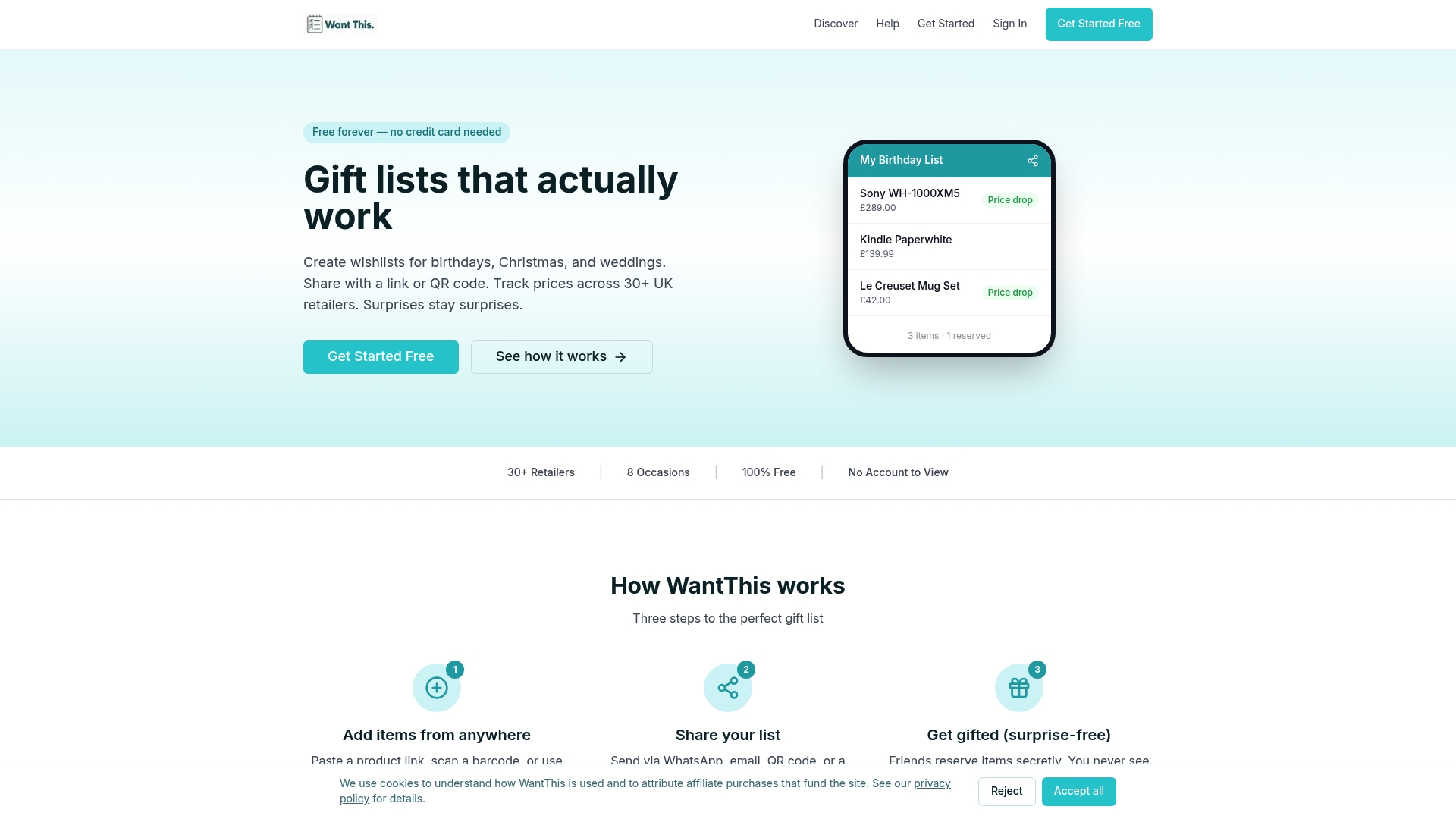
If you are planning a wedding, our wedding gift list page shows how couples bring together items they would like. Our sharing feature explains how guests see the list, and price tracking lets you watch for price drops on items you are saving for. You follow product links to the retailer to check the latest price and availability and to buy. Where we use affiliate links, we say so.
Choosing between cash and a gift
Sometimes cash is exactly right, and sometimes a chosen present will mean more. A few guides to help you decide:
| Situation | Cash works well when… | A chosen gift works well when… |
|---|---|---|
| Wedding | The couple is saving for a honeymoon or home | They have shared a list of things they want |
| Birthday | You are not sure of their taste | You know exactly what they have been eyeing |
| Christmas | The recipient is a teenager or hard to buy for | Someone has posted a wishlist |
| New baby | Parents are saving for the future | They need specific items for the nursery |
| Housewarming | They are mid-move and need flexibility | They have a list of practical items |
If you want more thinking on wedding registries, our guide to types of wedding gift registries covers the options for UK couples, and our wedding gift list guide for 2026 explains how to set one up. For ideas by person and budget, browse our gift guides.
FAQ
Should I write the amount in a cash gift card?
No. It is generally fine in the UK to leave the amount out, because the recipient will see it when they open the card. Focus the message on the occasion, what the money is for and a personal line about them.
How do I politely ask for money instead of presents?
Put the request on a wedding website, on a separate insert card or pass it on by word of mouth. Never print it on the invitation itself. Begin by saying that their presence is the real gift, then mention what you are saving for and make clear that there is no obligation.
What is the difference between cash gift wording and a gifted deposit letter?
A cash gift message is personal and warm, and usually leaves out the amount. A gifted deposit letter is a formal declaration signed by the giver for a mortgage lender. It states the exact amount and that the money is not repayable, and that the giver has no claim on the property.
Do I have to pay tax on a cash gift?
A genuine cash gift is generally not taxable income for the person who receives it. The giver may have Inheritance Tax to consider if they die within seven years, although each person can give £3,000 a year without that concern. For larger gifts, check your situation with a tax adviser.
How soon should I send a thank-you note for money?
Aim for within three months of the wedding or of receiving the gift, and sooner for birthdays and Christmas. Say what you plan to spend the money on, rather than quoting the figure.
Sources
- The Telegraph: how much cash to give at a wedding
- Emily Post: asking for money as a wedding gift
- Emily Post: wedding thank-yous
- NatWest: using a gift for a house deposit
- Oakstead Finance: gifted deposit letter template
- Chambers: Private Wealth 2026, UK
- Your Tax Help: does money from parents count as income?
- Terrific’s Entertainment: wedding reception add-ons