
Get Better Gifts: Organise Wishlists by Occasion with Wantthis for UK

Create a separate, named wishlist for each occasion, highlight two or three priority items, and set simple low, medium and high price tiers. Share the link with reservations switched on so buyers can mark items as bought without spoiling the surprise for anyone else. Use a wishlist tool that works with any retailer, like Wantthis, so you’re not stuck adding items from one shop.
TL;DR:
- Explicitly requesting specific items with clear links and notes significantly increases the likelihood of receiving desired gifts and reduces guesswork for givers.
- Creating separate, occasion-specific lists helps prevent duplicate gifts, streamlines shopping, and makes updating or maintaining lists easier over time.
- Including a variety of price tiers and highlighting priority items ensures the list appeals to different budgets and guides gift-givers effectively.
- Using tools that enable private reservations, price tracking, and cross-retailer organization simplifies managing multiple lists and preserves surprises.
- Avoid listing registry details on formal invitations to adhere to etiquette and prevent the appearance of demands that could detract from the gift’s perceived thoughtfulness.
Table of Contents
- Why organising wishlists by occasion helps (the research behind it)
- How do you create a wishlist for any occasion?
- Occasion-specific wishlist ideas you can copy today
- How do you share a wishlist without spoiling the surprise?
- Managing several occasion lists without losing track
- Quick wins and mistakes worth avoiding
- A short note on using occasion lists in family life
- Build your occasion lists with Wantthis
- Sources
- FAQ
Why organising wishlists by occasion helps (the research behind it)
Splitting your gifting into occasion-specific lists isn’t just tidier. It changes what people actually buy you.
Five separate experiments, including Amazon wishlist exercises and wedding and birthday scenarios, found that recipients rated explicitly requested gifts as more thoughtful than surprises, even though givers assumed the opposite would be true. That gap between what givers think works and what recipients actually prefer is the whole reason vague hints fail. Stanford Graduate School of Business found givers consistently underestimate how many recipients value being asked directly.
Pro Tip: A single clear list is easier for a busy relative to act on than a scattered mix of hints dropped over three conversations. Research from Harvard Business School backs this up: explicit requests reduce the guesswork that makes gift shopping stressful for the giver.
Occasion-based lists also solve the duplicate-gift problem before it starts. When your birthday list is separate from your Christmas one, nobody buying from either has to wonder whether Auntie Jean already grabbed that jumper for December. For the giver, it means faster shopping, clearer budgeting, and less last-minute panic in the supermarket aisle on Christmas Eve.

How do you create a wishlist for any occasion?
Building a wishlist by occasion takes ten minutes once you know the order to do it in. Follow this sequence and you’ll end up with something genuinely useful, not just a pile of links.
- Name and date each list clearly. “Sarah’s 30th, 14 March” beats “My Wishlist” every time, especially once you’re juggling four or five lists a year.
- Add exact product links with a short note. Paste the retailer link, let the title, image and price pull through automatically, then add a line explaining why you want it (colour, size, or “for my new flat”).
- Set price tiers. Tag items as low, medium or high, so a colleague with a £10 budget and a partner with £100 to spend both find something suitable.
- Mark two or three priority items. These are the things you actually want most. Everything else is a nice-to-have.
- Add group-gift or cash-fund options for bigger items. If you want something over £150, itemise it clearly and note whether contributions can be pooled.
- Maintain the list. Remove anything that’s been bought or that you’ve bought yourself, and refresh it every few months so it never goes stale.
Pro Tip: Treat price tiers like a filter, not a restriction. A guest deciding between two items in the same tier will almost always pick the one with your note attached, because it removes the guesswork entirely.
Keeping the naming convention consistent across every occasion also makes list number six, the maintenance step, far less of a chore. You’ll thank yourself in November when you’re trying to find last year’s Christmas list to update it.
Occasion-specific wishlist ideas you can copy today
Different occasions call for different structures. A birthday list that works brilliantly falls flat as a wedding registry, and vice versa. Here’s how to shape each one.

Birthdays: Structure this as one splurge item you’d love but wouldn’t buy yourself, three mid-range items in the £20 to £50 range, four smaller items under £15, and a voucher option for anyone who’d rather not guess. This spread means whoever’s buying, whatever their budget, finds something that fits without asking you directly.
Weddings: A hybrid registry works best here. Combine physical items from your usual retailers with named cash funds for a honeymoon or house deposit, and allow group gifting on bigger-ticket items so multiple guests can club together. Shortlist Wedding recommends offering a genuine range of price points rather than clustering everything at one end, and setting the list up six to eight months in advance with enough items so it doesn’t run dry after the first few guests have bought.
Christmas: Enable group gifts for anything expensive, add a handful of last-minute stocking-filler options under £10, and include at least one voucher for the relative who always leaves shopping until 23 December.
Baby showers: Prioritise practical needs and consumables over toys. Nappies, sleepsuits and feeding gear should carry sizes and, where relevant, expiry notes, since buying the wrong size wastes everyone’s time and money.
Seasonal and holiday lists: Favour experiences and consumables where it makes sense; a spa voucher or a bottle of something good tends to get used far more reliably than another ornament nobody asked for.
Browsing a gift ideas hub by category, whether that’s tech, home, beauty, or garden and outdoor, is often the fastest way to fill gaps once your structure is set.
How do you share a wishlist without spoiling the surprise?
Sharing well is mostly about controlling who sees what, and when. Get this wrong and you either spoil surprises or end up with three identical jumpers.
- Switch on private reservation features so anything marked as bought disappears from other viewers’ screens, not just yours.
- For weddings, put registry details on your wedding website or a separate insert card, never on the formal invitation itself, which UK etiquette still treats as a faux pas.
- Use short, polite wording: “If you’d like to give a gift, our list is on [wedding website]. There’s no obligation at all.”
- Add private notes for sizing, colour or variant preferences directly on each item, so nobody has to message you to double-check.
Pro Tip: Reservation privacy is the single feature that stops family group chats descending into “did anyone already buy the coat?” chaos. If a tool doesn’t offer it, that’s a genuine gap.
A dedicated sharing feature that hides reserved items from other guests does more heavy lifting here than any amount of polite wording.
Managing several occasion lists without losing track
Once you’re running a birthday list, a Christmas list, and maybe a baby shower list at the same time, organisation becomes the whole game. A few habits keep it manageable.
- Archive lists once the occasion passes instead of deleting them, so you can reuse successful formats next year.
- Use price tracking and drop alerts so items you’ve saved get cheaper before someone buys them; this matters most around sales events, when prices can shift significantly in a short window.
- Rely on private reservations and purchase tracking across every list, not just one, so duplicate gifts can’t slip through between occasions.
- Add items on the move with a browser extension or a mobile app, rather than saving links to message yourself later and forgetting about them.
Wantthis was built around exactly this pattern: paste a link from any retailer, organise by occasion, and let price tracking and reservations do the quiet work in the background.
Quick wins and mistakes worth avoiding
A few adjustments make the biggest difference to how useful your list actually is:
- Flag one item clearly as your top pick. It gives indecisive givers permission to stop scrolling.
- Include a genuine spread of price points, plus one flexible option like a voucher or experience.
- Mark items as fulfilled the moment they’re bought, not weeks later.
- Never print registry details on a formal invitation. Etiquette still frowns on it, and it reads as presumptuous.
Pro Tip: A list with only expensive items looks like a demand, not a request. Mixing tiers is what makes it feel considerate rather than transactional.
A short note on using occasion lists in family life
Running separate lists for each occasion has, in practice, cut down the number of duplicate gifts turning up in my house. It sounds like a small thing until you’ve unwrapped the same board game twice in one Christmas.
The clearest example was a wedding hybrid list: physical homeware alongside a named honeymoon fund, with group gifting switched on for the bigger items. Guests who wanted to spend £15 and guests who wanted to club together on something worth £200 both found a natural way in. If you want to try the same structure, the gift guides hub is a reasonable place to start building one out.
— Stuart
Build your occasion lists with Wantthis
Wantthis gives you one place to run every occasion list without juggling five different retailer accounts. Paste a link from any online shop and the title, image and current price pull through automatically, so building a wedding, birthday or Christmas list takes minutes rather than an evening.
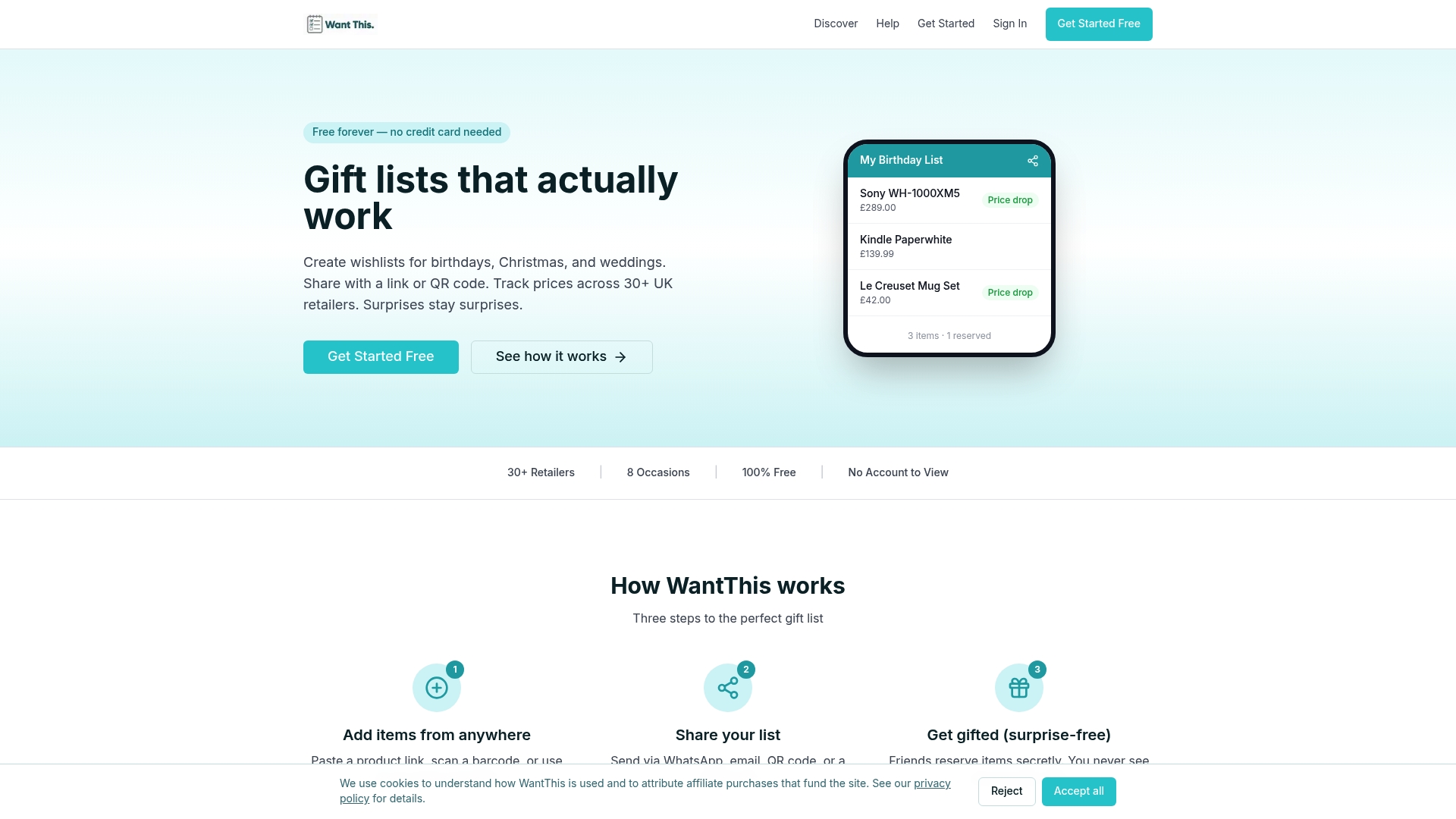
Price tracking and drop alerts sit quietly in the background across 30+ UK retailers, flagging when something on a saved list gets cheaper, which matters most in the run-up to sales events. Private reservations allow buyers to mark items as bought privately, helping keep surprises intact and avoiding duplicate gifts. There’s also a built-in Secret Santa organiser with an automatic draw for office or family exchanges, plus a browser extension and mobile apps for adding items while you’re actually shopping. It’s free to use, with no account needed just to browse. Start a list on Wantthis and organise your next occasion properly, from the first item to the last thank-you.
Sources
The gift-satisfaction research referenced throughout comes from Stanford GSB’s five-experiment study and its coverage by Harvard Business School. The giver-recipient mismatch findings draw on Steffel, Williams and LeBoeuf’s academic research, while practical registry structure follows guidance from Shortlist Wedding.
- Give Them the Gift They’re Expecting | Stanford Graduate School of Business
- Give Them What They Want: The Benefits of Explicitness in Gift Exchange - Harvard Business School
- Wedding gift registry guide, how to… | Shortlist Wedding
FAQ
What are some good ideas for a wishlist?
Mix price tiers rather than listing only expensive items: one splurge, a few mid-range picks, and some smaller extras under £15. Include at least one flexible option, such as a voucher or experience, since research on gift preferences shows recipients often value flexibility over highly personalised items.
What is the best wishlist site?
The right choice depends on whether you want a single-retailer registry or a tool that works across every shop you use. Wantthis is built for UK shoppers who want one occasion-organised list that pulls items from any retailer, tracks price drops, and lets buyers reserve gifts privately.
How do I find someone’s wishlist?
Ask them directly for the shared link, since most modern wishlist tools generate a private URL rather than listing publicly by default. If they’ve mentioned a platform like Wantthis, you can usually find the shared list through the link they’ve sent by email, text or a wedding website.
What should I put on my wishlist?
Highlight two or three priority items clearly, since explicit requests consistently outperform vague hints in gift satisfaction. Add a short note on sizing or colour for anything that needs it, and include a spread of price points so anyone buying, regardless of budget, can find something to give.