
12 Shareable Birthday Wishlist Ideas You Can Build in 10 Minutes (UK)

Start with a shortlist across four spots: one experience, one tech item, one subscription, and one home or self-care treat, then build outward. Create it as a shared online wishlist rather than a mental note, so guests avoid duplicate gifts and can pick something within their budget. WantThis is built for exactly this, and 15 to 25 items is the sweet spot for most lists.
TL;DR:
- Aim for 15 to 25 well-defined items across all price tiers to maximise choice without overwhelming guests or causing duplication.
- Include exact links, sizes, and colours for each item, and activate reservation features for smooth coordination among guests.
- Share the wishlist two to three weeks before the event to give guests enough time for planning and to avoid last-minute overlaps.
- Use dedicated tools like WantThis to automatically import product details, track prices, and facilitate private reservations, simplifying list management.
- Balance categories and price levels to cater to different budgets and preferences, ensuring the list appeals to a wide range of guests and gift givers.
Table of Contents
- 12 quick birthday wishlist ideas to add right now
- Gift ideas organised by category
- How many items to include and how to mix price tiers
- Step-by-step: create and share an online birthday wishlist
- How to share, reserve items and avoid duplicate gifts
- Copyable wishlist templates for different audiences
- Why WantThis is a practical tool for building your wishlist
- An honest note on what actually goes wrong
- Build your list in minutes with WantThis
- Sources
12 quick birthday wishlist ideas to add right now
Before you overthink categories and templates, here’s a starter set. Pick four or five that fit the person you’re shopping for (or the birthday you’re planning) and add them to a shared list before doing anything else.
- A weekend cookery class — best for food lovers who’d rather learn than unwrap. Mid-tier.
- Noise-cancelling earbuds — best for commuters and anyone who works from a busy kitchen table. Splurge.
- A three-month coffee or tea subscription — best for people who always say they “don’t need anything.” Budget.
- A digital gift card to a favourite shop — best for indecisive recipients or last-minute guests. Budget.
- A weighted blanket — best for anyone who mentions being stressed more than twice a month. Mid-tier.
- Tickets to a live show or comedy night — best for the friend who’s always up for a night out. Mid-tier.
- A personalised photo book — best for sentimental relatives and grandparents. Budget.
- A smart plant or herb-growing kit — best for reluctant gardeners with good intentions. Budget.
- A subscription box tied to a hobby (wine, crafts, books) — best for someone whose interests you don’t fully know yet. Mid-tier.
- A decent set of kitchen knives — best for the new cook or recent house-mover. Splurge.
- A spa or massage voucher — best for anyone overdue a proper rest. Splurge.
- A board game or puzzle — best for family gatherings and low-key birthdays. Budget.
None of these need much explanation on a wishlist beyond the item name and a link. That’s the point: a good birthday wishlist removes the guesswork for the buyer, not just the fun for the recipient. If a couple of these feel obvious once you see them written down, that’s normal. Most of the best birthday gifts are things people want but wouldn’t ask for out loud, which is exactly why a wishlist exists in the first place.
Gift ideas organised by category
A wishlist that leans entirely on one type of gift gets predictable fast. Spreading ideas across categories gives guests real choice and stops every present looking the same on the day.
Tech. Wireless charging pads, a smart speaker, a portable power bank, a phone tripod for content creators, a streaming device, noise-cancelling headphones, an e-reader, and a smartwatch band in a colour you actually like. Note the exact model and storage size where it matters, size and compatibility details prevent the wrong version turning up.
Experiences. A cookery class, an escape room, a spa day, theatre or gig tickets, a wine-tasting evening, a hot air balloon ride, a weekend away voucher, and an annual pass to a gallery or zoo. Experiences don’t sit on a shelf gathering dust, and mixing tangible gifts with experiences tends to broaden a list’s appeal across different budgets. For anything with a date attached, link the e-ticket page directly so the buyer can check availability before purchasing.
Home. A weighted blanket, a scented candle set, a stylish desk lamp, a set of good bed linen, a small kitchen gadget (air fryer, coffee grinder), framed prints, and a robot vacuum. Include size or colour preferences directly in the item note.
Hobbies. A beginner’s pottery kit, a film camera, running shoes in the correct size, a board game, gardening tools, a musical instrument accessory, and craft supplies for whatever they’ve recently taken up. Specify size, edition or skill level so the gift matches ability, not just interest.
Self-care. A massage voucher, a skincare set, a meditation app subscription, a weighted eye mask, a bathrobe, and a monthly flower delivery. A subscription slot works particularly well here, it keeps giving after the birthday itself.
Fashion. A cosy jumper, a leather wallet, a statement scarf, quality socks (genuinely always welcome), a watch strap, sunglasses, and a tote bag. Always note size and colour, this is the category where vague entries cause the most returns.
Kids. Building sets, a scooter, an art supply bundle, a subscription book box, outdoor play equipment, a board game for family nights, and a beginner’s science kit. Whether you’re shopping for a dad or picking fashion for anyone on the list, a specific size beats a general category every time.
How many items to include and how to mix price tiers
Aim for 15 to 25 items. Fewer than that and multiple guests end up eyeing the same present; more than that and the list becomes a scroll nobody finishes reading. That range gives a group of family and friends enough spread to pick without duplicating, which is the entire reason wishlists work better than guessing.
Split the list roughly like this:
- Budget tier (around 50% of items) — items under £20 to £25, gift cards, small self-care extras, books, socks, candles. This is where casual acquaintances and kids’ party guests will shop.
- Mid tier (around 35% of items) — £25 to £75, subscription boxes, experiences, mid-range tech accessories, home pieces. This is the sweet spot for close friends and colleagues.
- Splurge tier (around 15% of items) — £75 and above, for parents, partners or a group chipping in together. One or two aspirational items give people something to pool money towards.
A useful rule of thumb: aim for at least one item in every price band before adding a second in any single band. That single check does more to keep a list balanced than any amount of second-guessing.
Order matters too. Put two or three genuinely wanted items near the top rather than burying them under filler, most guests browse the first several entries and stop scrolling once they’ve decided. Add one or two “stretch” items at the very bottom, things you’d love but don’t expect, so ambitious buyers or group gifters have somewhere to aim.

Step-by-step: create and share an online birthday wishlist
Getting a wishlist from idea to shared link takes about ten minutes if you follow a sequence rather than adding items at random.
- Pick a platform. A dedicated tool like WantThis lets you paste a product link from almost any UK retailer and pulls in the title, image and current price automatically, which is faster than typing out descriptions by hand.
- Add items with exact titles and links. Vague entries (“a nice candle”) create confusion. A direct product link with size, colour or edition specified removes doubt entirely.
- Group items by priority and price. Put must-haves near the top, nice-to-haves in the middle, and stretch items at the bottom.
- Turn on reservations. This lets guests privately mark an item as claimed so nobody else buys the same thing.
- Set privacy and address options. Decide whether the list is public, link-only, or restricted to invited guests, and add delivery details if items are being shipped directly to you.
- Share the link. Send it alongside the party invitation or in a group message, with a short note asking people to check the list before buying elsewhere.
For experiences and gift cards, note whether the item is an e-ticket, a physical voucher, or a digital-only code, this single line avoids a guest turning up with a paper voucher when a digital one was expected, or vice versa. Retailer list tools already support this kind of item-saving and sharing, which is part of why the format feels familiar to most people the first time they use it.
Share the finished list two to three weeks before the birthday. Early enough that guests can plan and budget, late enough that the list still reflects what you actually want.
Pro Tip: Keep the share link private rather than posting it somewhere fully public. A link-only list still lets you send it to exactly the people you want, without search engines or strangers stumbling across your address details if you’ve included delivery information.
How to share, reserve items and avoid duplicate gifts
Reservation features exist for one reason: so two people don’t buy the same espresso machine. When a guest opens the list, they mark an item as reserved or bought, and it either disappears from view or shows as claimed to everyone else, while the recipient stays in the dark about who bought what.
A few habits make this run smoothly:
- Send the list with the invitation, not as an afterthought a few days before. Guests who shop early get first pick and are more likely to check the list at all.
- Add a short line in the invite such as “Here’s my wishlist if you’d like some ideas, no pressure either way.” It signals the list is a helping hand, not a demand.
- Follow up with a gentle reminder a week out, particularly for guests who haven’t RSVP’d, a quick nudge often prompts them to check the list before buying something unrelated.
- Update the list if priorities shift. If two items get reserved fast, add a couple of fresh entries so latecomers still have real options.
- Notify guests of major changes with a short message rather than assuming they’ll refresh the page unprompted.
Handled this way, a shared wishlist removes almost all the usual guesswork around birthday shopping, no more three identical candles, no more asking “what do you actually want?” three times over text.
Copyable wishlist templates for different audiences
These templates show a rough item mix and order you can copy, then swap in specifics for the actual person.
Adult birthday (20 items): 10 budget (gift cards, books, candles, socks), 7 mid tier (subscription box, tech accessory, experience voucher), 3 splurge (weekend away, watch, high-end gadget).

Teen birthday (18 items): 9 budget (gaming credit, skincare, phone accessories), 6 mid tier (headphones, clothing, streaming subscription), 3 splurge (games console accessory, concert tickets, a decent camera).
Child’s birthday (16 items): 9 budget (books, small toys, craft sets), 5 mid tier (building sets, a scooter accessory, a board game), 2 splurge (a bigger toy, a family experience day).
Milestone birthday (25 items): heavier on experiences and one or two group-gift splurge items, since milestone birthdays often attract pooled contributions from several guests.
Scale any of these up for a bigger celebration by adding more budget-tier items, and down for a small gathering by trimming the splurge tier to one entry. For virtual or long-distance guests, include at least a few digital-only options, e-gift cards, streaming subscriptions, e-tickets, so distance never stops someone contributing.
Why WantThis is a practical tool for building your wishlist
WantThis handles the mechanics so the list itself stays the focus. You paste a product link from any online retailer and it pulls in the title, image and current price automatically, no manual typing, no guessing at exact model numbers.
- Add items from any retailer rather than being locked into one shop’s own registry.
- Price tracking across hundreds of UK retailers, so you can see if that splurge item drops before the big day.
- Private reservations and mark-as-bought, keeping the surprise intact while preventing duplicates.
- A Secret Santa organiser with automatic name draws for group gifting beyond birthdays.
- Works in any browser, so you can paste a link from your phone the moment you spot something.
| Feature | Why it matters for a birthday wishlist |
|---|---|
| Add from any retailer | No need to recreate items on one store’s own list tool |
| Price tracking | Buyers can wait for a drop on splurge items |
| Private reservations | Stops two guests buying the same present |
| Secret Santa organiser | Extends the same tool to office or family gift exchanges |
| Works in any browser | Add items from your phone, right when you spot them |
Positive user feedback on similar universal wishlist tools reflects genuine demand for this kind of coordination, particularly among families and groups spread across different cities who need one shared, private link rather than a string of text messages.
An honest note on what actually goes wrong
Most wishlists don’t fail because the ideas are bad, they fail because the list is either too short to give guests real choice or too vague to buy from confidently. A list with three items prompts far more “no idea what to get” texts than a list with thirty.
A quick checklist before you share yours:
- At least 15 items, ideally closer to 25.
- A mix across all three price tiers, not clustered at one end.
- Exact links, sizes and colours, not descriptions.
- Reservations switched on before the first guest opens it.
- Shared two to three weeks ahead, not two days.
Build your list in minutes with WantThis
WantThis is the free way to skip the manual list-building most people default to, no typing out product descriptions, no separate note in your phone that guests never see. Paste a link from almost any UK retailer and the title, image and price appear automatically, ready to share as one clean list.
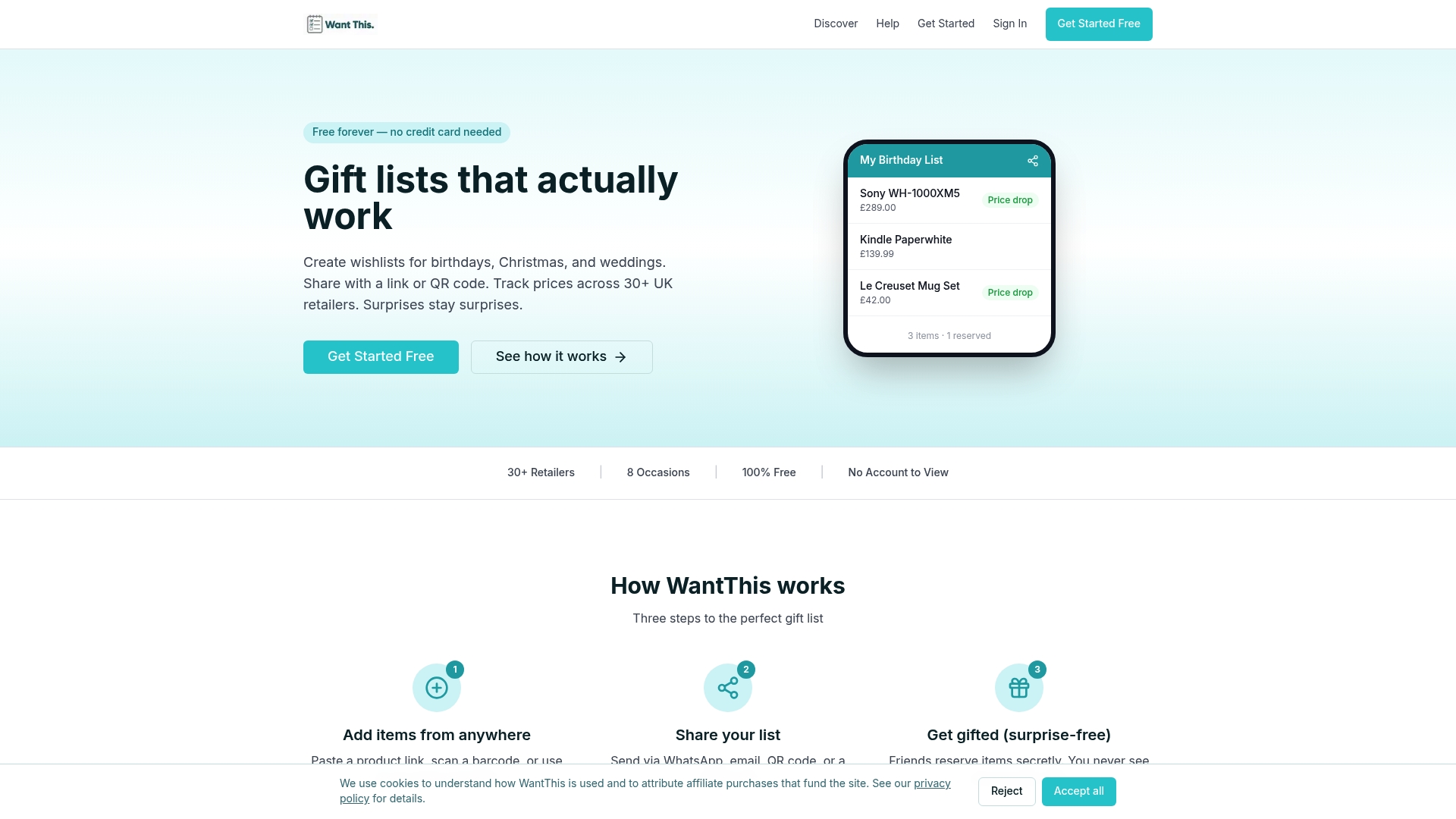
Beyond the basics, WantThis’s full feature set includes price tracking across dozens of UK retailers and a ChatGPT-powered assistant that can help draft or refine your list through the ChatGPT integration, useful if you’re staring at a blank list and need a starting point. Once it’s built, sharing takes one link, and guests can reserve items privately so nothing gets bought twice. Some product links on WantThis, including those to Amazon, are affiliate links, which is disclosed on the site and doesn’t affect the price you pay.
Start your list now: paste your first few links and add them to a birthday gift list you can share within minutes.
Sources
- 65+ birthday gifts to add to your wish list — Mashable
- ThingsToGetMe reviews — Trustpilot
- Create your list — Amazon Help