
Set Up in Minutes: Wish List or Registry for UK Weddings & Showers

A wish list is a flexible, ongoing collection of things you fancy, built for everyday saving and gift ideas. A registry is a formal, event‑specific list designed to stop guests buying the same present twice. Weddings and baby showers usually call for a registry, while birthdays, Christmas, and general “things I’d like” saving suit a wish list. This guide walks through how to set up and share both correctly in the UK.
TL;DR:
- Wish lists are flexible, ongoing collections used for saving, inspiration, and price tracking, but lack reservation features to prevent duplicate buying.
- Registries are event-specific, with features like duplicate protection, group gifting, and cash options, making them ideal for weddings and baby showers.
- Matching the tool to the occasion is straightforward: use a registry for weddings and baby showers, and a wish list for birthdays, housewarmings, or Christmas.
- Universal platforms like Wantthis combine the benefits of both by allowing cross-retailer item imports, price alerts, and reservation features in one free account.
- Setting up a list involves choosing a flexible platform, adding a variety of items, managing privacy, and testing links to ensure smooth shopping experience.
Table of Contents
- What is a wish list and how do people actually use it?
- What is a registry and why does it suit weddings and baby showers?
- Key differences at a glance
- Which one fits your occasion? A quick decision guide
- How to set up and share a list correctly in the UK
- What the research and UK practitioners say
- An honest note on which one actually works
- How Wantthis makes gift lists simpler for UK occasions
- Sources
- FAQ
What is a wish list and how do people actually use it?
A wish list is any personal collection of items you’d like to own or receive, built with no fixed event or deadline attached to it. It might live on a single retailer’s site, inside a browser extension, or on a universal platform that pulls items in from anywhere you shop. The common thread is flexibility: you add, remove, and reorder items whenever you like, and there’s no obligation for anyone to buy from it.
Most people use wish lists for three overlapping reasons: saving things for later, gathering inspiration before a purchase, and quietly tracking prices on items they’re not ready to commit to. Some lists stay entirely private, functioning as a personal shopping notebook. Others get shared with family ahead of a birthday or Christmas, doubling as a subtle gift hint.
Behavioural research adds a twist here. Two studies on the quasi‑endowment effect found that items sitting on a wish list start to feel psychologically “owned,” with public visibility and how long an item stays listed both affecting whether it’s eventually bought or quietly dropped. Separate research on online purchase journeys found that offering a wish list option turns a single decisive purchase into a two‑stage one, and that delay tends to lower the odds of the item ever being bought unless something re‑engages the shopper.
That’s a useful thing to know if you’re the one building the list.
- Flexibility: add anything, anytime, with no event tying your hands.
- Lower pressure: nobody’s expected to buy, so sharing feels casual.
- Duplicate risk: without reservation features, two relatives can buy the same jumper.
- Purchase drift: items can sit unbought for months once the initial urge fades.
Pro Tip: If you’re using a wish list to genuinely get gifts (not just to browse), pick a platform with price tracking and let whoever’s buying know when something drops in price. It’s often the nudge that turns a saved item into an actual present.
What is a registry and why does it suit weddings and baby showers?
A registry is a curated, event‑anchored list built for one specific occasion, usually a wedding, baby shower, or significant anniversary. Where a wish list drifts, a registry has a deadline: the event date, and often a delivery window tied to it.
The features that separate a registry from a casual list are practical, not cosmetic. Duplicate protection marks an item as reserved the moment someone commits to buying it, so two aunties don’t turn up with the same teapot. Group gifting lets several guests club together for one expensive item, such as a pram or a honeymoon fund. Many registries also support cash funds, vouchers, and completion discounts that reward the couple or parents for buying whatever’s left unpurchased once the event has passed.
For weddings specifically, UK planning guidance tends to favour a mixed composition rather than an all‑physical list. Rock My Wedding’s gift list advice suggests something close to half physical items, with the rest split between cash contributions and vouchers or experiences, so guests across a wide range of budgets and tastes can all find something appropriate.
Etiquette matters more here than with a wish list. Include the registry link on your wedding website or a discreet card in the invitation, never directly on the invite itself, and let the wording stay light (“if you’d like to mark the occasion…”) rather than demanding.
- Duplicate protection: items lock as reserved once claimed.
- Group gifting: several guests can split the cost of one big item.
- Cash and voucher options: useful for honeymoons, nursery furniture, or big‑ticket buys.
- Limitation: registries are rigid by design, less suited to ongoing or informal wish‑listing.
For baby showers, the same logic applies but the advice tilts toward restraint. First Time Mums UK’s baby registry guide recommends favouring genuine essentials over sheer volume, which keeps the list manageable for supporters and avoids the classic new‑parent problem of drowning in things nobody actually needed.
Key differences at a glance
The wish list vs registry decision boils down to a handful of practical contrasts, and once you see them side by side, the right choice for your situation tends to become obvious.
| Factor | Wish list | Registry |
|---|---|---|
| Purpose | Ongoing personal saving and gift hints | One‑off event coordination |
| Formality | Casual, no deadline | Formal, tied to an event date |
| Who controls it | You, indefinitely | You, until the event passes |
| How guests buy | Browse and buy, sometimes with reservations | Reserve, buy, or contribute to funds |
| Visibility | Often private or semi‑private | Usually shared widely for the event |
| Common perks | Price tracking, price‑drop alerts | Duplicate protection, group gifts, completion discounts |
UK guests usually find a couple’s registry through a wedding website link, a save‑the‑date email, or occasionally a card tucked into the invitation. Reserving an item typically takes one click, and the platform marks it as taken so nobody else buys it, though delivery timing is worth checking. Some registries ship straight to the couple’s new address; others hold items until a set date, which matters if guests are ordering from overseas.
A rough rule of thumb: if there’s a single date everyone’s working towards, lean registry. If the list has no natural end point, a wish list fits better. Trade research on universal registries that accept items from any retailer notes that letting guests shop wherever they prefer, rather than locking them to one store, tends to lift how many items actually get bought and delivered.
- Casual birthday hints → wish list.
- Wedding or baby shower → registry (or a universal list that behaves like one).
- Want cash without it feeling awkward → registry with a fund option.
- Want to track a price drop on something you fancy → wish list with alerts switched on.
Which one fits your occasion? A quick decision guide
Matching the right tool to the right event takes seconds once you know what to check for.
- Weddings: use a registry (or a universal list acting as one). Guests expect duplicate protection and the option to contribute cash toward a honeymoon.
- Baby showers: use a registry, kept tight and essentials‑focused so supporters aren’t overwhelmed by choice. A baby shower gift list works as a free alternative to a store‑bound registry.
- Birthdays: a wish list is usually enough. There’s no need for reservation features when only a handful of people are buying.
- Housewarmings: a short wish list works well, particularly if guests are choosing casually rather than coordinating.
- Christmas: a wish list, ideally one that several family members can view at once to avoid the classic double‑buy.
Guest geography changes the calculation slightly. If relatives live abroad, a universal registry that lets them buy from their own country’s retailers, rather than one locked to a single UK store, tends to get more items actually delivered on time. If you need cash more than objects, whichever list you choose should support a fund or voucher option outright, rather than forcing guests to guess what to do instead.
How to set up and share a list correctly in the UK
Getting a list working properly comes down to a short sequence, whether you’re building a wish list or a full registry.
- Choose your platform. Pick one that lets you import items from any retailer rather than locking you to a single shop.
- Add items across price ranges. Mix a few small stocking‑filler‑style items with one or two bigger‑ticket wishes, so every guest can find something within their budget.
- Set visibility. Decide whether the list is fully private, shared with named people, or open via a link.
- Test every link before sharing, particularly if you’ve pasted them from mobile apps, since broken links are the single most common complaint from guests trying to buy.
- Share with a light touch. A short message with the link, rather than a formal announcement, keeps things comfortable for UK tastes.
For hosts, check delivery and returns policies on each retailer before adding an item, and switch on reservation settings so two guests can’t buy the same thing. For guests, check how sharing works on whatever platform the list uses, mark an item as bought the moment you order it, and factor in postage costs and delivery windows if you’re buying close to the event date, especially over Christmas when courier delays are common.
Pro Tip: If any guests live overseas, check whether items can ship internationally before you reserve them; some UK retailers still won’t post outside the UK, which can leave a lovingly chosen gift stuck at checkout.
What the research and UK practitioners say
The behavioural evidence and the wedding‑and‑baby practitioner advice point in the same direction: structure reduces friction, and friction is what kills gifting.
Two‑study research into wish list behaviour found that social visibility and how long an item sits on a list both shape whether it eventually gets bought, meaning a wish list works best when it’s actively managed rather than left to gather dust.
Separate industry commentary on wish list conversion notes that targeted price alerts and reminders are what turn a static wish list into actual purchases, which lines up neatly with the practitioner advice to keep baby and wedding lists curated rather than sprawling.
An honest note on which one actually works

Most people don’t need a registry. They need a list that behaves like one when the occasion calls for it and behaves like a wish list the rest of the year, without forcing them onto a different platform every time life throws up a new event.
That’s the gap I see most often: someone sets up a proper registry for their wedding, then goes back to scribbled notes and half‑remembered Amazon browsing history for every birthday afterwards. A universal, all‑occasion list with duplicate protection and price tracking built in sidesteps that entirely. It won’t suit everyone, particularly those who want a highly branded, wedding‑specific website experience, but for most UK households juggling several occasions a year, one flexible tool beats switching tools every time the calendar changes. If you’re setting up your first list, start with whichever occasion is soonest and build the habit from there.
— Stuart
How Wantthis makes gift lists simpler for UK occasions
Wantthis is the practical alternative to juggling a different registry site for every event. Rather than locking you into one retailer or one occasion type, it lets you paste a product link from anywhere you shop, whether that’s a big high‑street name or a small independent site, and pulls in the title, image, and current price automatically.
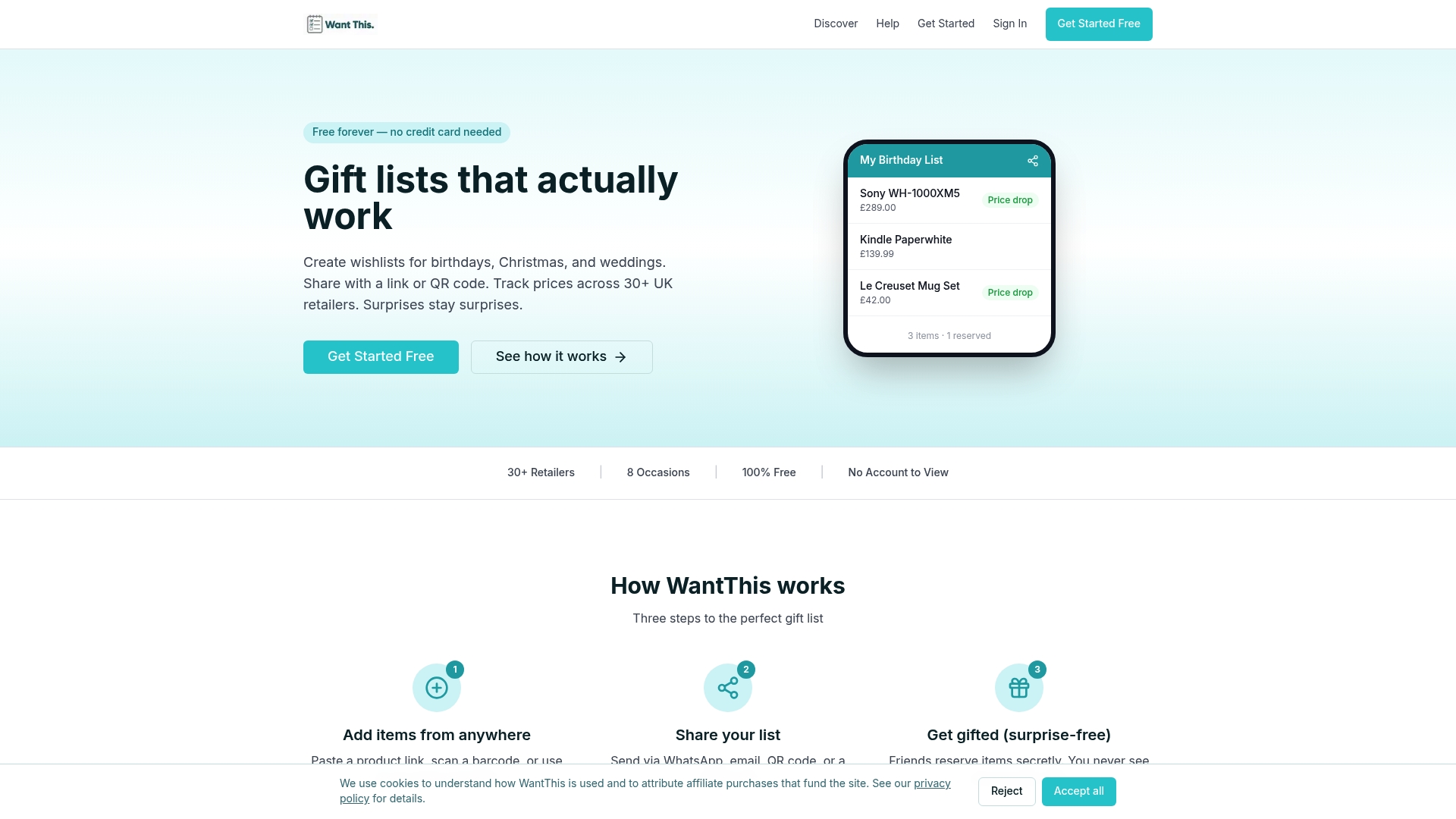
The platform tracks prices across more than 30 UK retailers, sends alerts when something you’ve saved drops in cost, and lets friends and family privately reserve or mark items as bought so gifts never get duplicated and surprises stay intact. It handles weddings, baby showers, birthdays, and Christmas all within the same free account, and there’s a Secret Santa organiser with an automatic draw for the office or family exchange too. If you want inspiration before you start, browse gift ideas by category for a nudge in the right direction. Setting up your first list takes a few minutes at Wantthis.
Sources
- Wish list thinking: The quasi‑endowment effect’s impact on online wish list outcomes
- RBR research: wish lists and online purchase journeys
- From bump to baby: the baby registry guide (First Time Mums UK)
- From dreaming to deciding: the role of wish lists in online purchase journeys - We Are ROAST
FAQ
What is the difference between a registry and a wish list?
A wish list is a flexible, ongoing personal collection with no fixed date, while a registry is built around a single event, usually a wedding or baby shower, with features like duplicate protection built in. A universal list on a platform like Wantthis can behave like either, depending on how you organise and share it.
How do I find someone’s Amazon wish list in the UK?
You’ll typically need a direct link shared by the list owner, or their name if they’ve made the list publicly searchable on Amazon’s own site. Amazon publishes details of its wishlist and registry features in its own company reporting, though search visibility depends entirely on the privacy setting the owner chose.
Do you get 20% off Amazon registry?
Amazon has offered completion discounts on registry items in the past, but exact percentages and eligibility change over time and vary by registry type, so it’s worth checking the current terms directly on Amazon’s site before relying on a specific figure.
Does an Amazon wishlist work like a registry?
Not quite. An Amazon wishlist lacks the duplicate protection, group gifting, and completion perks built into a proper registry, and it’s tied to items sold or fulfilled through Amazon rather than any retailer. A universal, multi‑retailer list gives you registry‑style reservation features without that single‑store restriction.
Can I use a wish list for a wedding instead of a registry?
You can, but you’ll lose duplicate protection and group gifting unless the platform supports those features specifically. A universal wish list with reservation settings switched on can cover most of what a traditional wedding registry offers.