
Product link parsing for developers: a practical guide

Product link parsing is the automated process of turning a product URL into a structured, canonical product object: title, price, SKU, images and availability, ready for a database or feed. It’s how a scraper, a price tracker or a wishlist app understands what’s actually behind a link.
The fields a parser typically pulls out include:
- Product title and brand
- Current price and currency
- SKU, GTIN or ASIN identifier
- Image URLs
- Stock or availability status
- Tracking and referral parameters in the query string
This underpins price monitoring, catalogue imports, wishlist tools and affiliate revenue attribution across most ecommerce tooling built in the last decade.
Key Takeaways
Product link parsing converts a raw product URL into a validated, canonical product object by combining schema-first extraction, selector fallbacks and rigorous validation.
| Point | Details |
|---|---|
| Start with JSON-LD | Structured schema.org data is faster and more reliable than selectors when it’s present. |
| Separate pipeline layers | Keep fetching, extraction, validation and mapping as independent components. |
| Trust the canonical tag | Always check <link rel="canonical"> before assigning product identity to avoid duplicates. |
| Layer your extraction methods | Fall back from JSON-LD to selectors to adaptive or ML extraction as needed. |
| WantThis applies this directly | Its paste-a-link feature uses schema-first parsing to auto-populate wishlist items and track prices. |
Table of Contents
- What is product link parsing and why do teams use it?
- What are the core steps in a parsing pipeline?
- Which extraction method should you use?
- Which tools handle product link parsing for you?
- How do you build a minimal Python pipeline?
- What are the common pitfalls in link parsing?
- How do you choose the right approach for your project?
- FAQ on product link parsing
- Sources
What is product link parsing and why do teams use it?
At its core, product link parsing takes one input (a URL) and produces one output: a validated record describing the product at that address. Feed it https://retailer.com/product/12345?ref=affiliate, and a good parser returns a clean object with the name, price and identifier, stripped of the noise.
Teams reach for this for a handful of recurring reasons:
- Price monitoring — watching a product’s price over time to flag drops or spikes.
- Inventory sync — keeping a catalogue’s stock status current without manual checks.
- Affiliate revenue attribution — correctly crediting a sale to the right link and partner.
- Catalogue feeds — populating comparison sites or marketplaces from third-party URLs.
- Wishlists and saved items — letting someone paste a link and get back a usable product card.
Three concepts do most of the heavy lifting here: schema.org and JSON-LD structured data embedded in the page, the canonical tag that identifies the “real” URL for a product, and third-party extraction providers such as Diffbot that handle the messy parts for you.
What are the core steps in a parsing pipeline?
A parsing pipeline breaks down into six repeatable steps, and most production systems separate each one into its own component so a failure in one doesn’t corrupt the rest.
- Discover product URLs from category pages, sitemaps or search results.
- Normalise the URL, resolving redirects and isolating the canonical path from query parameters.
- Fetch the landing page, following the same discover, extract, fetch pattern most scrapers rely on.
- Extract structured data from the HTML, JSON-LD or embedded scripts.
- Validate and normalise the extracted fields into a canonical product schema.
- Persist the result and map it into whatever downstream feed or database needs it.
In a typical architecture, steps one to three sit in a crawler or fetcher service, step four belongs to an extractor, and steps five and six live in a validator and mapper respectively. Keeping these as separate layers, rather than one large scraping script, is what makes the system maintainable a year from now.
Pro Tip: Prefer schema-first extraction wherever it’s available, and never let your mapping logic reach back into the raw HTML. Extraction should produce one clean object; mapping should only ever read from that object.
Which extraction method should you use?
No single method works everywhere, so most production pipelines run through a hierarchy rather than betting on one approach.
JSON-LD and schema.org markup is the fastest and most reliable route when a retailer implements it properly. The data sits in a <script type="application/ld+json"> tag, already structured, already typed. No guessing required.
CSS or XPath selectors work when structured data is missing, but they’re brittle. A retailer redesigns its product page and your selectors silently break, often without throwing an error, just quietly returning nulls.

Platform APIs and sitemaps give you the highest accuracy when a retailer offers one, but coverage is limited. Not every site exposes one, and access is often gated or rate limited.
Headless browser scraping, using tools like Playwright, renders JavaScript-heavy pages and can intercept network requests to grab raw product JSON before it’s even rendered. It’s resource-heavy and increasingly runs into anti-bot defences.
Adaptive or ML-driven extraction acts as a fallback for templates you’ve never seen before, inferring fields from page structure and text patterns when nothing else works.
Which tools handle product link parsing for you?
If building and maintaining your own extraction hierarchy isn’t the best use of your time, several tools already do it.
Diffbot’s Product API takes a URL and returns pricing, specs, images and product IDs automatically, with options for specifying fields, timeouts and proxy settings when you need finer control over how requests are handled.
ProductParse takes a JSON-LD-first approach with adaptive fallback when structured data is missing, and returns the extraction method and a confidence score alongside the data, which is genuinely useful when you’re deciding whether to trust a result automatically or flag it for review.
Shopextract, an open-source Python package, layers platform API pagination, sitemap parsing and browser-based crawling as successive fallbacks, a sensible pattern if you’re rolling your own discovery logic.
AutoExtract spiders from Scrapinghub expose discovery-only and allow-links options that let you tune how aggressively a crawler follows links versus just extracting from pages it already has.
| Tool | Response schema | Timeout / proxy options | Cost model | Rate limits |
|---|---|---|---|---|
| Diffbot | Structured JSON | Yes | Per-call API pricing | Plan dependent |
| ProductParse | JSON with method + confidence | Configurable | API pricing | Plan dependent |
| Shopextract | Python objects | Self-hosted | Free, open source | Self-managed |
| AutoExtract spiders | Item objects | Self-hosted | Free, open source | Self-managed |
How do you build a minimal Python pipeline?
You don’t need a large stack to get a working parser. A minimal version needs four modules, each doing one job.
- Fetcher — use
HTTPXorrequestsfor static pages, andPlaywrightwhen the product data only appears after JavaScript renders. - Normaliser — strip tracking parameters, resolve redirects, and check the
<link rel="canonical">tag before treating a URL as the product’s true identity. - Extractor — parse JSON-LD first with
json.loads, falling back toBeautifulSoupselectors only when no structured data exists. - Validator — define your canonical product shape as a
Pydanticmodel, so any extracted dictionary that doesn’t match gets rejected before it reaches your database.
A rough flow looks like: fetch the page, look for a script[type="application/ld+json"] tag, parse it as JSON, map matching fields onto your Pydantic schema, and only fall back to CSS selectors if the JSON-LD is absent or incomplete. Variants (size, colour) usually need their own nested list within the same object rather than separate top-level records.
Pro Tip: Store the raw extracted object exactly as parsed, before any mapping. If a downstream format changes later, you can remap from the stored canonical object instead of re-scraping every page.
What are the common pitfalls in link parsing?
A handful of mistakes account for most production failures, and nearly all of them are avoidable with a bit of discipline upfront.
- Relying on brittle selectors instead of stable
data-attributes or intercepted network JSON. - Treating a URL’s identity at face value instead of checking its canonical tag, which creates duplicate records when retailers rotate session parameters.
- Ignoring redirects, so a moved or discontinued product silently maps to the wrong record.
- Mixing extraction and mapping logic in one function, making both harder to debug and test independently.
- Mis-attributing affiliate parameters, which quietly breaks revenue reporting.
Watch for sudden spikes in schema mismatch rates, drops in extraction confidence scores, or a rise in duplicate product IDs. All three usually mean a retailer changed its template or its canonical tag behaviour.
Pro Tip: Run a small, fixed set of known product URLs through your pipeline on a schedule and alert on any field going empty. This catches template changes days before your main dataset degrades.
How do you choose the right approach for your project?
Match your method to your actual constraints rather than the most impressive-sounding option.
- Count expected sites and how often they update their templates. High churn favours adaptive extraction over hand-built selectors.
- Weigh your tolerance for ongoing maintenance against your budget for a commercial API like Diffbot or ProductParse.
- Assess JavaScript complexity and anti-bot exposure on your target sites. Heavy JS usually means a headless browser is unavoidable.
- Factor in compliance and privacy requirements before scraping at scale.
For an MVP, JSON-LD extraction with a selector fallback is usually enough. Enterprise price monitoring justifies a commercial API. Affiliate feed generation benefits from batch extraction rather than real-time calls, since prices rarely need second-by-second freshness.
A note on schema-first parsing in practice
WantThis built its paste-a-link feature on this schema-first approach, because it’s what most reliably turns a pasted URL into an accurate title, image and price, with fallbacks for the pages where a retailer’s structured data is missing or incomplete.

How WantThis puts product link parsing to work
Paste a product link into WantThis and it auto-populates the title, image and current price straight onto your wishlist, using the same JSON-LD-first extraction logic covered above. From there, price tracking keeps watching that product for drops, so you never need to check it manually again.
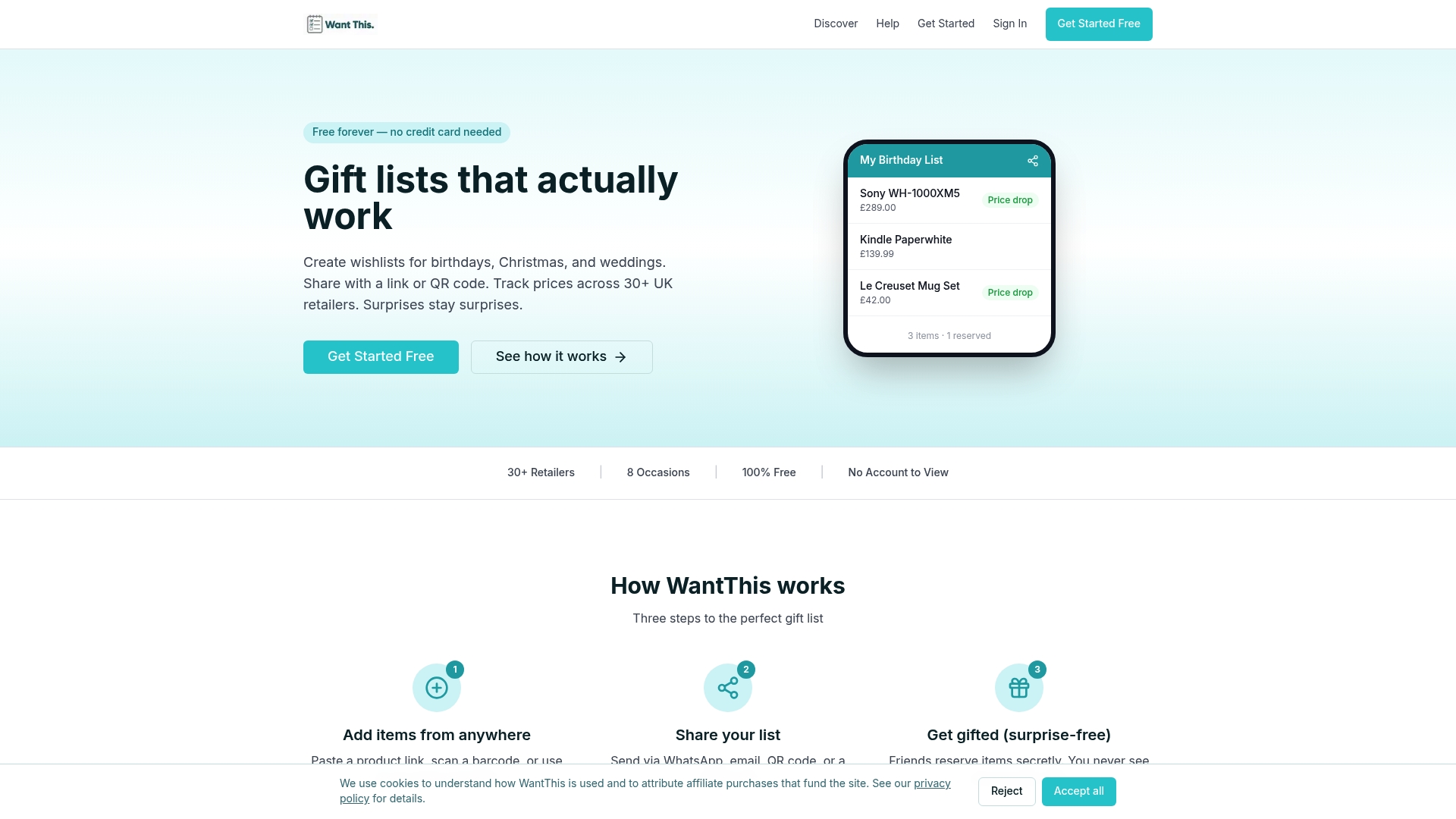
Purchases made by clicking through a shared list to a retailer generate an affiliate commission for WantThis, disclosed in full on the affiliate disclosure page. If you’d rather use a ready-built tool than maintain your own parsing pipeline, start a free wishlist on WantThis and paste in your first link to see it populate automatically.
FAQ on product link parsing
What is product link parsing in one sentence? It’s the automated extraction of structured product data, such as title, price and SKU, from a product URL, producing a canonical object usable in feeds, trackers or apps.
How does product link parsing differ from general web scraping? General scraping pulls arbitrary content from a page. Product link parsing specifically targets product-identifying fields and normalises them into a consistent schema, usually via structured data first.
Is JSON-LD always available on product pages? No. Many retailers implement it well, but plenty don’t, or implement it incompletely, which is why most pipelines need a selector-based or adaptive fallback.
Can I automate product link parsing without building my own pipeline? Yes. Services such as Diffbot and ProductParse handle discovery, extraction and validation behind an API, which suits teams that don’t want to maintain scraping infrastructure.
Why do tracking parameters matter for canonical identity?
Query strings like ?ref= or ?utm_source= don’t change the product but do change the URL, so stripping them before deduplication prevents the same item being logged as multiple products.