
What is affiliate disclosure in retail? A quick guide

An affiliate disclosure is a short, plain-English statement placed next to a recommendation or link that tells you the publisher may earn a commission if you buy through it. The standard it must meet is “clear and conspicuous”: easy to spot, easy to understand, and positioned right where you’re deciding whether to click.
That standard comes from consumer protection law and advertising regulators, including the ASA (Advertising Standards Authority) in the UK and the FTC (Federal Trade Commission) in the US. A disclosure hidden three clicks deep in a footer doesn’t count, no matter how honest the intention. Platforms like WantThis, which use affiliate links on buy buttons for saved items, are expected to make that relationship obvious rather than technically findable.
- Tells you a link may earn the publisher money
- Must sit next to the link or recommendation, not buried elsewhere
- Should use plain wording, not legal jargon or shorthand
Key Takeaways
Affiliate disclosures must be clear, conspicuous, and placed directly next to the link or endorsement they relate to, not hidden in a footer or policy page.
| Point | Details |
|---|---|
| Definition | An affiliate disclosure tells shoppers a publisher may earn commission from a linked purchase. |
| Placement rule | Disclosures must sit adjacent to the link or endorsement, not only in an “About” page. |
| Wording | Plain phrases like “This post contains affiliate links” work; jargon and shorthand like “sp” don’t. |
| Shopper check | Look for disclosure near every recommendation, on desktop, mobile, video and social. |
| WantThis example | WantThis pairs a dedicated affiliate disclosure page with in-context notices near shared links, including Amazon UK. |
Table of Contents
- What is affiliate disclosure in retail, and why does it matter?
- How do you make a disclosure clear and conspicuous?
- Examples of disclosures that work (and ones that don’t)
- A checklist for retailers, publishers and platforms
- What should you look for as a shopper?
- How WantThis applies these disclosure rules in practice
- Try a wishlist that’s upfront about how it works
- Where to check the detailed rules
- Frequently asked questions
- Sources
What is affiliate disclosure in retail, and why does it matter?
Affiliate disclosure in retail exists to stop shoppers being quietly nudged towards a purchase without knowing money changes hands behind the scenes. The regulatory baseline is straightforward: UK consumer protection guidance requires that any material connection be easy to find and unambiguous, placed directly alongside the endorsement so you’re informed before you act on it.
For you as a shopper, this matters because it lets you weigh a recommendation properly. A “best kettles under £50” list reads differently once you know the writer earns a cut from every sale. That’s not necessarily a problem, but it’s information you’re entitled to have before you decide.
For retailers and creators, disclosure isn’t just box-ticking. It reduces regulatory exposure and, done well, builds the kind of trust that keeps people coming back.
Transparency isn’t a legal hurdle to clear and forget. Done honestly, it’s a foundational part of how audiences learn to trust a recommendation rather than suspect it.
How do you make a disclosure clear and conspicuous?
Placement is where most disclosures fail. A statement tucked into an “About” page or a general policy link does not meet the standard, because the ASA expects the disclosure to sit immediately before or adjacent to the affiliate link or endorsement itself, not somewhere the reader has to go hunting for it.
Wording matters just as much as placement. Plain statements work; vague industry terms don’t.
- Use this: “This post contains affiliate links” or “I may earn a commission if you buy through this page”
- Avoid this: “commissionable link,” “sp,” “spon,” or a single generic policy statement covering the whole site
- Place the disclosure adjacent to every separate endorsement, not just once at the top of a long page
- Make sure it survives on mobile, inside video overlays, and within social captions, not only on desktop layouts
- If a “Buy Now” button is itself an affiliate link, the disclosure needs to sit where that button appears
A useful gut check: read the page as if images were switched off, or scroll it on a phone screen. If the disclosure disappears or becomes unreadable, it fails the test.
Pro Tip: Platform-level labels and automated disclosure tools help, but legal responsibility usually stays with the publisher. Add your own explicit wording in the content itself rather than relying solely on a platform’s built-in disclosure feature.
Examples of disclosures that work (and ones that don’t)
Some phrasing passes the clear-and-conspicuous test instantly. Other phrasing looks like an attempt to comply while quietly avoiding it.
Do use:
- “This page contains affiliate links. We may earn a commission if you buy through them.”
- “I get a small commission for purchases made via links in this post.”
- “Ad” or “Paid partnership” clearly marked on a sponsored post
Don’t use:
- “commissionable link” (jargon most shoppers won’t recognise)
- “sp” or “spon” tucked into a caption (shorthand regulators have flagged as inadequate)
- A single disclosure buried on a separate policy page with no in-context mention
The “do” examples work because they name the relationship in words anyone can understand, right where the link sits. The “don’t” examples fail because they either use language only insiders decode, or they rely on a reader finding a separate page they were never directed to.
A checklist for retailers, publishers and platforms
Compliance splits across three parties, and each has a distinct job.
- Retailers should ensure their own promotional material discloses affiliate arrangements where products appear, including in ads that point shoppers elsewhere to buy, as FTC guidance on online advertising sets out.
- Publishers and creators should check every placement, desktop and mobile, feed and overlay, and update contributor guidelines so new writers know the rule from day one.
- Platforms should build disclosure prompts into their tools and keep an audit trail, since regulators may ask for evidence of past compliance.
- Review partner integrations periodically. An affiliate arrangement added six months ago can quietly go undisclosed if nobody rechecks the page.
- Keep screenshots or logs of disclosure changes, so you can show what was live and when if a query ever arises.
What should you look for as a shopper?
A genuine disclosure sits near the link, not hidden away. On a blog it usually appears at the top of the post or right beside the recommendation. In a video, it should show as an on-screen overlay, not just a spoken aside three minutes in. On social media, it belongs in the caption itself, not buried under a “see more.”
- Red flags: disclosure only in a footer, vague shorthand like “aff,” or a “Buy Now” button with no nearby mention of commission
- A good sign: the same wording repeated next to each separate product mention, not just once at the top
- If you can’t find a disclosure at all, check whether the site has a dedicated affiliate disclosure page, and treat the absence of one as worth factoring into how much weight you give the recommendation
How WantThis applies these disclosure rules in practice
WantThis uses affiliate links, including links to Amazon (UK), on the buy links for items you save to a wishlist. That relationship is set out on our affiliate disclosure page, which explains how commissions work when someone clicks through a saved item and buys it.
The disclosure sits both as a standalone page and as an in-context notice near shared links, which is the combination regulators actually ask for: a policy page alone isn’t enough, but pairing it with adjacent, in-context notices closes that gap.

Pro Tip: If you’re building a shoppable list yourself, don’t rely on a policy page alone. Add a short line next to each “Buy” button or shared link, the same way you’d want a disclosure to appear if you were the shopper reading it.
Why this matters to us
We’d rather you trust every price and link on WantThis than wonder what’s behind them. Clear disclosure protects that trust and keeps your choices genuinely informed. Read the full detail on our affiliate disclosure page.
Try a wishlist that’s upfront about how it works
WantThis makes affiliate relationships visible rather than something you have to dig for. Paste a product link from almost any UK retailer and we pull in the title, image and current price automatically, with affiliate links (including Amazon UK) clearly disclosed on the site itself.
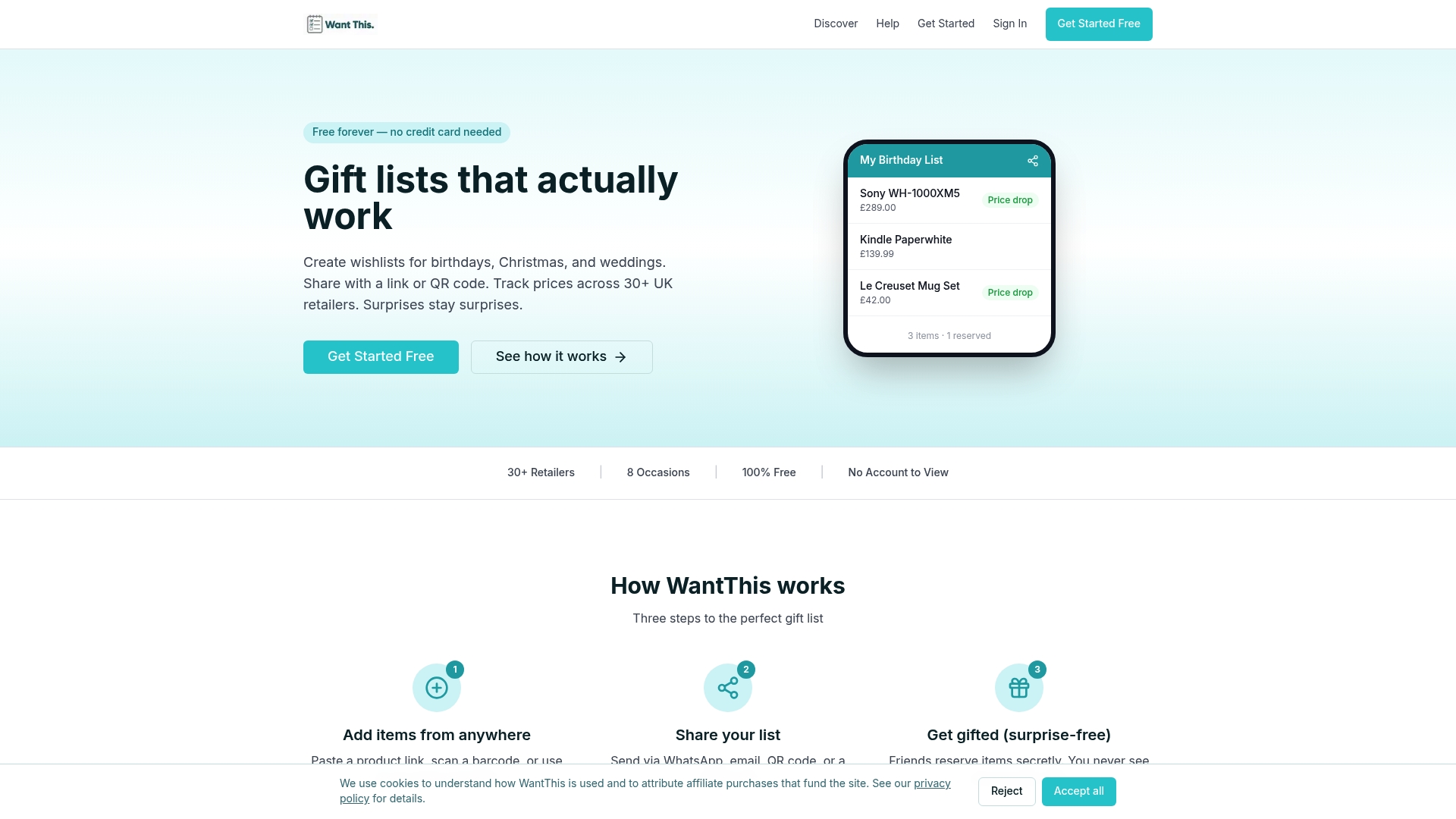
That transparency runs alongside features built for actual gifting: price drop tracking so you know whether to buy now or wait, private reservations so gifts don’t get duplicated, and a Secret Santa organiser with an automatic draw for group gifting. If you’re setting up a list for a birthday, Christmas or a wedding, create a shared wishlist and see how the pricing and disclosure work in practice, right on the items you save.
Where to check the detailed rules
Frequently asked questions
What is affiliate disclosure in retail, in one sentence? It’s a plain statement, placed next to a link or recommendation, telling you the retailer or publisher may earn a commission if you buy through it.
Is an affiliate disclosure legally required in the UK? Consumer protection guidance requires material connections to be disclosed clearly and unambiguously wherever the endorsement appears, so yes, in practice it is expected rather than optional.
Does a disclosure page on its own count as compliant? No. Regulators expect an in-context notice next to the actual link or endorsement, with the policy page treated as supplementary detail rather than the whole answer.
What phrasing should I look for as a shopper? Plain wording such as “this page contains affiliate links” or “I may earn a commission” is a good sign. Shorthand like “sp” or a vague single policy page is not.

Does WantThis use affiliate links? Yes. WantThis uses affiliate links, including links to Amazon UK, on the buy links for saved items, with the relationship disclosed on its affiliate disclosure page.
Sources
- FTC’s endorsement guides: what people are asking
- Dot Com Disclosures: Information about online advertising (FTC plain‑language guide)