
Cap Gifts at £20: Secret Santa Rules for UK Offices

The core Secret Santa rules UK groups should agree before drawing names are simple: set a fair budget, draw one name at random and keep it secret, make participation voluntary, and rule out anything risqué, political or overly personal. Get those four things settled first and almost every other problem, from awkward gifts to office grumbling, sorts itself out.
TL;DR:
- Setting a maximum budget of £10 to £20 and involving junior participants in this decision helps ensure affordability and fairness for all participants.
- Using digital tools for the draw and shared wishlists reduces mistakes, such as self-draws and duplicate gifts, especially for large or remote groups.
- Confidentiality of pairings and clear labeling of gifts with only the recipient’s name are essential to maintain secrecy and prevent awkward reveals.
- Office gifts must comply with legal considerations, avoiding discriminatory, political, or health-related items, and participation should remain voluntary to prevent conflicts.
- Having a written, circulated rules sheet covering budget, banned categories, opt-out options, and deadlines minimizes misunderstandings and legal risks.
Table of Contents
- How Secret Santa works and common variants
- Core rules to agree first: budget, secrecy and boundaries
- Workplace considerations and legal risks in the UK
- Step-by-step: running a Secret Santa from start to finish
- Gift ideas and safe choices for UK Secret Santas
- Common problems and how to fix them
- Where a digital organiser actually earns its keep
- What the rules actually protect against
- Try a free Secret Santa organiser that skips the guesswork
- Sources
- FAQ
How Secret Santa works and common variants
The traditional format is straightforward: everyone’s name goes into a hat (physical or digital), each person draws one name, and that draw stays private until the big reveal on exchange day. No one should end up buying for themselves or knowing who has their name, and swapping names after the draw defeats the point entirely.
Several variants suit different groups better than the classic version:
- Wishlist-assisted draws — participants share a short list of preferences so buyers aren’t guessing blind, which works well for mixed-age family groups.
- White Elephant or Yankee Swap — everyone brings a wrapped gift and takes turns stealing or swapping, favoured by larger, more boisterous gatherings.
- Rubbish Secret Santa — deliberately naff, cheap gifts as a running joke, popular with close-knit teams who enjoy the bit.
- Non-material gift exchanges — favours, experiences or acts of service instead of objects, a good fit for groups trying to keep costs and clutter down.
Offices with large or hybrid teams tend to do best with a digital draw and shared wishlists, since paper slips get lost and self-draws happen more often than anyone likes to admit.
Core rules to agree first: budget, secrecy and boundaries
Agree these points before a single name goes in the hat, not halfway through the exchange when someone’s already overspent.
- Set the budget together. UK offices commonly cap spending at £20 or under, and many workplaces give staff at least two weeks’ notice to plan around it. For friends and family, £10–£15 is a common sweet spot.
- Let junior voices weigh in. Etiquette guidance from Debrett’s-style advice suggests letting the most junior or lowest-paid participants help set the figure, so nobody feels priced out.
- Keep the draw genuinely secret. No swapping names, no hinting, and no fishing for clues about who has yours.
- Label gifts clearly with the recipient’s name only, never the giver’s, until the reveal.
- Ban anything risqué, political, religious or health-related. These categories cause the most complaints every single year.
- Make it voluntary. Some people opt out for religious, financial or personal reasons, and that should always be respected without question, a point etiquette experts consistently stress.
Pro Tip: Circulate a one-page rules sheet before the draw, covering budget, banned categories, opt-out deadline and exchange date. It sounds basic, but it heads off nearly every argument before it starts.
For a deeper look at setting a fair number, see this guide to setting a Secret Santa spending limit.
Workplace considerations and legal risks in the UK
Office Secret Santa etiquette in the UK isn’t just about being nice. It carries genuine legal weight. Employers should set clear boundaries because inappropriate gifts can breach equality and harassment policies, and what one person calls banter, another can reasonably treat as a grievance. Employment-law commentary is blunt on this point: “banter” is not a defence if a gift carries discriminatory or sexual undertones.
Roughly 58% of UK workplaces cap Secret Santa spending at £20 or under — a figure worth knowing before you set your own budget too high.
Practical mitigations that actually work:
- Circulate written rules and banned-item categories before the draw, not after a complaint lands.
- Have senior staff opt in visibly and follow the same rules as everyone else, since tone comes from the top.
- Build in accommodations for religious observance, tight budgets or accessibility needs without singling anyone out.
- Give HR a quiet route to flag concerns before exchange day, not after.
Step-by-step: running a Secret Santa from start to finish
- Invite and confirm participants. Get a final headcount and share the rules sheet alongside the invite, including the opt-out window.
- Agree budget and deadline. State the spending cap and the exchange date clearly, and stick to both.
- Collect wishlists if you’re using them. A short list of three or four preferences cuts down on guesswork considerably.
- Perform the draw. Paper hats work for small, in-person groups; a free Secret Santa generator is far more reliable for remote or larger teams, since it handles exclusions automatically and no one can accidentally draw themselves.
- Keep pairings secure. Only the organiser should see the full list, and even then, discretion matters.
- Sort logistics. Decide where gifts get dropped off, how they’re labelled, and who manages latecomers.
- Run the exchange day. A simple run sheet, gifts opened one at a time, works better than a free for all where half the room misses the reveal.
Gift ideas and safe choices for UK Secret Santas
Universally liked categories beat clever ones almost every time. Chocolate, candles, mugs, novelty socks and gift vouchers rarely offend and rarely disappoint.
By budget bracket:
- Under £5: novelty stationery, a small chocolate selection, a keyring.
- Under £10: scented candles, a decent mug set, a paperback from a favourite genre.
- £10 to £20: a small beauty set, a board game, a good bottle of non-alcoholic fizz.
Avoid anything with common allergens unless you know the recipient well, skip alcohol unless you’re certain everyone drinks, and steer well clear of anything too personal, from clothing sizes to inside jokes only three people understand. A short questionnaire or shared wishlist removes most of this guesswork, and browsing a gift ideas hub organised by category can shortcut the search considerably. For more inspiration under a tenner specifically, this list of Secret Santa gifts under £10 is a solid starting point.
Common problems and how to fix them
Duplicate gifts, missed deadlines and awkward reveals are the three complaints that come up every year without fail.
- Duplicate presents: shared wishlists with private reservations stop two people buying the same thing, since items get marked as claimed the moment someone commits.
- Missed deadlines: build in a buffer day and a backup gift option (a voucher works well) for latecomers.
- Awkward or offensive gifts: accept with grace in the moment, then raise it privately with the organiser afterwards rather than calling it out publicly.
- When to involve HR: if a gift is discriminatory, sexual or clearly targets someone, document it and escalate rather than letting it slide as a joke.
Pro Tip: Keep a written record of any incident, however minor it seems at the time. If it escalates, dates and details matter far more than memory.
A fuller breakdown of these fixes lives in this guide to common Secret Santa problems.
Where a digital organiser actually earns its keep
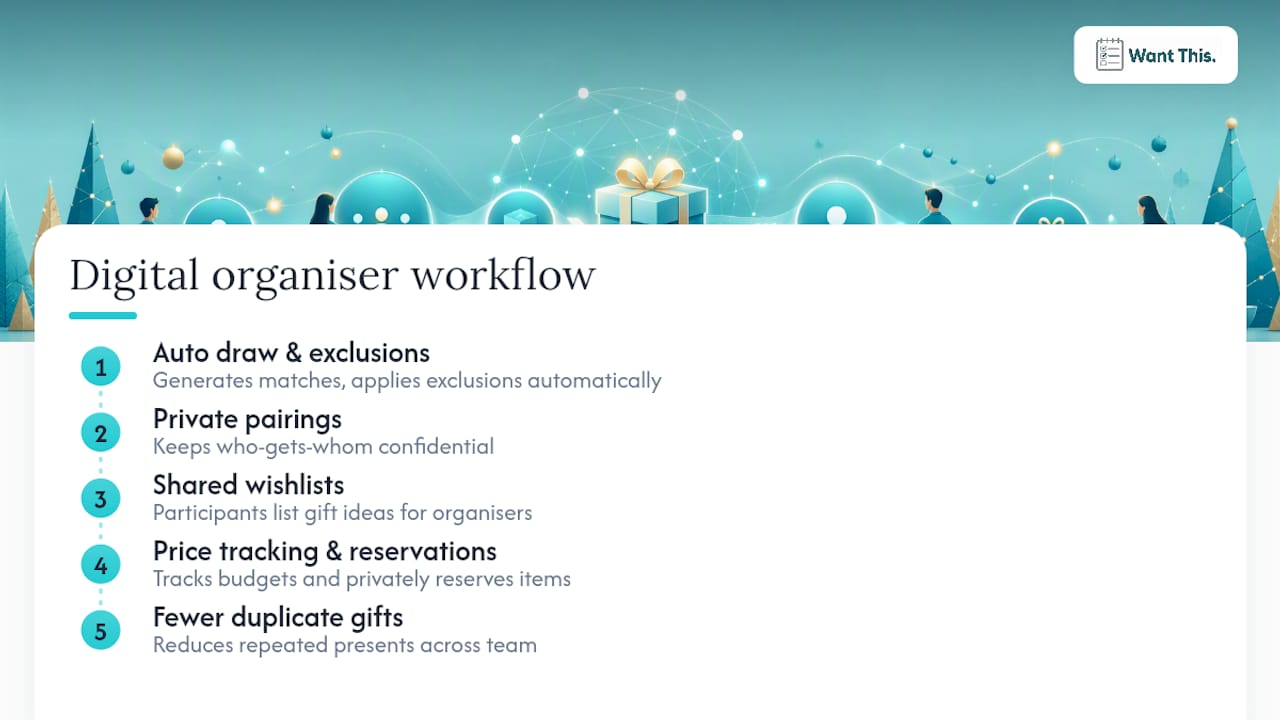
Paper hat draws fail in predictable ways: lost slips, accidental self-draws, someone forgetting who they had last year. A free Secret Santa generator with shared wishlists handles exclusions automatically and keeps pairings private, which matters most for remote or larger teams. Add price tracking and private reservations, and duplicate gifts stop being a yearly inevitability.
What the rules actually protect against
Most Secret Santa advice focuses on the fun bit: what to buy, how to wrap it, how to make the reveal entertaining. That’s the wrong starting point. The rules exist to protect the people least able to push back, the new starter who can’t afford £20, the colleague who doesn’t drink, the person who’d rather not celebrate Christmas at all.
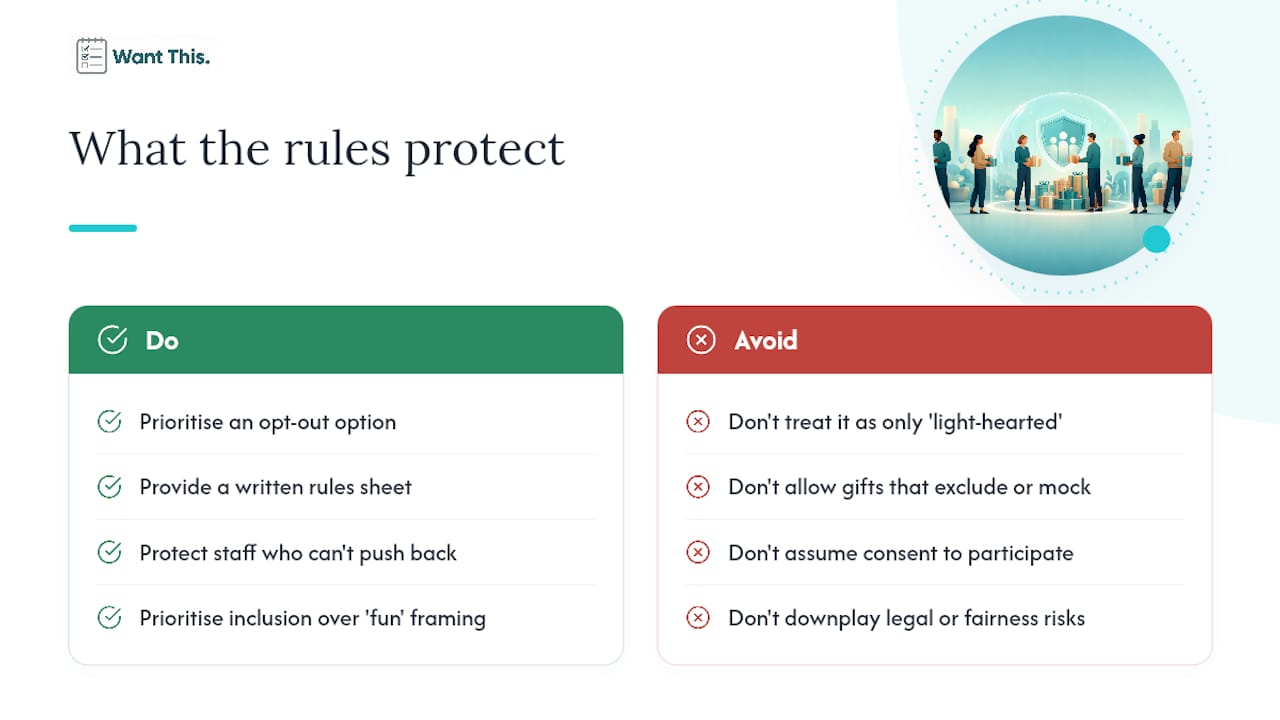
Conventional advice tends to treat “keep it light-hearted” as the main goal. It isn’t. A light-hearted exchange that quietly excludes someone on a tight budget, or lands a gift that reads as a dig at someone’s appearance, has failed regardless of how funny the room found it. The legal risk around workplace gifting isn’t a killjoy add-on to etiquette advice; it’s the same advice, just with consequences attached.
If you take one thing from this guide, prioritise the opt-out and the written rules sheet over anything else. Everything else, the gift ideas, the reveal format, the variant you choose, is far less likely to cause a problem than an exchange nobody actually agreed to join in the first place.
— Stuart
Try a free Secret Santa organiser that skips the guesswork
Wantthis is the free alternative to paper hats and spreadsheet chaos for anyone running a Secret Santa in the UK this year. It handles the draw automatically, keeps exclusions and pairings private, and pairs with shared wishlists so gifts never get duplicated or spoiled before the big day.
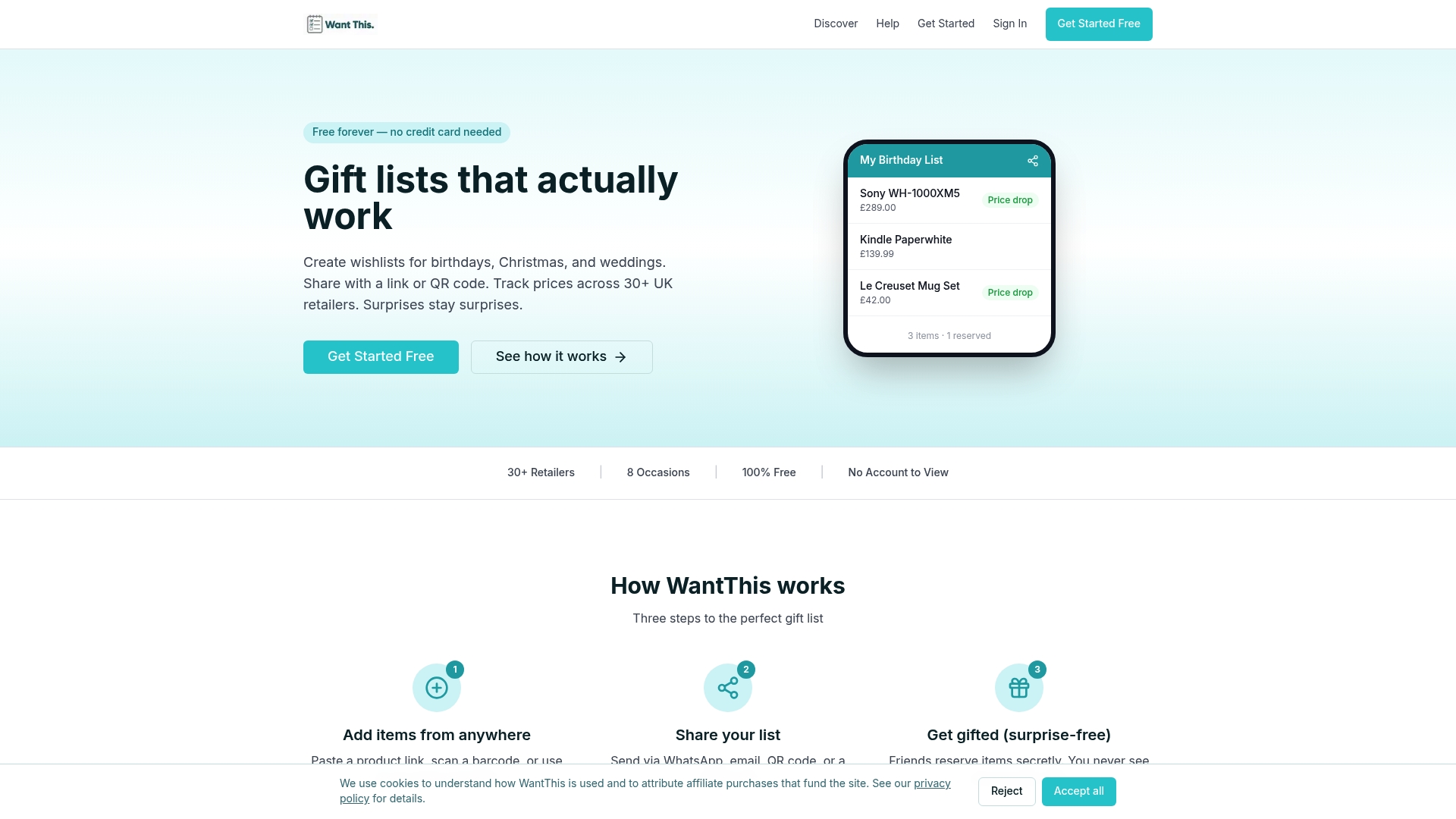
Add your group, set exclusions and let the free Secret Santa generator do the rest, no sign-up required. If you’re also coordinating gift lists for other occasions this Christmas, browse the gift ideas hub for inspiration across every budget, or set up wishlist sharing so nobody buys the same thing twice. Head to Wantthis to get your draw sorted in minutes.
Sources
For UK-specific etiquette and legal guidance, see the Telegraph’s Secret Santa etiquette guide, Real Employment Law Advice on workplace Secret Santa for grievance and equality risk, and Prime Office Space’s office etiquette breakdown for budget and timing norms. If you’re posting gifts from abroad, check UK duty-free thresholds for parcels first.
- The guide to Secret Santa etiquette
- Secret Santa in the Workplace | Real Employment Law
- Office Secret Santa etiquette – the dos and don’ts
FAQ
What are the official rules of Secret Santa?
There’s no single official rulebook, but the widely accepted core rules are: agree a budget upfront, draw one name at random, keep the draw secret, and avoid swapping names or over-spending. Participation should always be voluntary.
What is the 7-gift rule?
The “7 gifts” idea isn’t a standard Secret Santa rule; it’s more commonly associated with other festive gift-giving traditions for children, where presents are grouped into categories like “want, need, wear, read”. For Secret Santa specifically, stick to one gift per person within the agreed budget.
Can Secret Santa work between 5 people?
Yes, Secret Santa works with any group size from around four people upwards, since the only requirement is enough participants that the draw feels genuinely random and anonymous. Smaller groups just need extra care that nobody guesses who has their name from process of elimination.
What are the five rules of gift giving?
There’s no universally fixed “five rules” for Secret Santa, but the practical equivalents are: agree a budget, keep the draw anonymous, make participation optional, avoid risqué or overly personal gifts, and set a clear deadline. Circulating these as a written sheet before the draw prevents most disputes.
How much should you spend on Secret Santa in the UK?
Typical UK budgets range from £10 to £20, with many offices capping spend at £20 or under to keep things inclusive. Letting the most junior or budget-conscious participants help set the figure tends to produce a fairer number for everyone.