
Set spending limit Secret Santa: organiser’s guide

Set your Secret Santa spending limit as a single maximum cap and state it plainly in the invitation. For most UK groups, a modest spending limit is the sweet spot: enough to buy something genuinely useful, low enough that nobody feels excluded. Put that number in the invite, not a range, and call it a ceiling.
- Recommended cap: a moderate maximum amount (adjust down for large or mixed-income groups)
- Does shipping count? Clarify upfront. For in-person exchanges, wrapping and postage are typically excluded from the cap; for remote groups, state explicitly whether delivery costs count
- Affordability concerns: ask participants to message the organiser privately — no public discussion needed
Sample invite line (£20 cap):
“Our Secret Santa limit is £20 maximum per gift. Please keep to this ceiling — it keeps things fair for everyone.”
Lower band (£10 cap): “Spending limit is £10 max — think fun, practical or a little treat.” Mid band (£15 cap): “Gifts up to £15 please — quality over quantity!”
Pro Tip: Use the word “maximum” or “ceiling” in your invite rather than “around £20” or “roughly £20.” Vague language invites overspend; precise language keeps everyone on the same page.
Table of Contents
- Which GBP budget suits which group?
- Should the limit be a hard cap or a flexible guideline?
- How to decide the number and communicate it clearly
- What to do if someone goes over the limit
- Practical gift ideas by budget and how wishlists prevent duplicates
- Your organiser checklist and paste-ready messages
- Key takeaways
- Why the spending limit matters more than the amount
- Wantthis makes Secret Santa simple from draw to delivery
- Useful sources
Which GBP budget suits which group?
Picking the right number depends on who is in the group and how well they know each other. Common recommended ranges place mixed groups at a moderate level, offices around the same, and close friends at a higher range. The table below maps group type to a practical band, with UK-relevant examples.

| Group type | Suggested band | Example gifts | Rationale |
|---|---|---|---|
| Children’s party / novelty | low budget | Stationery set, novelty socks, small puzzle | Fun over value; parents appreciate a low cap |
| Large workplace or students | moderate budget | Candle, mug, notebook, chocolate box | Inclusive for mixed incomes |
| Typical office (10–20 people) | mid-range budget | Skincare set, book, desk gadget | Comfortable for most salaried employees |
| Close friends or family | higher budget | Experience voucher, quality spirits, tech accessory | Closer relationships justify a higher ceiling |
One practical note on ranges: when you give people a band (say, £15–£25), most will spend to the top. A single fixed number removes that pressure entirely. If you do want to allow a small buffer, an optional “+£5” wiggle is reasonable for close groups, but make it explicit so it does not quietly become a competition.
- For students or large mixed-income groups, start at a lower budget and move up only if the group agrees
- For workplace exchanges, a moderate default amount helps avoid anyone feeling outspent
- For family or close friends, a higher budget range is common, but always check before assuming
Pro Tip: Ask participants to vote on two options (e.g., £15 or £20) before you finalise the number. A quick group chat poll prevents complaints later.
Should the limit be a hard cap or a flexible guideline?
A hard cap means nobody spends more than the stated amount, full stop. A guideline means the number is a suggestion, and participants can spend more if they choose. Both have their place, but they create very different social dynamics.
Overspending can make other participants feel inadequate, which is why a hard cap works better for most groups, particularly in workplaces or where incomes vary. A guideline suits close friends who genuinely do not mind variation and have agreed to it openly.
“Label the budget as a ‘maximum cap’ and include a confidential opt-out route so participants uncomfortable with the number can be accommodated without public awkwardness.”
Hard cap wording: “The spending limit is £20 maximum. Please do not exceed this — it keeps the exchange fair for everyone.”
Guideline wording (close friends only): “We’re suggesting around £25, but anywhere from £20–£30 is absolutely fine.”
- Hard caps work best for: workplaces, large groups, mixed incomes, first-time exchanges
- Guidelines work best for: small groups of close friends who have explicitly agreed to flexibility
- Whichever you choose, state it in writing so there is no ambiguity
Pro Tip: If you go with a guideline, add one sentence: “Please don’t feel any pressure to reach the top of the range.” Without it, the upper number becomes the implicit target.
How to decide the number and communicate it clearly
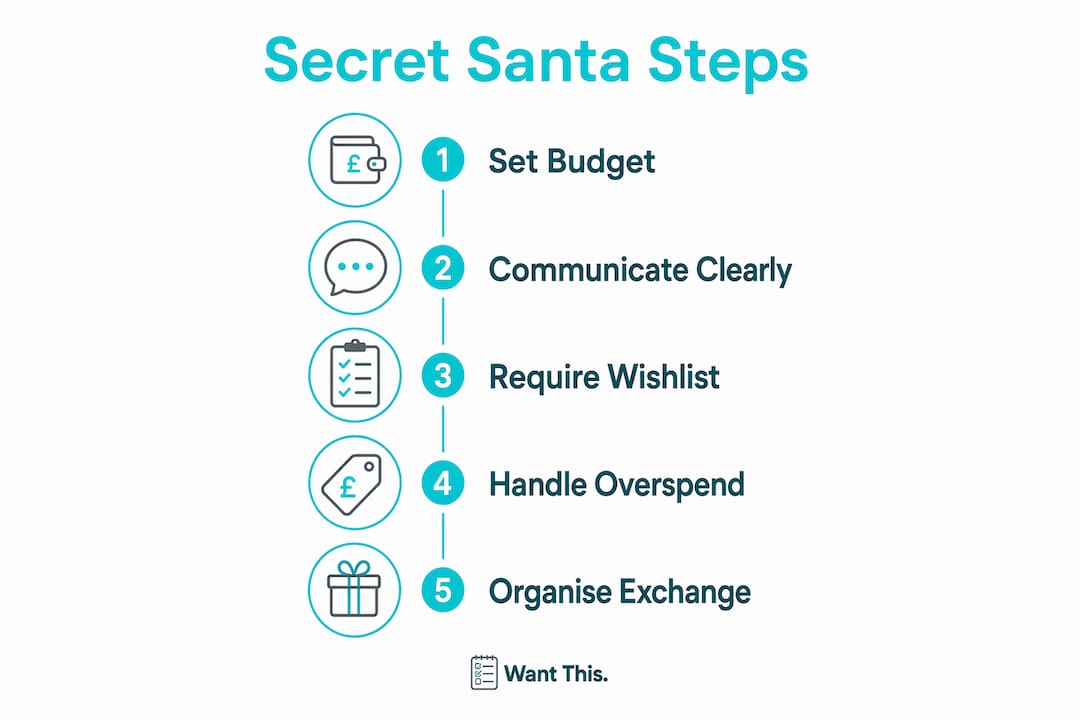
A straightforward decision process prevents last-minute confusion and keeps the exchange running on time.
- Survey affordability — send a quick, anonymous poll asking participants whether £10, £15, or £20 feels comfortable. Pick the number most people can manage without strain.
- Set one number — choose a single maximum cap, not a range. State whether postage and wrapping count towards it. For remote groups, clarify shipping rules explicitly (or suggest ordering directly to the recipient).
- Fix a sign-up deadline — give participants at least one week to confirm. Set a draw date two to three days after the deadline closes.
- Run the draw — use a tool like the Wantthis Secret Santa organiser for an automatic name draw. Participants can add a wishlist link during sign-up, which helps buyers stay within the cap without guessing.
- Set a reveal date — confirm when gifts are exchanged and whether they are delivered by post or in person.
Copy-ready invite message:
“Hi everyone! We’re running a Secret Santa this year. Spending limit: £20 maximum per gift (wrapping not included). Sign up by [date], and we’ll do the draw on [date]. Add a short wishlist when you sign up — it really helps your gifter! Reply to this message or message [organiser name] privately if you have any questions.”
- State the cap, the sign-up deadline, the draw date, and the reveal date in every invite
- Include a private contact route for anyone with affordability concerns
- Require a wishlist link at sign-up to help buyers choose something the recipient actually wants
Pro Tip: Send a reminder three days before the sign-up deadline. A short message (“Last few days to sign up for Secret Santa — limit is £20 max!”) doubles response rates in most groups.
What to do if someone goes over the limit
Overspending in a Secret Santa is rarely malicious, but it creates real awkwardness. The recipient feels obliged to reciprocate; others feel their gift looks inadequate by comparison. Office etiquette guidance is clear: going over budget in a workplace exchange can read as showing off, even when the intention is generosity.
If it happens, here is what to do:
- Address it privately, never publicly. Message the overspender directly and thank them, then explain the issue calmly.
- Offer a practical fix: the overspender keeps the excess value as a personal gift to the recipient outside the exchange, or quietly swaps the item for something within the cap.
- If the gift has already been given, let it go and tighten the wording for next year.
Dos and don’ts for organisers:
- Do address overspend privately and promptly
- Do update your invite wording to be more explicit next time
- Don’t call out the overspender in a group chat or at the exchange event
- Don’t ask the recipient to return or downgrade the gift
Pro Tip: The best prevention is clear wording in the original invite. Adding “Please do not exceed £20 — gifts over the cap may need to be swapped” removes any ambiguity before it becomes a problem.
Practical gift ideas by budget and how wishlists prevent duplicates
Staying within the cap is much easier when participants share a wishlist. Wishlists with private reservation features mean buyers can see what the recipient wants, reserve an item privately, and avoid duplicates without spoiling the surprise.
By budget band:
- Under £10: novelty socks, a small scented candle, a pocket notebook, a chocolate selection box, a card game. Browse Secret Santa gifts under £10 for ready-made ideas.
- £10–£20: a quality mug and coffee set, a paperback from a favourite author, a bath bomb gift set, a desk plant, a puzzle. The SPRITZ Christmas gift guide has solid ideas in this range too.
- £20–£30: a skincare set, a hardback book, a small kitchen gadget, a scarf, a personalised item. Gifts for her under £25 covers this band well.
- £30–£50: an experience voucher, a bottle of quality gin or whisky, a wireless charger, a cookbook from a well-known chef.
Alternative formats for tight budgets:
- Handmade gifts (baked goods, a framed photo, a hand-written recipe book) can be capped at materials cost
- Experience vouchers (a coffee catch-up, a cinema ticket, a cooking class) work well for groups that value time over things
- Group gifts let several participants pool contributions for one larger item, which suits close groups with a willing organiser
Pro Tip: Ask every participant to add at least three items to a shared wishlist at sign-up. Three options give the buyer real choice while keeping purchases within the cap.
Your organiser checklist and paste-ready messages
Organiser checklist:
- Decide the maximum cap (single number, in GBP)
- Clarify whether postage and wrapping count towards the cap
- Set a sign-up deadline and a draw date
- Confirm the reveal date and delivery method (in person or by post)
- Require a wishlist link from each participant at sign-up
- Share a private contact route for affordability concerns
Three paste-ready messages:
Initial invite: “Secret Santa is on! Spending limit: [£X] maximum. Sign up by [date] and add a short wishlist. Draw on [date], gifts exchanged on [date]. Questions? Message [name] privately.”
Reminder (three days before deadline): “Quick reminder — Secret Santa sign-ups close on [date]. Limit is [£X] max. Don’t forget to add a wishlist item or two!”
Overspend response (private message): “Thanks so much for your generosity! Just a heads-up — our cap was [£X], so we may need to adjust. Could we have a quick chat? No big deal at all.”
In-person enforcement line: “Just a reminder — we agreed on [£X] max, so let’s keep it to that. It keeps things fair for everyone.”
Pro Tip: Pin the cap and reveal date in your group chat at the start. A pinned message means nobody can claim they missed the rules.
Key takeaways
Setting a clear maximum cap upfront, stating it in plain GBP, and requiring a wishlist at sign-up are the three steps that prevent most Secret Santa problems before they start.
| Point | Details |
|---|---|
| Use a single maximum cap | State one number (e.g., £20 max), not a range, to prevent spending to the top |
| Clarify hidden costs | State whether postage and wrapping count towards the cap, especially for remote groups |
| Require a wishlist at sign-up | Wishlists with private reservations prevent duplicate gifts and help buyers stay within budget |
| Address overspend privately | Never call out an overspender publicly; handle it one-to-one and update wording for next time |
| Use Wantthis for the draw | Wantthis’s free Secret Santa organiser handles automatic draws, wishlist collection, and private reservations in one place |
Why the spending limit matters more than the amount
The number itself is almost secondary. What actually makes a Secret Santa exchange work is the clarity around it. Groups that fall out over gift exchanges almost never argue about the gifts themselves — they argue about the feeling that the rules were not applied equally. One person spent £40 when the cap was £20; another gave a handmade card and felt embarrassed; nobody was sure whether Amazon delivery counted.
A fixed limit reduces social comparison in a way that a guideline simply cannot. When the ceiling is stated plainly and applied consistently, participants stop worrying about whether their gift measures up and start focusing on choosing something the recipient will actually enjoy. That shift in attention is the whole point.
The other thing most organisers underestimate is the wishlist. Requiring participants to share even two or three items at sign-up does not spoil the surprise — it narrows the field to things the recipient genuinely wants, which makes the buyer’s job easier and the recipient’s experience better. Wantthis’s private reservation feature takes this further: once someone reserves an item, it disappears from the available options for other buyers, so duplicates become impossible without anyone knowing who bought what.
— Stuart
Wantthis makes Secret Santa simple from draw to delivery
Running a Secret Santa involves more moving parts than most organisers expect: collecting sign-ups, drawing names fairly, gathering wishlists, and making sure nobody buys the same thing twice. Wantthis handles all of it in one free tool built for UK gift exchanges.
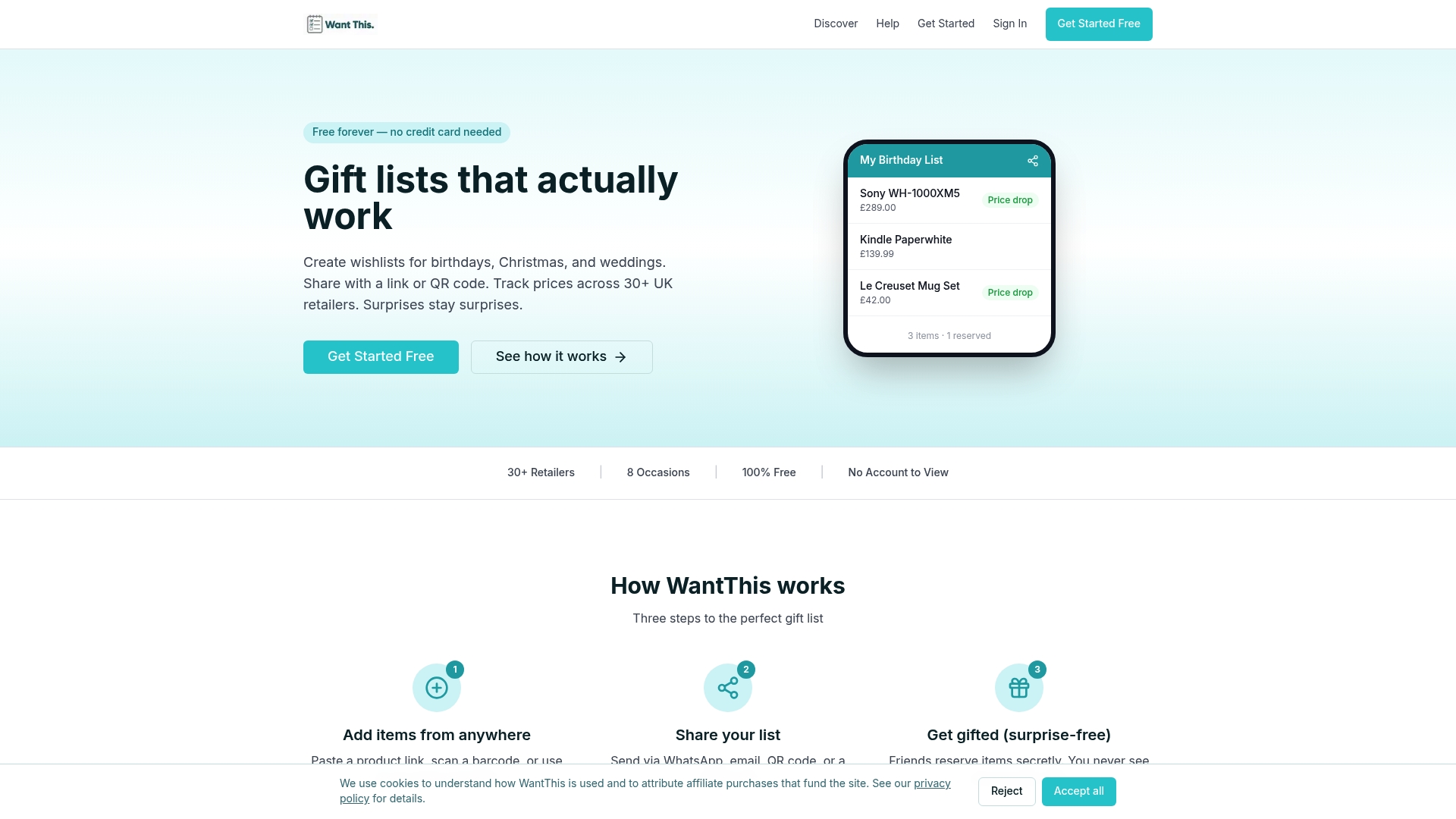
The Wantthis Secret Santa organiser lets you set up an exchange in minutes: add participants, include your spending cap in the event message, and run an automatic name draw. Each participant can add a wishlist by pasting product links from any UK retailer, and friends or family can privately reserve items so surprises stay intact. Price tracking across 30+ UK retailers means buyers can watch for a drop and grab something within the cap at the right moment. Set up your free Secret Santa exchange on Wantthis today and spend less time organising, more time enjoying it.
Useful sources
- Secret Santa Budget Rules That Actually Work — covers hard cap vs guideline wording, hidden costs, and opt-out etiquette
- Secret Santa Rules: The Complete Guide — recommended GBP spending ranges by group type
- Tips to set the right Secret Santa gift budget — guidance on fixed vs flexible budgets for different group compositions
- 10 Secret Santa rules everyone should know — practical rules including the “+£5 wiggle” approach
- Secret Santa budget: how much to spend by group type — shipping and wrapping rules for remote exchanges
- Secret Santa budget rules (what’s reasonable?) — inclusivity guidance for large or mixed-income groups
- Office Secret Santa dos and don’ts — workplace etiquette on overspending
- Wantthis Secret Santa organiser — free tool for automatic draws, wishlist collection and private reservations