
Multi-Store Price Tracking for Gift Wishlists Across Hundreds of UK Retailers

Use a wishlist-based tracker like WantThis: paste any UK product link, get an instant alert when the price drops, and skip the tab-hopping. It works across more than 30 UK retailers, keeps a price history for every saved item, and lets you organise everything by occasion rather than by which website you happened to buy from. Paste your first link now and see what it pulls in.
TL;DR:
- Price trackers relying on polling may miss quick price changes during high-demand sales like Black Friday or promotional events.
- Variant mismatches, especially for sizes or colours, can cause false alerts and reduce tracking accuracy across UK retailers.
- Regional pricing differences and frequent retailer promotions make it essential to manually verify prices at checkout despite tracker alerts.
- Using a wishlist-based system like WantThis helps prevent duplicate gifts and streamlines coordinated buying among friends and family.
- Trackers work best with hourly checks, comprehensive store coverage, and transparency about data handling and alert thresholds.
Table of Contents
- How does multi-store price tracking actually work?
- Which ways can you track prices across UK stores?
- How do you choose the right tracker for UK shopping?
- How do you use WantThis to track prices across UK stores?
- What limits UK price tracking, even with a good tool?
- Is price tracking and data scraping legal in the UK?
- When does price tracking actually earn its keep?
- WantThis: get started with price tracking and wishlist sharing
- Sources
How does multi-store price tracking actually work?
Every price tracker relies on one of two mechanisms: it either polls a product page at intervals to check the listed price, or it pulls data from a retailer’s feed or API. Polling is slower but works on almost any site. Feed-based tracking is faster and more accurate, but only for retailers that have shared their data with the tracker’s operator. That’s why some tools cover a fixed list of stores and others let you paste in a link from practically anywhere.
This split explains a lot of the frustration shoppers feel with tracking apps. A tool that only accepts links from a handful of named retailers might miss the independent electronics shop or specialist homeware store where you actually found the item. A tool built to accept any product URL, by contrast, has to do more work behind the scenes, matching product identifiers and variant details so the price it shows is genuinely for the trainers in your size, not a different colourway sitting £15 cheaper.
Price history charts are where this becomes useful rather than just interesting. A chart showing three months of data tells you whether today’s “sale” price is a genuine drop or the item’s normal price wearing a red sticker. Retailers run promotions constantly, and a flat line with one brief dip usually means a real discount, while a jagged, frequently-discounted line suggests the “was” price is inflated to begin with.
- Push notifications arrive fastest, often within minutes of a price change being detected.
- Email alerts are more reliable for people who don’t want another app pinging their phone.
- Telegram-based alerts, offered by some trackers like DealMonitor, suit shoppers who already live in messaging apps.
Update frequency varies by tool and by retailer, and a handful of factors limit accuracy across the board: bot-blocking on busy retail sites, regional pricing differences, and product variants that don’t map cleanly onto a single price. A jumper in “navy, size M” and “navy, size L” can price differently, and a tracker that doesn’t separate them will send you false alerts.
Which ways can you track prices across UK stores?
You’ve got four realistic options, and each suits a different kind of shopper.
- Browser extensions. These capture a price the moment you land on a product page, which makes them genuinely convenient while you’re actively browsing. The catch is that they only track what you tell them to, on the browser you installed them in, so anything spotted on your phone at lunchtime gets missed until you’re back at your laptop.
- Dedicated apps and web apps. These sync across devices, so a link added on your phone shows up on your laptop and vice versa. This matters more than it sounds. Gift shopping rarely happens on one device.
- Manual comparison. Opening ten tabs or keeping a spreadsheet still has a place, particularly for one-off big purchases where you’re comparing three or four specific retailers rather than tracking dozens of products over weeks.
- Wishlist-based tracking. This is the WantThis approach: price tracking sits inside a shared list, so you’re not just watching a number fall, you’re coordinating who’s buying what with the people around you.
Pro Tip: If you’re tracking gifts rather than personal purchases, a wishlist-based tool beats a plain price tracker every time, because it also stops two relatives buying the same thing.
How do you choose the right tracker for UK shopping?
Coverage is the first filter. A tracker that only handles five major chains is no use if you shop at specialist retailers, marketplaces, and supermarkets in the same week. Check what it actually supports before committing, not just what its homepage claims.
Beyond coverage, run through this checklist:
- Check frequency. Daily checks miss flash sales; hourly checks catch far more.
- Variant accuracy. Does it distinguish sizes, colours, and models, or lump them together?
- Alert method. Push, email, or both, and can you set a threshold rather than being told about every 50p wobble?
- Cost and limits. Some tools cap the number of tracked items on a free tier.
- Data handling. Does it disclose affiliate relationships and explain what it stores about you?
Testing a tracker takes ten minutes and saves weeks of false trust. Add one item you know the price of, wait a day, and check the recorded history matches what you saw on the retailer’s own page. Then check the variant, colour or size, matches exactly. Finally, manually change nothing and just wait for a routine price movement to see whether the alert actually arrives and how fast.
| What to check | Why it matters |
|---|---|
| Retailer coverage | Determines whether your usual shops are even trackable |
| Check frequency | Affects how quickly you catch flash sales |
| Variant matching | Prevents false alerts on the wrong size or colour |
| Alert channel | Push is fastest; email suits fewer interruptions |
| Data transparency | Shows how your saved links and prices are handled |
Delivery costs and returns policies matter as much as the headline price. A £5 saving disappears fast against a £4.99 delivery charge or a retailer with a poor returns record, so factor that in before an alert turns into an impulse buy.
How do you use WantThis to track prices across UK stores?
Setting this up takes about the same time as adding a bookmark.
- Paste any UK product link into WantThis. The title, image, and current price pull in automatically, whether it’s from a supermarket, a marketplace, or a specialist retailer, thanks to the price tracking feature.
- Add it to an occasion list. Drop it into a birthday list, a Christmas list, or a Secret Santa exchange, and set a target price if you’re waiting for a drop.
- Share the list and let people reserve items. Friends and family can privately mark something as reserved or bought, so nobody ends up with two of the same present, a feature explained in more detail on the gift list tracking guide.
Alerts arrive by email, in-app notification or push, so you’re covered whether you added the item at your desk or on the bus. Coverage spans many UK retailers, which suits everyday gift buying, big-ticket electronics where significant price swings are common, and seasonal sales where prices move frequently.
Pro Tip: Set your alert threshold a little above the price you’d genuinely pay, not the lowest figure you’ve ever seen. That way you don’t dismiss useful drops while holding out for a record low that may never come again.
What limits UK price tracking, even with a good tool?
No tracker, however wide its coverage, catches everything a determined bargain-hunter would find manually, and it’s worth knowing where the gaps sit.
Regional pricing is the first snag. Some UK retailers vary prices by delivery postcode or by whether stock sits in a local warehouse, so the price a tracker records isn’t always the price you’d see when you actually check out. Promotional frequency compounds this. Retailers running near-constant flash sales and voucher codes mean a tracked “price” is really a snapshot, and the actual number at checkout can shift again with a discount code applied at the till.
Bot-blocking on busier retail sites occasionally causes trackers to miss updates entirely for a few hours, which matters most during high-demand periods like Black Friday, when prices can change several times a day. Variant mismatches remain the most common source of false alerts. Detecting that a product identifier belongs to the right size, colour, or model is genuinely hard at scale, and even well-built trackers slip on it occasionally.
None of this makes tracking pointless. It just means treating an alert as a strong signal to go and check, rather than a guarantee of the exact price you’ll pay.

Is price tracking and data scraping legal in the UK?
Tracking publicly listed prices on a retailer’s own website is a normal, lawful activity for personal use. You’re viewing information the retailer has already published; a tool that checks a public page periodically on your behalf isn’t doing anything a human couldn’t do by refreshing the page themselves.
Where things get more complicated is automated scraping at scale, which sits under a mix of UK data protection law, the Computer Misuse Act, and each retailer’s own terms of service. Large-scale scraping that ignores a site’s terms, overloads its servers, or extracts data for resale can breach those terms even where it doesn’t breach the law outright. This is a matter for the businesses building tracking tools rather than for individual shoppers, but it’s worth knowing that reputable trackers tend to work with retailer feeds or APIs where possible, precisely to stay on the right side of that line.
On the data protection side, any UK service handling your saved links, email address, or notification preferences is processing personal data, which brings it under UK GDPR. Check that a tracker states clearly what it stores and whether it shares data with retailers for affiliate purposes. Notification permissions themselves usually sit with your device or account provider. Google’s account terms, for instance, let you control which apps can send you push alerts at the operating system level, separate from whatever the tracking app itself offers.

When does price tracking actually earn its keep?
Tracking pays off hardest around Black Friday, Christmas, and big product launches, when prices genuinely move day to day and a missed drop costs real money. It’s less useful for catching app-only codes, loyalty discounts, or stacked vouchers, since none of those show up in a public listed price. A tracker tells you the shelf price moved; it won’t tell you that a retailer’s app has a further 10% off buried in a banner. Coordinating a group gift list makes the gaps matter less, because you’re watching for “good enough,” not perfection.
WantThis: get started with price tracking and wishlist sharing
WantThis gives you a lower-effort route to the same outcome those tab-hopping and spreadsheet methods above are chasing: one place that tracks prices across hundreds of UK retailers, keeps a history for every item, and lets the people buying gifts for you reserve them without anyone finding out by accident.
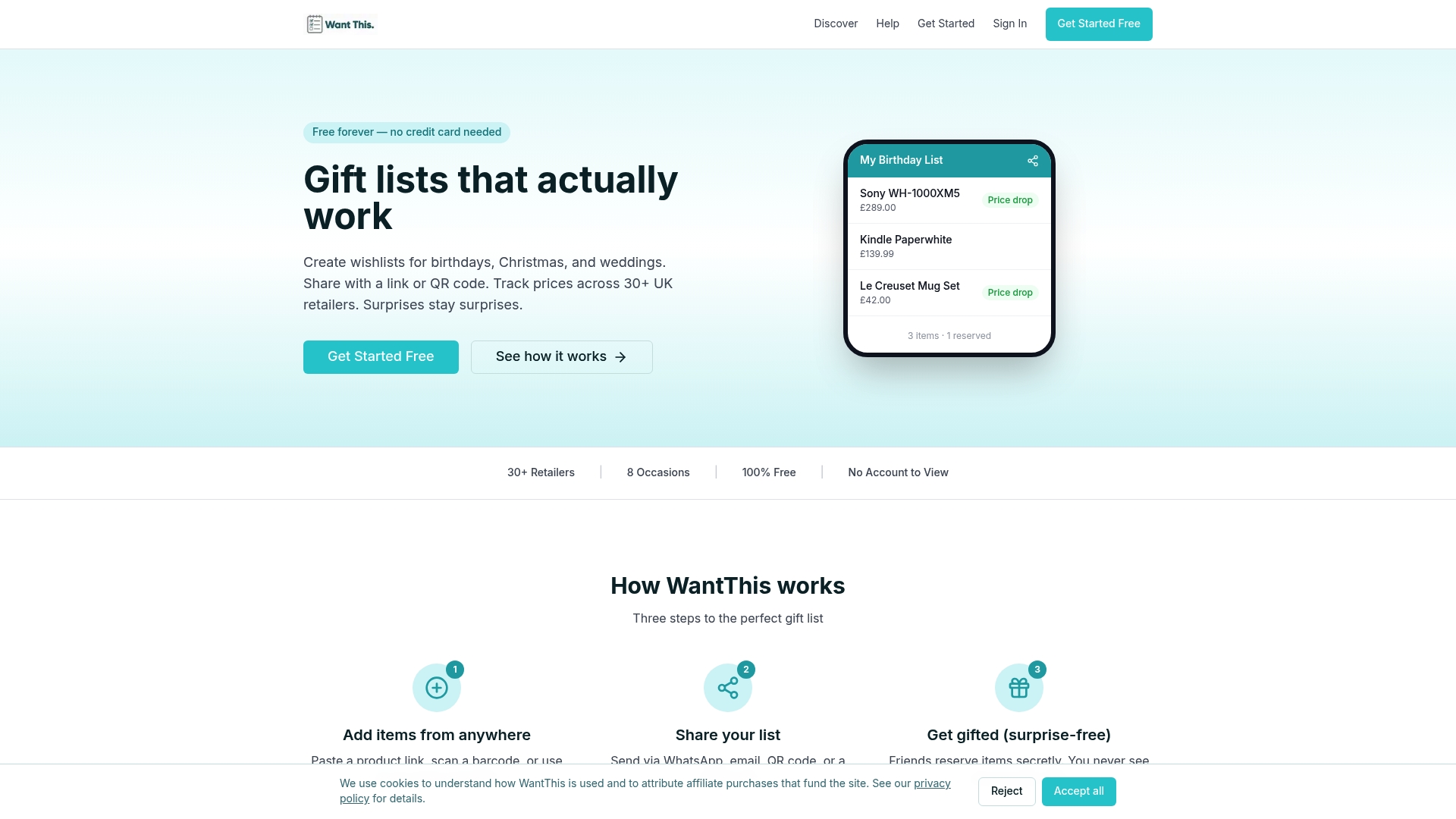
There’s no manual checking, no separate app for each shop, and no awkward “did you already get this?” text before a birthday. Paste a link from any UK retailer and the price tracking feature pulls in the title, image, and current price automatically. Add it to a birthday list, a Christmas list, or a Secret Santa draw, set an alert, and share it. Friends and family can privately reserve or mark items as bought, so surprises stay intact and nobody ends up with a duplicate. It works in any browser, on desktop or mobile, so a link added on your phone during lunch shows up wherever you check next.
Paste your first product link into WantThis and see the price history build from day one.