
Secure Your Gift List Privacy in 10 Minutes

The fastest fix is simple: set your list to private or invite-only, and kill any public link you’ve already shared. Most exposure happens through two blind spots: an address field visible to anyone with the link, and a “show what’s been purchased” toggle left on by default. Choosing a privacy-first platform like WantThis removes most of this risk from the start.
TL;DR:
- Setting your gift list to private or invite-only and revoking any shared public links significantly reduces exposure risks.
- Always check and hide delivery addresses, or use alternative addresses like PO boxes or gift cards, to prevent unintended address sharing.
- Testing your list as a stranger by logging out and viewing it privately can reveal potential privacy gaps effectively.
- Sharing links via private messaging and creating new invite-only links for groups help maintain surprises and limit access.
- Immediate actions to take if your details are exposed include disabling shared links, changing passwords, and contacting platform support.
Table of Contents
- How to change your gift list privacy settings
- Checking and changing your gift list privacy: a step-by-step process
- Why gift lists reveal your home address, and how to stop it
- Sharing your list without spoiling it or duplicating gifts
- What to do if your gift list details are exposed
- Why WantThis builds privacy into gift lists by design
- Try a gift list that treats privacy as the default, not an afterthought
- Sources
How to change your gift list privacy settings
Most exposure problems trace back to a handful of toggles people never check after setting up a list. Fixing them takes less time than writing the list itself.
Run through this before you share anything else:
- Set list visibility to private or invite-only, never “public” or “anyone with the link”.
- Revoke any public link you’ve previously shared on social media or in a group chat.
- Remove or mask your delivery address; use a nickname for the address label if the platform allows it.
- Turn off “show purchased items” so buyers can see what’s needed without spoiling surprises for you.
- Turn on reservation features so two people can’t buy the same thing.
- Refresh your account password and switch on two-factor authentication.
Pro Tip: Do a “stranger test” once a month: open your list in a private browser window with no login. If you can see more than a first name and a wish list, so can anyone else with that link.
Recent reporting on wishlist privacy found that platform interface changes have quietly exposed more location detail than users realised was on display, which is exactly why a periodic check matters more than a one-off setup.
Checking and changing your gift list privacy: a step-by-step process
Every gift list platform arranges its menus differently, but the underlying settings are almost identical. Work through this order once, and you’ll cover the risks that matter regardless of which service you use.
- Find the settings menu. Look under your account or profile icon for “list settings”, “privacy” or “sharing options”. On most platforms it sits one click away from the list itself, not buried in general account preferences.
- Choose the right visibility level. You’ll typically see three options: public (searchable by anyone), link-only (visible to whoever has the URL) and private (invite-only, often requiring an account or email match). Private is the safest default for anything containing an address.
- Check your delivery address fields. Some platforms display a full address to viewers; others show only a city or nothing at all. Edit or hide this field wherever the option exists.
- Test reservation and “mark as bought” features. Reserve a test item yourself and check whether other visitors can still see it as available. A working reservation system should hide the reserver’s identity from other viewers, not just tick a box.
- View the list as a stranger would. Log out, open a private browser tab, or send the link to a trusted friend and ask them to describe exactly what they can see. This single step catches more privacy gaps than reading a settings page ever will.
Tech reporting on wish list changes has specifically recommended this kind of settings review after platform updates altered what visitors could see by default, a reminder that “set and forget” doesn’t really apply to shared lists.
Why gift lists reveal your home address, and how to stop it
Address exposure rarely happens through a dramatic hack. It happens through a form field nobody thought to hide, or a checkout confirmation email accidentally forwarded to a group chat. Some platforms display a partial or full street address on the list itself so buyers know where to send items; others reveal it only during checkout, but that’s still visible to anyone who reaches that stage.
A few practical mitigations solve most of this:
- Use a PO box or a click-and-collect delivery point instead of your home address.
- Offer an alternative delivery address, such as a trusted relative’s house, for anything shared publicly.
- Choose gift cards for occasions where you’d rather not share delivery details at all.
- Ask your list platform to show only a city or region, if that option exists, rather than a full street address.
There’s a real trade-off here: buyers need enough delivery information to complete a purchase, so total anonymity isn’t always practical. Independent coverage has flagged this tension directly, finding that wish list interface changes can expose more location detail than shoppers expect, which is why reviewing what’s visible before you share a link matters more than trusting the default settings.
Sharing your list without spoiling it or duplicating gifts

A public link and an invite-only link solve different problems. Public links are convenient for reach, sharing on social media, in a family group, wherever, but they’re also visible to anyone who stumbles across them, including people well outside your intended circle. Invite-only sharing restricts visibility to specific email addresses or accounts, which is worth the extra step for anything containing personal details.
Reservation features do double duty here: they stop two people buying the same gift, and a well-designed system hides who’s reserved what from other viewers, so surprises stay intact right up to the day itself.
- Share links through private messaging (direct message, email, WhatsApp) rather than posting them publicly.
- Avoid pasting list links into public social media posts, even in a “friends only” setting, since screenshots travel further than you’d expect.
- For larger or expensive items, suggest a group-gift option or a gift card instead of individual home delivery.
Pro Tip: If a list has to go into a group chat with people you don’t know well, generate a fresh invite-only link rather than reusing your main one. It’s easier to revoke one link than to track down every place the original was shared.
What to do if your gift list details are exposed
If you discover your address or personal details are visible to people who shouldn’t see them, act in this order:
- Disable or delete the shared link immediately, even if that means resending a new one to legitimate recipients.
- Change your account password and turn on two-factor authentication if you haven’t already.
- Contact the platform’s support team to report the exposure and ask what data they can remove or restrict on their end.
- Arrange a temporary mail hold, PO box, or local pick-up point for anything already in transit until you’re confident the issue is resolved.
Community reports on platform privacy changes show this is a recurring concern, not a one-off glitch, so treating it as routine housekeeping rather than a crisis makes the response faster.
Why WantThis builds privacy into gift lists by design
Privacy shouldn’t be an advanced setting you have to hunt for. That’s the thinking behind how WantThis structures its sharing and reservation features: you choose who gets the link, reservations hide the reserver’s identity from other viewers, and price tracking works without needing to expose a delivery address to anyone browsing the list.
A few specifics worth knowing:
- Lists are shared by link, QR code, WhatsApp or email, so they reach only the people you send them to.
- Reservation and “mark as bought” tools prevent duplicate gifts without revealing who bought what.
- Price tracking across retailers works independently of any address field, so buyers get useful information without seeing sensitive details.
WantThis also publishes buyer-facing guidance on keeping gifts a genuine surprise, which reflects a broader view that privacy and good gift-giving aren’t in tension. They should work together.
Try a gift list that treats privacy as the default, not an afterthought
Most of the friction in this article exists because general-purpose retailer wishlists weren’t built with gift-giving privacy as the priority. WantThis was: you decide who receives the link, reservations keep purchases hidden from other viewers until the big day, and price tracking works without pulling your delivery details into view for anyone browsing.
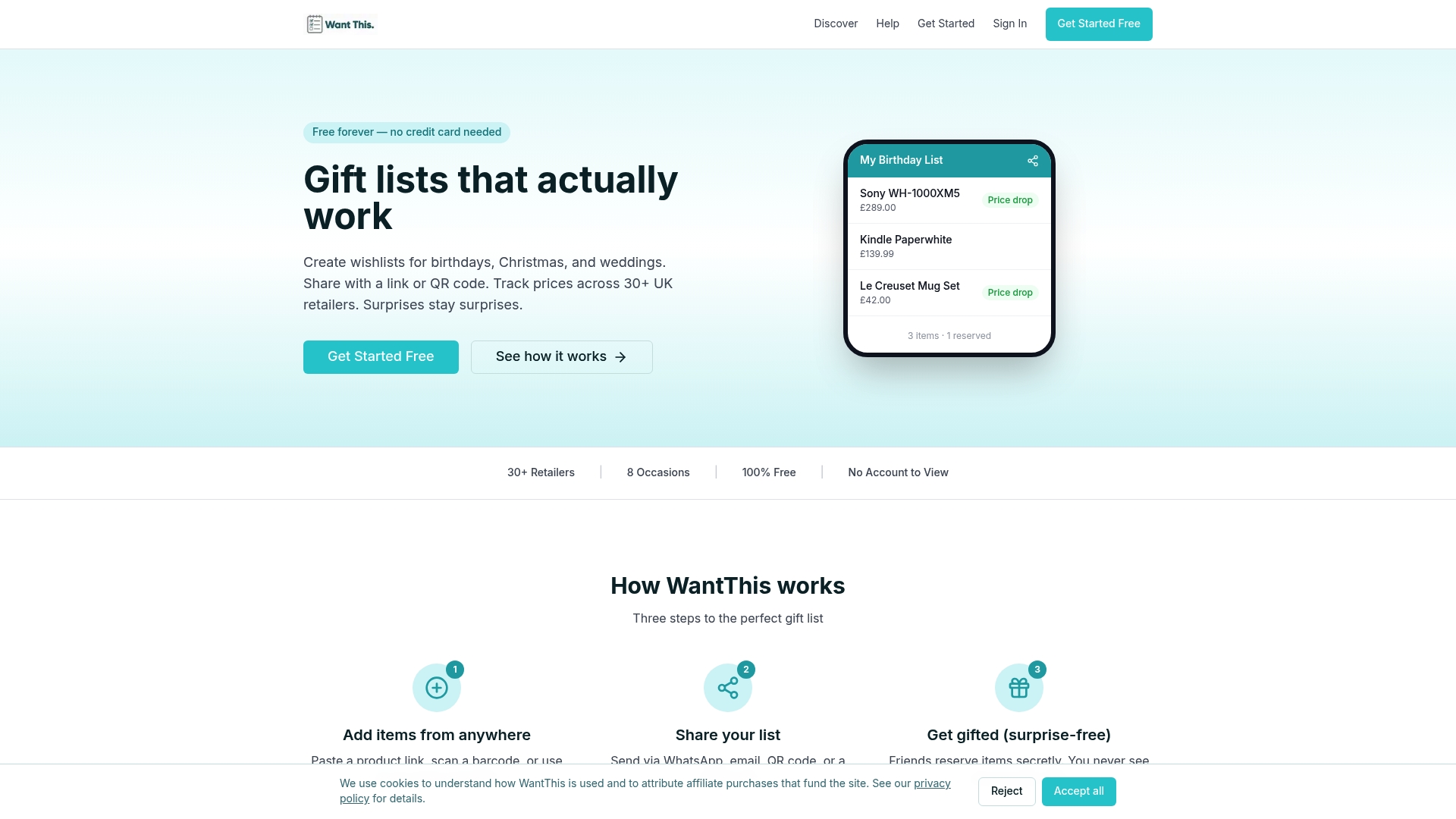
If you’ve spent the last ten minutes auditing settings on a platform that keeps changing its defaults, it’s worth seeing what a list built around this from day one looks like. You can organise gift lists by occasion, track price drops across UK retailers, and share with exactly who you choose, no more, no less. Start a free list at WantThis and see how little time it takes to set one up properly.
Sources
For more on the issues raised here, see Reader’s Digest’s coverage of wishlist address exposure, Lifehacker’s practical settings advice, and general online shopping safety guidance.
- This quiet Amazon change may reveal your address to strangers
- Changes to Amazon wish lists could reveal your home address