
What is an online savings tracker for gift wishlists?

A savings tracker online, in the gift-shopping sense, is a wishlist price tracker: a tool that watches items you have saved and tells you when the price drops to a target or hits a new low. It has nothing to do with squirrelling away cash into a savings account. It is about not paying full price for the birthday present you spotted three weeks before you needed it.
For anyone building and sharing a gift wishlist, this matters in three concrete ways:
- You catch genuine price drops instead of guessing when to buy, because the tracker checks for you.
- Friends and family avoid buying duplicates, since a shared list shows what has already been reserved or bought.
- Group gifts get simpler, because everyone can see the same live price and decide together whether to buy now or wait.
Industry write-ups on how these tools work describe the same basic mechanism: a price tracker records periodic price snapshots and alerts you when a rule or target is met. WantThis builds this directly into its wishlist platform, so tracking sits alongside sharing and reservation rather than as a separate app you have to juggle.
Key Takeaways
A wishlist price tracker works by monitoring saved gift items and alerting you when the price meets a target, which saves money and prevents duplicate gifts on shared lists.
| Point | Details |
|---|---|
| Definition | A wishlist price tracker monitors saved items and alerts you when the price drops to a set target. |
| Core benefit | Shared, tracked lists stop friends and family buying the same gift twice. |
| Verify before buying | Check the seller, variant, and final checkout price against the price history, not just the alert. |
| Best use case | Tracking suits gifts you’re planning weeks ahead, not urgent or one-off purchases. |
| Recommended next step | Add a few items to a free WantThis list, set targets, and watch for a month to judge the value. |
Table of Contents
- How does a wishlist price tracker actually work?
- What features should you expect from a good tracker?
- Why does price tracking help people sharing gift wishlists?
- How do you set up and use a wishlist price tracker?
- What data does a wishlist tracker collect and share?
- Where do wishlist price trackers fall short?
- How does WantThis handle wishlist price tracking?
- When is a wishlist price tracker actually worth using?
- Try WantThis for your next gift list
- Frequently asked questions
- Sources
How does a wishlist price tracker actually work?
A wishlist price tracker monitors saved items, records a snapshot of the price at intervals, compares that snapshot against your target, and sends an alert the moment the conditions are met. That is the whole mechanism, and it runs quietly in the background once you have added an item.
The tracker does not just watch the headline number. It also captures context: the specific product page, the retailer, availability, and often the seller or condition. This matters because trackers collect details like seller and variant information since the cheapest visible price may apply to a different seller or a different version of the item. A £40 “deal” attached to a used listing or a different colourway is not the deal you thought it was.
Checking frequency varies between services, and this is worth understanding before you rely on alerts for time-sensitive shopping. Short-lived promotions can be missed if a tool doesn’t check a listing often enough, which is why a flash sale that lasts four hours sometimes slips through even a good tracker.
The flow, in practice, looks like this:
Save the item → the tracker monitors the listing → it records a price snapshot → it compares that snapshot to your target → it alerts you when the conditions match.
Pro Tip: Set your target price using the item’s price history rather than a hopeful guess. If a jacket has dropped to £45 twice in the last three months, £45 is a realistic target. £30 probably is not.
What features should you expect from a good tracker?
Not every wishlist tool tracks prices the same way, and the difference between a useful tracker and a frustrating one usually comes down to five features. A visible price history built from timestamped snapshots lets you judge whether today’s price is actually low or just average dressed up as a discount.
| Feature | What it delivers for a gift list | What good implementation looks like |
|---|---|---|
| Price history | Shows whether a price is a real low or a recurring pattern | Chart or log going back weeks, not just today’s figure |
| Target-price alerts | Notifies you only when the price meets your own threshold | Clear rule set once, no repeated manual checking |
| Multi-retailer coverage | Lets one list track items from different shops | Works from a pasted link regardless of the retailer |
| Sharing and reservation | Stops two people buying the same gift | Private view for buyers, no visibility for the recipient |
| Extension or mobile capture | Lets you add items while browsing, not just at a desktop | One click to save, with price data pulled in automatically |
Reliability is the thing to judge hardest, because a tracker that raises false alarms trains you to ignore it. Look for transparent price history you can actually scroll through, visible seller information rather than a single blended number, and alert rules that are plain about what triggers a notification.
Pro Tip: A tracker that shows its price history openly, names the seller on every listing, and lets you set your own alert threshold is almost always more reliable than one that just flashes “deal” badges.
Why does price tracking help people sharing gift wishlists?
Tracking saves money and prevents duplicate gifts, and both effects get stronger the moment a wishlist is shared rather than kept private. A list that only you can see is useful. A list your whole family can see and act on is where the real value shows up.

Consider three everyday situations. During the run-up to Christmas, a tracked list means you are not manually checking six different retailer sites every evening hoping for a drop, which is exactly the kind of guesswork multi-store tracking is meant to remove. When a group of siblings is pooling money for a parent’s larger gift, a shared tracked list lets everyone watch the same price and agree together on when to pull the trigger. And when grandparents, aunts, and close friends are all shopping from the same birthday list, reservation marks stop two people turning up with the same board game.
Alerts change behaviour for both sides of the gift exchange. For the buyer, a price-drop notification is often the nudge that turns “I’ll get to it” into “I’ll buy it now.” For the list owner, seeing an item reserved by someone else means they can stop thinking about it entirely, which is arguably the quieter but more useful benefit of the two.
How do you set up and use a wishlist price tracker?
Getting a gift list tracking prices takes a few minutes, and the process is largely the same across tools that support link-paste capture.
- Find the item on the retailer’s site and copy the product link, whether that’s a phone, a cookbook, or a pair of trainers.
- Paste the link into your wishlist tool, which should pull in the title, image, and current price automatically rather than asking you to type it all in by hand.
- Set a target price based on what you know of the item’s history, not a random round number.
- Share the list with the people you want involved, whether that’s a partner, a family group, or friends organising a joint gift.
- Check reservation status before buying anything from someone else’s list, so you don’t duplicate a gift another guest has already claimed.
If an item won’t track properly, the usual culprits are a link that points to a search results page rather than a specific product, or a variant mismatch where the size or colour saved doesn’t match what you actually want. WantThis’s own guidance on pasting product links walks through fixing both.
Pro Tip: When sharing a list for a surprise gift, check the sharing settings before you send the link. Some tools let recipients see reservation marks; make sure the person the gifts are for isn’t one of them.
Pro Tip: Round targets to a price you’ve actually seen the item hit before, not a number that just sounds satisfying.
What data does a wishlist tracker collect and share?
A typical wishlist tracker collects saved item metadata, timestamped price snapshots, and, when you share a list, some profile details such as your name or a display handle. None of this is unusual, but it is worth knowing before you connect an email address or install a browser extension.
Before adding items, it’s worth checking a few things:
- What permissions the browser extension asks for, since some request broader page access than they strictly need.
- Whether your email address is used only for alerts or also for marketing you didn’t sign up for.
- Who can see reservation marks and purchase status on a shared list, especially if the gift recipient has access to the same account.
Affiliate links are a normal part of how these tools stay free. When you click through from a wishlist to buy, the platform may earn a small commission from the retailer. This does not change what you pay at checkout. It is simply how the service funds itself instead of charging you a subscription.
Pro Tip: If you’re tracking a surprise gift, use a private or minimal-profile share setting so the recipient can’t accidentally see what’s been reserved.
Where do wishlist price trackers fall short?
No tracker guarantees a deal, and knowing the common failure points saves you from buying on a false alarm. Flash sales that run for a few hours can end before the next scheduled check. Regional pricing means a price shown to one shopper may not match another’s. Retailers occasionally block automated checks entirely, leaving a gap in coverage. Variant mismatches, where the tracked price belongs to a different size or colour, are a recurring cause of alerts that turn out to be wrong.
A few red flags are worth watching for:
- An alert with no seller name attached, which makes it hard to know if the price applies to the item you actually want.
- A sudden spike in the price history chart right before a “sale,” which sometimes signals an inflated reference price rather than a real discount.
- Vague coupon terms on a discount alert, where the fine print excludes the exact item you’re tracking.
Before buying on any alert, check the final price at checkout including delivery, confirm the seller and condition, and compare that against the price-history record rather than the badge alone.
How does WantThis handle wishlist price tracking?
WantThis is built around exactly the workflow described throughout this article, rather than tracking being an add-on feature bolted onto a generic wishlist.
- Paste any retailer link, and the platform automatically extracts the title, image, and current price, so there’s no manual data entry required.
- Price history and target alerts let you set a realistic threshold and get notified when an item actually drops, rather than checking manually.
- Sharing and reservation mean friends and family can privately mark items as reserved or bought, which is the direct fix for the duplicate-gift problem covered earlier.
- Occasion-based lists and a Secret Santa organiser cover birthdays, Christmas, weddings, and baby showers, plus group exchanges with an automatic draw.
WantThis is UK-based and free to use, which matters if you’re coordinating a family list across several households rather than paying for yet another subscription. For a practical next step, the full features page covers how tracking, sharing, and reservation fit together.
When is a wishlist price tracker actually worth using?
Price tracking earns its place when you’re shopping ahead of a fixed date, whether that’s a birthday two months out, a Christmas list started in October, or a group of people pooling towards a larger gift. The tool’s job is to remove the manual checking, not to manufacture a discount that isn’t there.
It’s less useful for very low-cost items, where a few pounds of potential saving isn’t worth the alert, and for urgent buys where you need the item today regardless of price. One-off limited editions rarely track well either, since there’s no meaningful price history to compare against, only a single listing that either exists or doesn’t.
The sensible way to judge whether tracking suits your habits is to add a handful of items to a list and watch them for a month. If the alerts feel useful and the price history matches what you’d expect, keep going. If they don’t, you’ve lost nothing but a few minutes of setup.
Try WantThis for your next gift list
WantThis gives you multi-retailer price tracking, sharing, and reservation in one free tool, so you’re not juggling a spreadsheet alongside three different retailer apps to plan a birthday or Christmas.
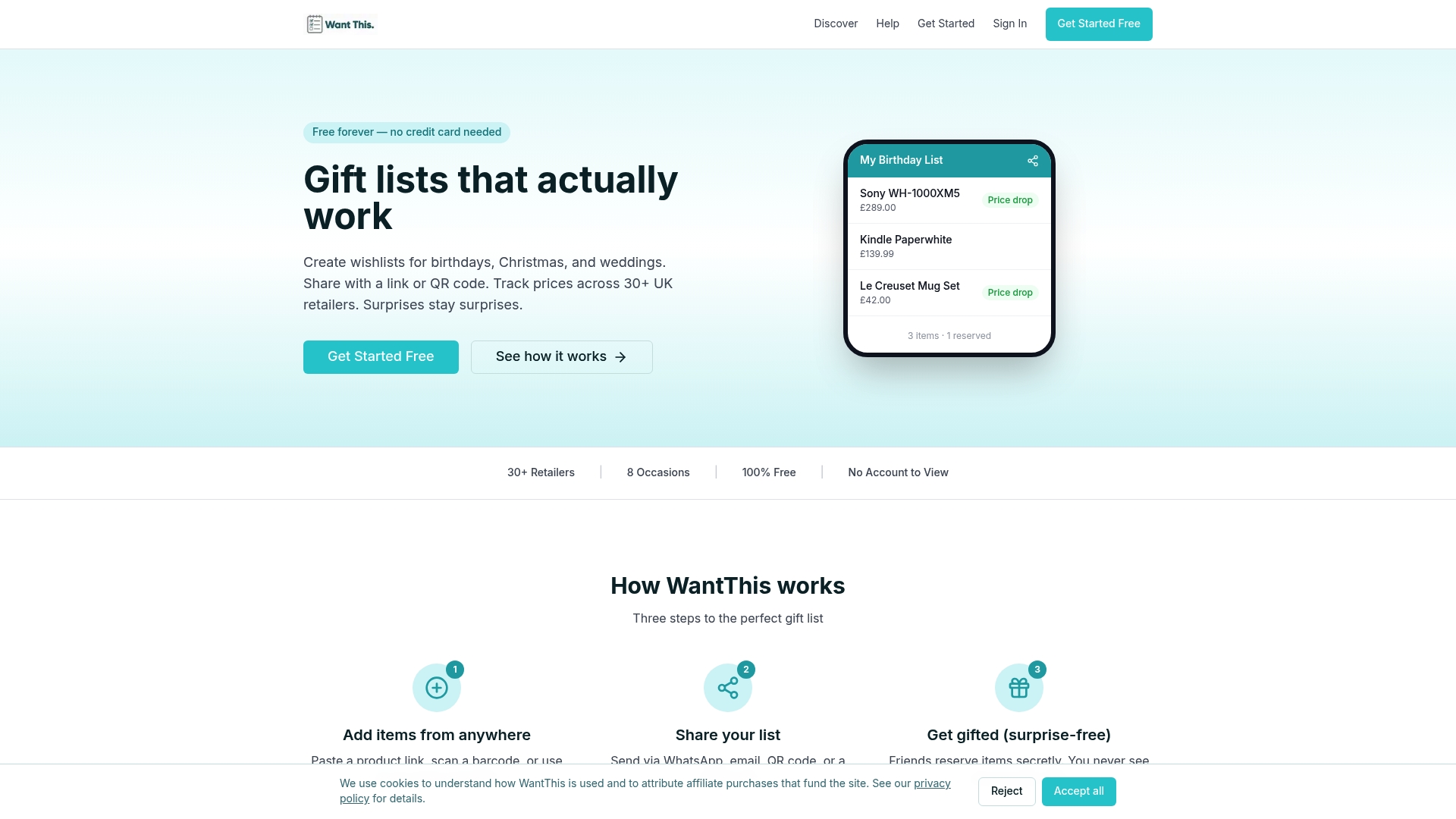
Paste a product link from any retailer and WantThis pulls in the title, image, and current price automatically, then tracks it for you. Share the finished list with family so gifts don’t get duplicated, or set up a Secret Santa draw for the office or the extended family this year. WantThis earns a small commission when someone buys through a shared list link, which is disclosed on the site and never changes what the buyer pays. Reservations are never shown to the list owner, so the surprise stays intact. Head to the features page to see price tracking in action, or start your first list at WantThis.
Frequently asked questions
Is a savings tracker online the same as a budgeting app? No. In the gift-list context, a savings tracker online refers to a wishlist price tracker that watches saved items and alerts you to price drops, not a personal finance app for managing cash savings.
Do wishlist price trackers cost anything? Many, including WantThis, are free to use. Revenue typically comes from affiliate commissions when someone buys through a shared list link, which doesn’t affect the price you pay.
Can a price tracker guarantee I’ll get the lowest possible price? No tool can guarantee that. Trackers work from periodic checks, so short flash sales or retailer-specific pricing can occasionally be missed, which is why checking the final price before buying still matters.
How do I stop family members seeing gifts I’ve reserved for them? Use a private list or adjust sharing settings so the recipient isn’t included in the group who can see reservation marks and purchase status.