
A present idea generator gets you unstuck fast, if you use it right

A present idea generator earns its place when you feed it four things: who the gift is for, the occasion, your budget, and something about their tastes. Give it vague input and you get vague output. Give it specifics and most tools narrow thousands of possible presents down to a shortlist you can actually act on.
The smarter approach isn’t a one-off search the week before a birthday. It’s pairing a generator with an ongoing wishlist, so ideas you spot in January don’t vanish by December.
- Generators typically hand back one of three things: broad idea “seeds” to build on, specific product links with live prices, or experience and subscription suggestions.
- An integrated wishlist and generator setup remembers people over time, so you’re never starting from zero when the next occasion arrives.
Key Takeaways
A present idea generator works best when paired with a running wishlist that remembers people, tracks prices, and prevents duplicate gifts across occasions.
| Point | Details |
|---|---|
| Feed it specifics | Enter recipient, occasion, budget, and one interest tag for sharper, more usable suggestions. |
| Treat outputs as seeds | Generator suggestions are a starting point to personalise and verify, not a finished shopping list. |
| Match the tool to the task | Use filter tools for speed, quizzes for accuracy, and AI free-text for unusual or complex briefs. |
| Verify before buying | Check stock, delivery time, and return policy on any suggested product before committing. |
| Build the habit year-round | Capture ideas as they occur, then use a generator closer to the date to narrow and refine them. |
| Use WantThis to close the loop | WantThis saves generator ideas to a shareable list, tracks price drops, and avoids duplicate presents. |
Table of Contents
- How does a present idea generator actually work?
- When should you actually use a gift generator?
- How do you get better results from a present idea generator?
- Which type of generator suits your situation?
- How WantThis supports the whole gifting workflow
- Sources
How does a present idea generator actually work?
Most tools ask for the same core inputs before they suggest anything: who the recipient is (their age, your relationship to them), the occasion, a budget range, and something about their interests or the vibe you’re going for. Some also ask about delivery deadlines, which matters more than people expect when a gift needs to arrive by a specific date.
Behind that questionnaire, a few different engines tend to be doing the work.
- Filtered databases — a curated catalogue of products tagged by category, price, and recipient type, narrowed down by your answers.
- Quiz or wizard tools — a short sequence of guided questions that funnels you towards a handful of matched suggestions.
- AI free-text engines — you describe the person and situation in plain language, and the tool generates suggestions based on that description rather than fixed tags.
- Hybrid tools — a mix of the above, often layering AI suggestion on top of a filtered product database for more relevant results.
Outputs vary by design. Some tools give you abstract seed ideas (“something for a coffee obsessive”) that you then have to shop for yourself. Others link straight to specific products with current prices attached. It’s worth knowing which type you’re using, because a static idea list from a database that hasn’t been updated in months can point you to something that’s out of stock or discontinued.
Pro Tip: Always click through to check a suggested product is still in stock before you commit to it as “the plan” — generators are only as current as their last data refresh.
When should you actually use a gift generator?
A generator earns its keep in specific situations, not every gifting decision.
- Last-minute pressure. When you’ve got two days and no ideas, a generator narrows the field faster than scrolling an editorial gift guide.
- Too many options, not enough focus. Large curated retailers can present gifts by occasion and interest in the thousands, which is inspiring but overwhelming without filters. A generator does that filtering for you.
- Creative or unusual recipients. If someone’s into something niche, a generator can surface experience-based or subscription gifts you wouldn’t have thought to search for directly.
Where a generator falls short: hunting for a specific collector’s piece, a bespoke or custom-made item, or anything with a hard delivery deadline that needs a specialist retailer’s guarantee. For those, a direct search or a niche supplier, such as one specialising in gifts for silver stackers, beats a general-purpose tool every time.
How do you get better results from a present idea generator?
The quality of what you get back depends almost entirely on what you put in. Vague prompts produce vague suggestions, so treat the input stage as worth a bit of effort.
- Write a compact recipient snapshot first. Note your relationship to them, two clear interests, and one thing to avoid (allergies, a colour they hate, a hobby they’ve quit). This single step does more to improve results than any amount of re-running the tool.
- Set your budget bracket and deadline before you start. A range like “£20 to £40, needs to arrive by Friday” filters out a huge amount of noise immediately.
- Choose your vibe deliberately. The difference between tagging a gift “sentimental” versus “practical” can shift the entire suggestion list, even for the same person and budget. Playful, thoughtful, and practical tend to pull in quite different product categories, so try more than one tag if the first batch feels off.
- Refine rather than accept the first list. Use any filter options, mark ideas you like or dislike, or re-prompt an AI tool with more detail. Small tweaks such as swapping one interest or widening the budget by £10 often reveal much better matches.
- Verify before you buy. Check the actual retailer page for stock, delivery time, return policy, and whether personalisation is available. A generator suggests; it doesn’t guarantee.
Pro Tip: If a generator gives you three underwhelming options in a row, don’t keep clicking “regenerate” blindly. Change one input, usually the interest tag, and you’ll often see a completely different, better-fitted set of results.
Which type of generator suits your situation?
Different generator formats solve different problems, and picking the wrong one for the job wastes time.
- Filter or database tools win on speed. If you know the age bracket and budget and just want a fast list, these get you there in seconds.
- Quiz or wizard tools trade a little more time for accuracy. Answering four or five guided questions tends to produce more reliably matched picks for a fairly typical recipient.
- AI free-text tools handle complexity best. When the brief is unusual (a combined budget for two people, or a very specific hobby crossed with a dietary restriction), describing it in your own words beats trying to force it through rigid filters.
- Hybrid, repeat-use tools are the strongest fit if you buy gifts often. Tools that remember a person’s profile and past choices save you from re-entering the same details every single occasion, which matters most for family organisers juggling multiple recipients across the year.
Editorial guides that group ideas by hobby or role are genuinely useful for browsing, but they don’t adapt to your specific person the way a generator does. If you want that browsing experience with more personalisation, WantThis’s gift guides organised by person, occasion and budget sit somewhere between the two.
How WantThis supports the whole gifting workflow
A generator solves the “what do I get them” problem for one moment. It doesn’t solve the “I forgot what I decided last time” problem, which is where most gifting stress actually comes from.
WantThis is built around remembering people, not just generating ideas once and forgetting them.
- Add any product from any online retailer and it automatically pulls in the title, image, and current price, no manual entry needed.
- Track price drops across saved items so you can buy when the price is actually good, not just when you happen to remember.
- Share lists privately so family and friends can reserve or mark items as bought, which stops the classic problem of two people buying the same thing.
- Run a Secret Santa exchange with an automatic draw, rather than organising names manually over a group chat.
Lists that remember people over time cut down the repeat work that comes with buying gifts for the same circle of people year after year, which is exactly the gap a one-off generator search leaves open.
A habit worth building
Keeping an ongoing list of gift ideas as they occur to you, rather than starting cold each time, is the single biggest improvement most people can make to their gifting. A generator works best as the polishing step, not the starting point: capture ideas as you go, generate to narrow choices near the date, personalise what comes back, then buy.
Try WantThis for your next gift list
WantThis is the practical next step once a generator has given you a few ideas worth keeping. Rather than losing a good suggestion in a browser tab or a screenshot you’ll never find again, save it straight to a list tied to that person, where it stays put until the occasion arrives.
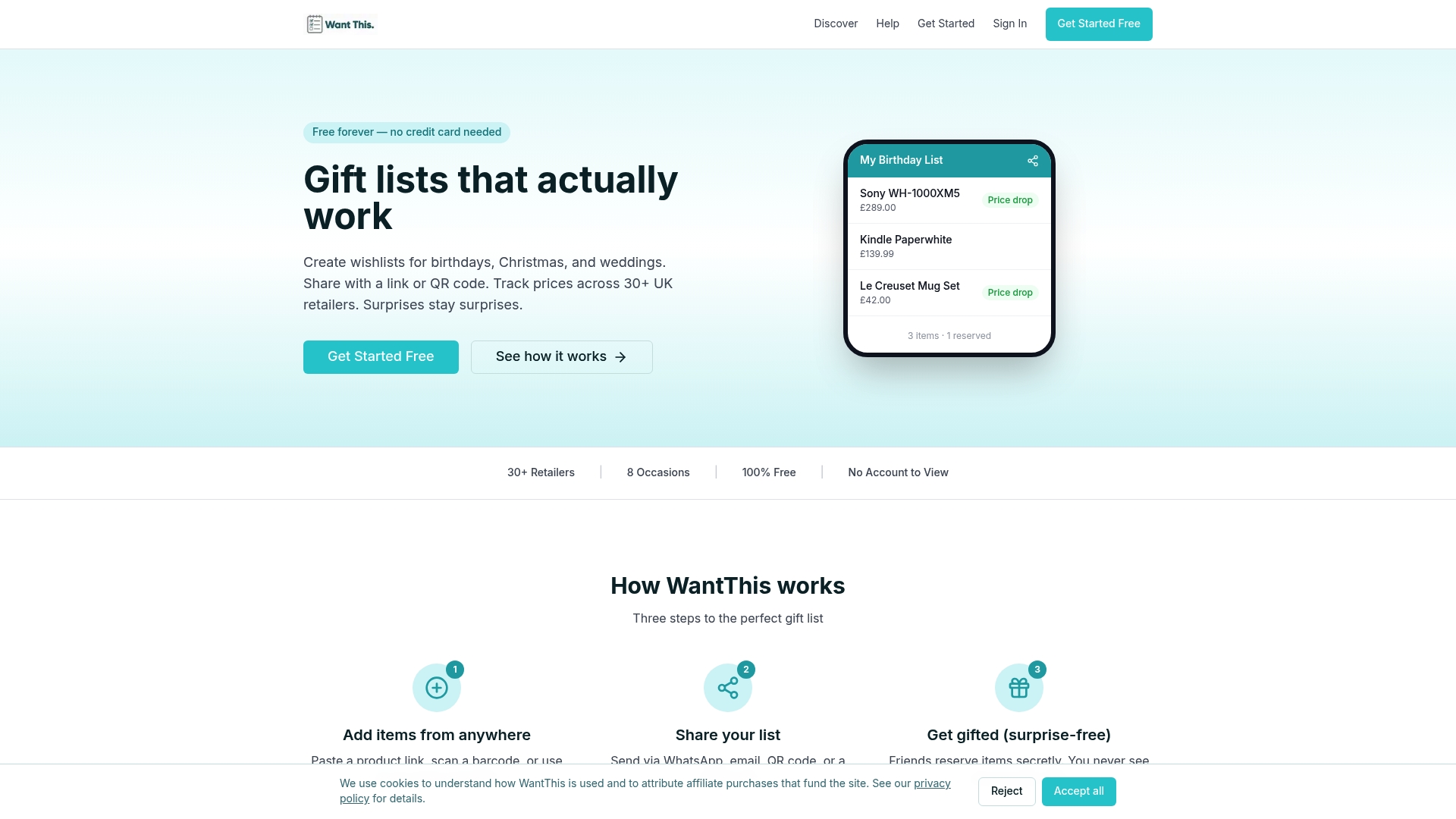
Sharing a list means whoever’s buying can see what’s already reserved, so nobody ends up with two of the same thing. If you’re organising a group exchange this year, the Secret Santa organiser runs the draw automatically, no spreadsheet required. Start by creating and sharing your first list with the people you buy for most.
Sources
- How to come up with good gift ideas every time
- Creative gift ideas (Cratejoy blog)
- Uncommon Goods – gifts by occasion and interest