
Kids Wishlist Ideas by Age: Toys, Books and Experiences

The best kids’ wishlist mixes a few things a child is excited about with some practical, non-toy and experience gifts, and is shared so relatives don’t buy the same thing twice. Below you’ll find ideas for each age group, a safety checklist for UK toys, and a simple way to build and share the list.
TL;DR
- Match gifts to what a child can do now, not what they might grow into. Experts recommend toys that suit current play skills.
- Build the list in three layers: one or two big wants, several small treats, and a few non-toy ideas such as books or days out.
- Check toy safety before you buy. In Great Britain, toys for under-14s must meet the Toys (Safety) Regulations 2011 and carry the UKCA marking.
- Share the list privately so family can reserve items, and nobody doubles up or spoils the surprise.
- If a child already has plenty, put experiences, books and practical items on the list instead of more toys.
Table of Contents
- How to build a kids’ wishlist that actually gets used
- Kids wishlist ideas by age
- Creative and imaginative gifts
- Active and outdoor wishlist ideas
- Non-toy gifts and experiences
- Checking toy safety in the UK
- Low-cost ideas when a child already has plenty
- Perspective: what we’ve learned about children’s lists
- Build and share your child’s list on WantThis
- Sharing the list without spoiling the surprise
- FAQ
- Sources
How to build a kids’ wishlist that actually gets used
A wishlist for a child is really a message to grandparents, aunts, uncles and friends: here is what would be loved, at a range of budgets. A list with only one expensive item leaves people stuck. A list of fifty things leaves them overwhelmed. Aim for around eight to twelve items.
A structure that works well:
- One or two big wants. The bike, the LEGO set, the games console accessory. These are often group gifts from several relatives.
- Four to six smaller items. Craft kits, a new book series, a sports ball, pyjamas with a favourite character.
- Two or three non-toy ideas. A theatre trip, a swimming lesson block, a book token and a trip to choose the book.
- Sizes and notes. Clothing sizes, favourite colours, series the child has already finished.
Let the child help. Even a five-year-old can point at things in a catalogue, and an eight-year-old can paste links themselves with a grown-up supervising. Children are more excited on the day when the list reflects their own choices, and you learn what is a passing craze and what has lasted weeks.
On WantThis you paste a link from any online retailer and we pull in the title, image and current price automatically. You can sort items into lists by occasion (a birthday list and a Christmas list, for instance), and the birthday wishlist ideas guide walks through building one quickly.

Kids wishlist ideas by age
Age is a starting point, not a rule. Children develop at different speeds, and the most useful guidance is to choose toys that fit a child’s current play skills rather than ones that are too advanced. That is the position of the Early Intervention Research Group at Northwestern University, and it holds for every age below.
Babies and toddlers (0 to 3)
At this age, play is about touching, stacking, banging and copying adults. Good wishlist items include:
- Stacking cups and chunky shape sorters
- Soft books with textures and flaps
- Simple instruments such as shakers and drums
- Push-along walkers and ride-on toys
- Bath toys and chunky crayons
Books deserve a place early. BookTrust lists The Very Hungry Caterpillar and The Gruffalo among classic picture books for ages 2 to 7, so one purchase can last for years of bedtime reading.
Safety matters most with this age group, because small parts and button batteries are a risk for under-threes. Read the packaging and see the safety checklist further down.
Preschoolers (3 to 5)
Imagination takes over. NAEYC, a US early-years body, suggests dress-up clothes, play kitchens and puppets to support pretend play, and finger paints and modelling clay for creative play. Which? also lists dress-up costumes and play kitchens among toys that encourage imagination and social play.
Wishlist ideas:
- Dress-up costumes (doctor, firefighter, superhero, princess)
- Play kitchen and pretend food
- Hand puppets or a simple puppet theatre
- Chunky jigsaws and first board games
- Modelling clay, finger paints and washable pens
- Wooden or plastic building blocks
- Balance bike or scooter (with a helmet)
Early primary (6 to 8)
Children now enjoy rules, collecting and making things. Seattle Children’s suggests active-play ideas for this age such as bikes, scooters, jump ropes and sports balls, and notes that play supports physical, thinking and social skills.
Wishlist ideas:
- Bike, scooter, roller skates (plus helmet and pads)
- Skipping rope, football, badminton or tennis set
- LEGO or other construction sets at the right level
- Card and board games the family can play together
- Craft kits: friendship bracelets, painting by numbers, clay
- Chapter books and comics
- Torch, binoculars or a bug-hunting kit for outdoor exploring
If your child loves football, our gifts for young footballers guide covers useful, practical buys.
Older primary and tweens (9 to 12)
Interests become more specific, and so do opinions. Expect requests tied to games, YouTubers, trading cards and sports clubs. Practical gifts start to compete with toys: a decent water bottle, a school bag, headphones.
Wishlist ideas:
- Strategy and card games, and larger jigsaws
- Science, coding or electronics kits
- Art supplies: sketchbooks, better pencils, acrylics
- Sports kit for their club or school team
- Books in a series they are hooked on
- Headphones, a first speaker or a simple camera
- A workshop: pottery, sewing, cooking, woodwork
Our gift ideas for tweens guide goes deeper on ages 8 to 12, and when they outgrow this stage, the teen wishlist ideas article picks up from there.
A quick comparison
| Age | Best play style | Wishlist staples | Watch out for |
|---|---|---|---|
| 0 to 3 | Sensory, copying | Stacking toys, board books, ride-ons | Small parts, batteries |
| 3 to 5 | Pretend play | Dress-up, play kitchen, art supplies | Toys too complex to use alone |
| 6 to 8 | Active, rule-based | Bikes, sports kit, construction sets | Missing safety gear |
| 9 to 12 | Hobby-led | Kits, games, books, workshops | Gifts that suit last year’s interest |
Creative and imaginative gifts
If your child is always drawing, building or putting on shows, put creative materials high on the list. Consumable supplies such as paints, paper, modelling clay and stickers are cheap, which makes them ideal contributions for friends or relatives with small budgets, and they get used up and need replacing, so they’re welcome again next year.
Good creative picks:
- A large pad, a good set of coloured pencils and a tin to keep them in
- Air-dry clay and sculpting tools
- A dressing-up box topped up with hats, capes and props
- Stop-motion or simple craft kits for older children
- A small easel or a roll of paper for the wall
For a wider view of how art can make a memorable present, this roundup of art gift ideas is a good place to find inspiration for children who love to draw and paint.
Active and outdoor wishlist ideas
Active play builds physical skills and gets children away from screens. Think of items that live in the hallway and get used every day:
- Scooter or balance bike. Which? says that if you give a scooter, a helmet is a must, so list the helmet alongside it.
- Skipping rope and hula hoop
- Football, netball, basketball or cricket set
- Swimming kit: goggles, a towel, a bag
- Wellies, waterproofs and a rucksack for walks
- Garden games such as quoits or a small badminton set
Putting the helmet and pads on the list as separate items is a neat trick: it lets another relative contribute something small while the main gift is reserved.
Non-toy gifts and experiences
Plenty of families reach a point where the toy cupboard is full. Non-toy ideas take pressure off storage and often create better memories. The top-ranking guides for this topic all lean on the same themes: books, library trips, theatre, workshops and experience days.
Books and reading
- A book token plus a trip to the bookshop to choose
- A series the child is already hooked on
- Picture books with few words. Illustrator Nick Sharratt says that sharing a book with little or no text gives adults and children a chance to talk about the story and look closely at the pictures.
- An audiobook subscription for car journeys
For a ready-made example, see our Christmas books for kids by age list.
Days out and lessons
- Cinema, theatre or pantomime tickets
- A term of swimming, gymnastics, football or dance lessons
- A pottery, baking or woodworking workshop
- Zoo, farm or museum membership
- A night away: camping in the garden counts
Our experience gifts guide has more on choosing something the child will remember. Experience gifts are intangible, so write a short note on the list (who it’s for, rough timing, ideal budget) so a relative knows how to buy it.
Practical gifts
- Pyjamas, slippers, a dressing gown
- A proper school bag, lunchbox and water bottle
- Swimming and sports kit
- Savings account contribution, where a parent has set one up
- Bedroom upgrades such as a reading lamp or a bookshelf
These are the gifts parents quietly wish others would buy, so including them on the list is helpful for everyone.
Checking toy safety in the UK
A wishlist can be lovely and still lead to a bad purchase if the toy isn’t safe or suitable. A few checks take a minute.
- Look for the UKCA marking. Under the Toys (Safety) Regulations 2011, toys designed or intended for play by children under 14 must meet essential safety requirements in Great Britain. Manufacturers must carry out a safety assessment and the relevant conformity assessment, affix the UKCA marking and provide safety information and instructions where appropriate. Northern Ireland follows different marking rules, so check the product’s packaging if you are buying there.
- Read the age warning. If a toy says it’s not suitable for under-threes, take it seriously. It usually means small parts.
- Be careful with magnets. Official product safety reporting has warned that small, high-powered magnets can cause serious internal injuries if swallowed. Avoid them for younger children and for any home with toddlers around.
- Buy safety gear with wheeled toys. Helmets for scooters and bikes belong on the list.
- Be wary of unbranded marketplace sellers. If a listing has no clear manufacturer, importer or safety information, pick a different one.
- If in doubt, ask. Which? advises checking with the parents when you are unsure about a gift. A shared wishlist does this job for you, because the parent has already approved every item.
If a product has been recalled, the retailer should say so, and it’s worth a quick search for the product name plus “recall” before you buy something second-hand.
Low-cost ideas when a child already has plenty
Not every wishlist needs big-ticket items. If your child has plenty of toys, or if relatives want to spend modestly, try:
- Small consumables: stickers, notebooks, colouring books, bath bombs, craft refills
- Stocking-filler books: short paperbacks and joke books
- Hobby top-ups: a new set of cards, a football for the park, a jigsaw
- Time-based gifts: a promised baking afternoon, a cinema trip with a grandparent, a bike ride picnic
- Practical items: socks, hair accessories, a lunchbox
- Hand-me-down swaps: books and games from friends
You can set a rough budget band on each item in the note, so people know it’s a stocking filler, a birthday present or a group gift. If you are shopping at the last minute, our last-minute gifts guide can help.
Perspective: what we’ve learned about children’s lists
We built WantThis because gift coordination is more awkward than it should be. Group chats get lost, someone buys the same jigsaw twice, and the child ends up with three versions of one thing and nothing they actually asked for.
Three things stand out for children’s lists in particular.
Smaller lists get bought from. A list of a dozen items, with a clear spread of prices, gets more use than a sprawling one. People like to choose, but not from a hundred options.
Mix prices and types. The most successful lists have a few cheap things, a few mid-range things and one or two aspirational items. Add a book or an experience and you give the more thoughtful relatives something to look at.
Privacy protects the surprise. For a child’s list, it matters that the parent can see what’s been reserved while the child can’t. When an item is reserved or marked as bought, others can see it’s taken without anyone spoiling the day.
Our view is that a wishlist should save everyone effort, not create another job. That’s why it’s free, why you can paste a link from any retailer, and why the person you share with doesn’t need an account to browse or gift.
— Stuart
Build and share your child’s list on WantThis
WantThis is a free UK wishlist and gift-list platform. Paste a product link from any online retailer and we bring in the title, image and current price. You can organise items by occasion, track price drops across 30+ UK retailers with alerts and price history, and share the list privately so family can reserve items without duplicates or spoiled surprises. There are a browser extension and iOS and Android apps for adding items while you shop.
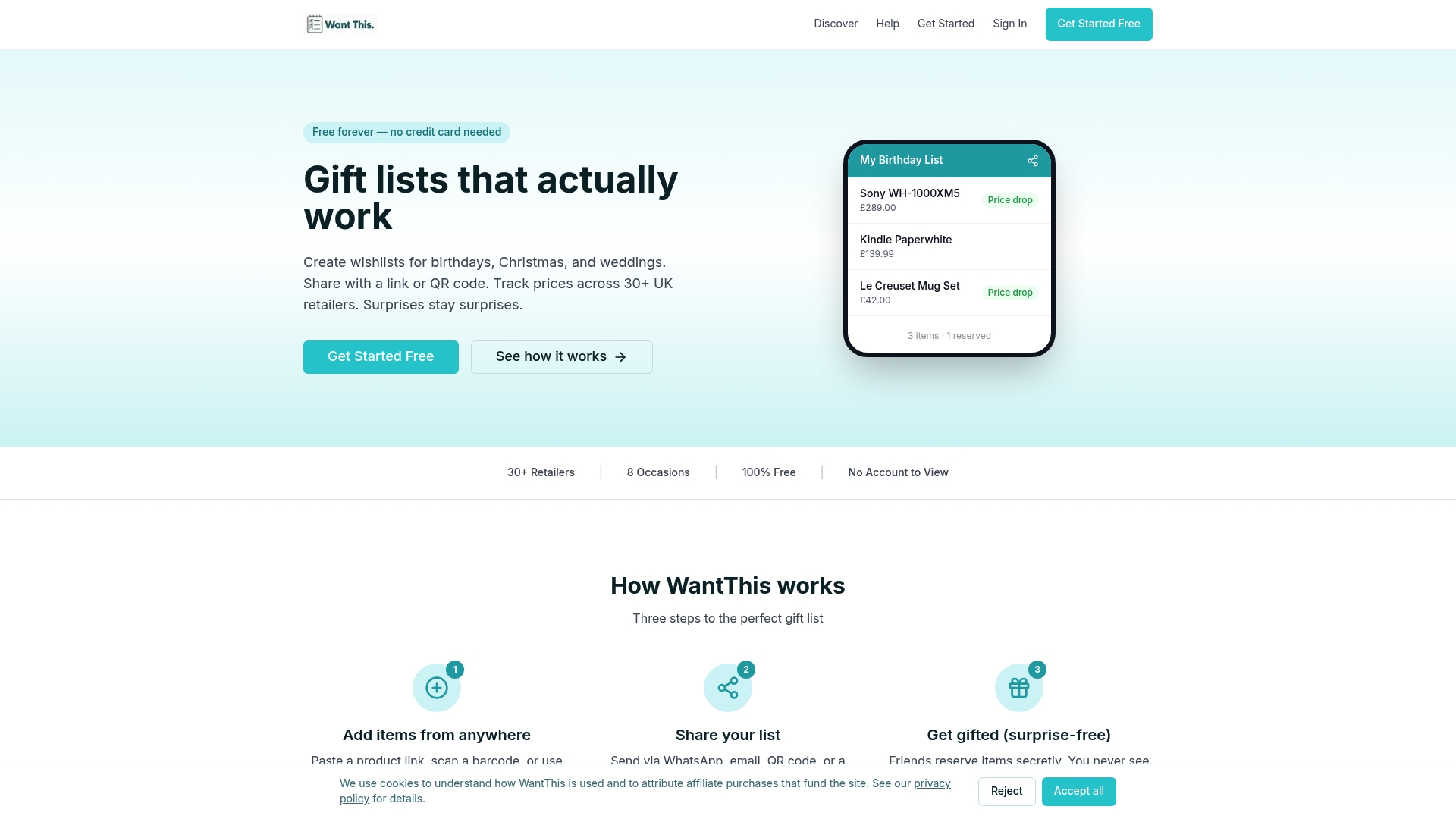
Start your child’s wishlist for free or browse our gift ideas and inspiration for kids’ categories. To see how the sharing side works, read about sharing your wishlist. For toys specifically, our guide on avoiding duplicate toy gifts takes you through it in three steps, and you can see real examples on the public wishlists page.
Sharing the list without spoiling the surprise
A few habits make a shared list work well:
- Share with the right people. Send the link to close family and friends, not everyone you know.
- Explain how reserving works. Tell relatives to reserve an item as soon as they decide, so others see it’s taken.
- Keep the child’s view separate. Where children are old enough to have their own list, let them build it, but keep reservation details with the parent.
- Update after the occasion. Remove bought items and add new ones. A list that reflects what the child likes now is worth more than one that is a year out of date.
- Use price tracking. Saving big items and watching for price drops means you can buy at a better moment, or tell relatives when the price has fallen.
FAQ
How many items should be on a child’s wishlist?
Around eight to twelve is plenty for most birthdays or Christmas lists. That gives relatives choice without overwhelming them. Include a mix of small, medium and larger items, plus a couple of non-toy ideas.
What can a child ask for if they have too many toys?
Books, experiences, hobby supplies and practical items such as pyjamas, sports kit or a school bag work well. Days out, lessons and workshops give the child something to look forward to without adding clutter. You can note rough budgets on each so relatives know what suits.
How do I check a toy is safe in the UK?
Look for the UKCA marking and read the age warning on the box. In Great Britain, toys for children under 14 must meet the Toys (Safety) Regulations 2011. Avoid small, high-powered magnets for young children, and buy from sellers that clearly list the manufacturer.
Should my child make their own wishlist?
Yes, with your help. Letting children choose items gives you insight into what they actually want, and they tend to be more excited on the day. Review the list before sharing it, so everything on it is age-appropriate and affordable for the people it will reach.
Do relatives need an account to buy from a WantThis list?
No. Anyone you share the list with can browse it and gift without creating an account. They can privately reserve an item or mark it as bought, so gifts aren’t duplicated and the surprise stays intact.
Sources
- Good Toys for Young Children by Age and Stage, NAEYC
- Best Christmas gifts for kids, Which?
- Toys and Play: 6- to 8-Year-Olds, Seattle Children’s
- Toy Recommendations Overview, Northwestern University Early Intervention Research Group
- Classics booklist, BookTrust
- Books with brilliant pictures and not too many words, BookTrust
- Toys (Safety) Regulations 2011: Great Britain guide
- Product Safety Report on magnet toy recall