
Baby Shower Etiquette in the UK: A Guide for Hosts and Guests

UK baby shower etiquette comes down to one idea: the party is something done for the mum-to-be, not by her. A friend or relative usually hosts, guests reply promptly and bring a small, useful gift, and the parents-to-be send a personal thank-you afterwards. The part that causes the most awkwardness is the gift list, because nobody wants to look as if they are demanding presents. A private, shareable list that guests can reserve from, such as a baby shower gift list on WantThis, lets you answer the “what does she need?” question without anyone feeling pushed.
TL;DR
- Baby showers are still less common in the UK than in the US, so keep things relaxed, warm and low-pressure.
- A friend, sister or cousin traditionally hosts. Co-hosting is increasingly normal, and parents can now take the lead if they wish.
- Most showers happen four to six weeks before the due date, last two to three hours, and invitations go out three to six weeks ahead.
- Guests RSVP promptly, arrive on time, bring a small practical gift and stay until the gifts are opened.
- Share gift preferences privately and offer reservations, so there are no duplicates and no spoiled surprises. Then send personal thank-yous.
Table of Contents
- Are baby showers a British tradition?
- Who hosts a baby shower, and who is invited?
- When to hold it, and how long it lasts
- Invitations and RSVPs
- What guests should do on the day
- Do you bring a gift?
- Gift lists without the awkwardness
- Saying thank you
- Our view
- Build your baby shower list with WantThis
- FAQ
- Sources
Are baby showers a British tradition?
Not historically. The BBC has noted that baby showers are still relatively rare in the UK, in contrast with the lavish celebrations familiar from American celebrity culture. They have grown in popularity in recent years, but you will still meet people who have never been to one and are not sure what is expected.
That is useful to know for two reasons. First, there is no single rulebook, so the etiquette below is the generally agreed UK custom rather than law. Second, the best approach is to match the tone of the people involved. A small afternoon tea at home is far more in keeping with British taste than a large, theatrical party, and the mum-to-be may well prefer it.
If you are the one being invited, treat the invitation as what Ideal Magazine describes as a warm request for your presence, not a summons. The aim is for the parents-to-be to feel loved and supported.
Who hosts a baby shower, and who is invited?
The host
Traditionally, the parents do not organise their own shower. GoodtoKnow explains that the idea is for other people to “shower” the parents with gifts, so the party is organised and paid for by someone else, such as a sister, friend, colleague or other relative. Having more than one shower with different groups, for example family and work, is not unusual.
There is a reason behind the custom. Etiquette coach Tami Claytor, quoted by HuffPost UK, says that a close relative hosting can look as if she is asking guests to buy gifts for her own family. A friend, cousin or aunt avoids that impression.
Co-hosting is increasingly common. Crown Banqueting Suite’s UK guide notes that two or three people can split the work and the cost, as long as one person takes the lead on final decisions. If you are co-hosting, agree early who handles invitations, food and the gift list, so guests only get one set of messages.
Times are relaxing, too. Emma’s Diary says that while it is traditional for a friend or family member to host, parents can now take the lead themselves if they want to. If that is you, the polite way to do it is to keep the tone about celebrating and not about collecting presents.

The guests, and whether dad comes
Guests are usually close friends and family, and the exact list depends on the parents and the style of party. The Baby Hamper Company confirms that fathers do attend, and many showers include both parents. The older tradition was different: GoodtoKnow says showers were typically women-only, with the father popping in at the end to thank everyone.
The simplest way to settle it is to ask the parents-to-be. If the guest list is mixed, make that clear on the invitation so nobody wonders whether partners are welcome.
When to hold it, and how long it lasts
The most quoted UK timing is four to six weeks before the due date. Emma’s Diary and GoodtoKnow both give that window, and GoodtoKnow’s reasoning is sensible: it is far enough along that the shower does not feel like tempting fate, but not so close that the baby arrives at or just before the party.
Other UK guides allow a little more flexibility:
| Source | Suggested timing |
|---|---|
| BubsNest | Weeks 28 to 32 of pregnancy |
| BabyMade | Weeks 28 to 36, with Saturdays the most popular day |
| Emma’s Diary | Four to six weeks before the due date |
The practical message is to choose a date when the mum-to-be is likely to feel comfortable and energetic, and to have a backup in mind if the baby is early. Some families prefer a “welcome baby” gathering after the birth, as The Red Lion Hotel notes, so guests can meet the newborn. Both are perfectly acceptable.
As for length, most UK showers run two to three hours, which leaves time to eat, chat, open gifts and take photos without the afternoon dragging. Afternoon tea, brunch or a relaxed lunch all suit that format.
Invitations and RSVPs
For hosts
Send invitations three to six weeks ahead. Johnson’s Baby UK says they should include the location, time, dress code and what to bring, and Tami Claytor’s advice in HuffPost UK is a minimum of four weeks and a maximum of six. Include the following:
- Who the shower is for and who is hosting.
- Date, start time and an approximate finish time.
- The address, with any parking or access notes.
- An RSVP date and how to reply.
- Anything about gifts, such as a list link, a group gift or a “no gifts” request.
- Any dietary question, if you are providing food.
Chase replies about a week before. BabyMade recommends doing exactly that, which gives you time to confirm numbers with a caterer or venue.
For guests
Reply promptly. Both Ideal Magazine and Tiny Welcome point out that the host needs numbers to plan food, seating and games. If you cannot attend, say so early, and consider sending a card or a small gift anyway.
What guests should do on the day
The guest checklist is short and mostly common sense:
- Arrive on time. Ideal Magazine suggests 10 to 15 minutes early, and being punctual means you do not miss the games.
- Dress smart-casual unless the invitation names a dress code. Comfort matters, as the guest of honour may be heavily pregnant.
- Offer to help. At a home-hosted shower, helping to set up or clear away goes a long way. At a hired venue, follow the venue’s rules.
- Drink in moderation. Both Ideal Magazine and Tiny Welcome advise it, and the mum-to-be will not be drinking.
- React warmly to gifts. Gift opening is often the centrepiece, so show enthusiasm for every present, whatever it is.
- Stay until after the gifts are opened. Leaving before then can feel abrupt.
- Avoid touchy topics. Emma’s Diary advises steering clear of sensitive subjects such as birth horror stories, baby names that have not been announced or comments on size.
Hosts should keep games light. Many mums-to-be are not keen on anything messy, embarrassing or invasive, so a quiz, a guessing game or a pledge box usually goes down better.
Do you bring a gift?
Yes, usually. MYPICTURE’s UK gift guide says guests are generally expected to bring one, and that turning up empty-handed is the only real faux pas, unless the host has said no gifts or asked for charity donations. Emma’s Diary says a small gift is polite, such as a babygrow, a book or a small toy.
A few guidelines make the choice easier:
- Choose practical over cute. Ideal Magazine suggests long-lasting items over baby clothes that will be outgrown in weeks. Nappies, wipes, bibs and muslins are always useful, as HuffPost UK notes.
- Club together for something bigger. Friends can pool money for a keepsake, such as jewellery or a bump and newborn photoshoot, or for a higher-priced item from the list.
- Think about the mum too. Many guests only buy for the baby. Something for her, like a comfort item for the postnatal weeks, is often remembered. Our guide to postpartum gifts new mums actually want has ideas.
- Consider the home. Natural, soft items for the pram or nursery, such as sheepskin pram liners, can be a thoughtful present when the parents have not listed one.
- Do not forget dad. If he is attending or the shower is mixed, gifts for new dads are a nice touch.
For a wider look at what to buy, see our types of baby shower gifts guide.
Gift lists without the awkwardness
Some Brits find gift lists impersonal, and a few online discussions describe them as rude. The reality is that a list works in the guests’ favour: the mum may already have bought some things, and a list stops three people buying the same steriliser.
Johnson’s Baby UK recommends putting together a gift list from the parents-to-be, with everyday essentials alongside clothes and toys, and with some higher-priced items so guests can buy individually or organise a group gift. HuffPost UK also says a list is useful because the mum may have already purchased things.
The etiquette is in how the list is shared:
- Offer it, do not announce it. Put a link in the invitation or mention it when guests reply. MagicMum suggests registry details are mentioned or offered with the RSVP.
- Mix price points. Include small items for guests with a modest budget and a few larger ones that friends can split.
- Include items from several shops. Guests then buy from wherever is easiest for them.
- Let guests reserve privately. This avoids duplicates and keeps the parents from knowing exactly who bought what.
- Make clear that nothing is compulsory. A line such as “a card and your company are the best gift” takes the pressure off.
A worked example
Imagine a shower for 12 guests. The host builds a list of 15 items: six small ones (muslins, a baby book, bibs), six mid-range (a sleep suit set, a bath seat, a pram blanket) and three larger ones (a baby carrier, a high chair, a night light projector). Guests reserve what they like. Four friends split the high chair. Nobody buys the same muslins, and the parents still open a few unexpected extras. The host has not asked anyone to spend a set amount, and each guest has chosen their own level.

Some guests are also nervous about practical choices for a pregnant person’s home. If you are choosing something like cleaning or household products, it helps to know what is considered gentler. This overview of cleaning products during pregnancy covers what to use and avoid.
Saying thank you
Thank-you notes are not optional. Etiquette expert Post, quoted by HuffPost UK, says they should be personal rather than pre-written, and hosts should not ask guests to pre-address envelopes or record who bought which gift. Emily Post’s advice is that even when you thanked the giver in person, a written note is still warmer.
In practice:
- Mention the gift and how you will use it.
- Send notes within a few weeks of the shower, or once the baby has arrived if things are hectic.
- Thank the host separately, and consider a small gift or flowers.
- For group gifts, thank everyone who contributed, not just the person who organised it.
A private reservation list helps here too, because you can see which gifts have been marked as bought, which makes writing personal notes simpler.
Our view
Baby shower etiquette is really about making two things easy: celebrating the parents-to-be and helping guests choose something they will actually use.
We built WantThis as a free UK wishlist and gift list platform, so people can gather products from different retailers into one list, organise it by occasion and share it privately. Friends and family can reserve a gift or mark it as bought, which avoids duplicates while keeping surprises intact.
Our view is that a gift list is a courtesy to your guests, not a demand on them. When it is shared quietly, with a range of budgets and a clear “no pressure” message, it takes the guesswork out for everyone and leaves more time for the party itself.
Stuart
Build your baby shower list with WantThis
If you are hosting, or the mum-to-be wants to share what she needs, WantThis is free to use. You can add product links from different retailers, organise them into a list for the shower, and share it privately so guests can reserve gifts without spoiling surprises. When a product link is added, WantThis can import available product details to help build the list.
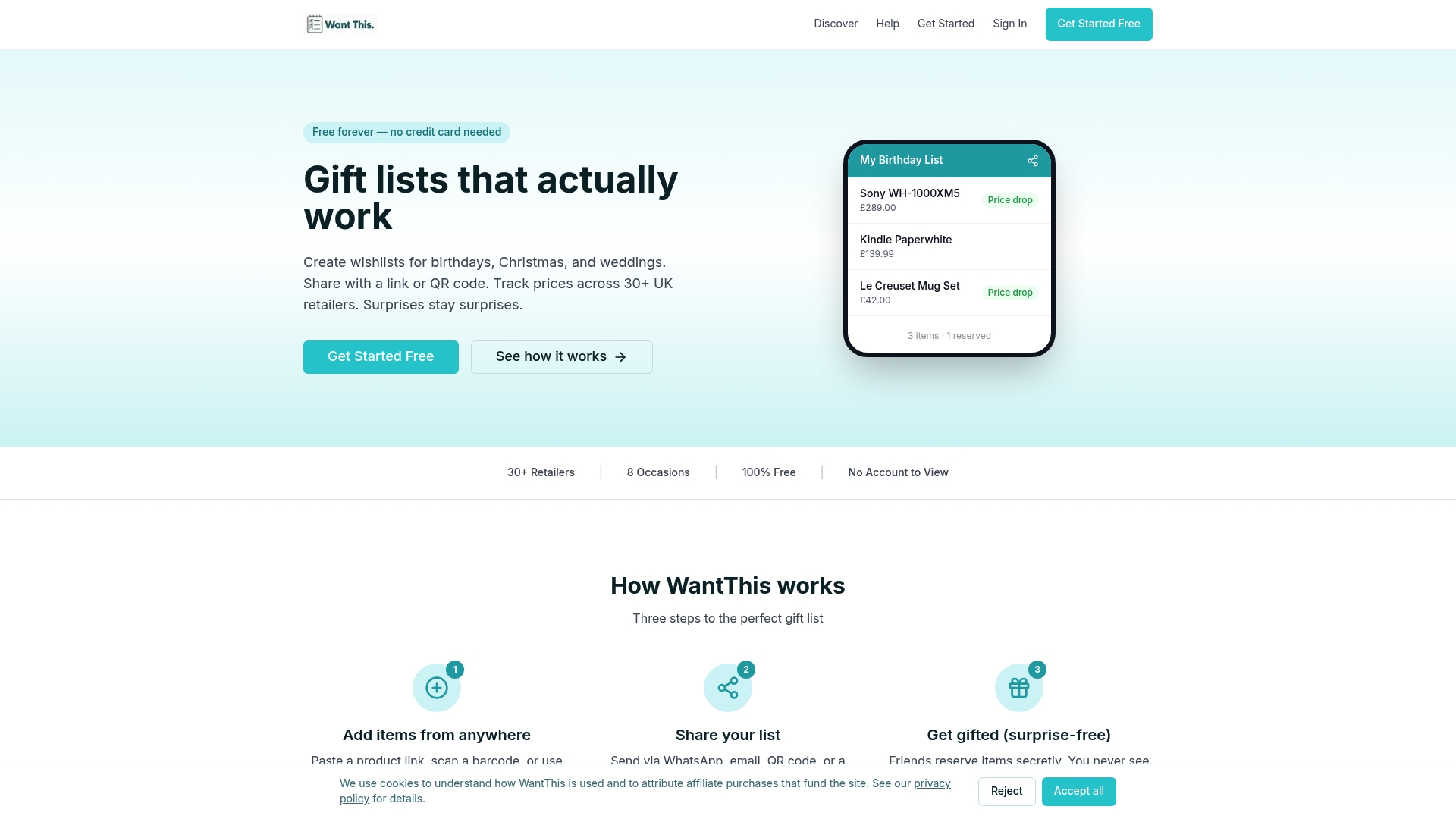
Guests follow the product link to the retailer to check the latest price and availability and complete the purchase. Start on the WantThis homepage, see how sharing a wishlist works, or browse gift guides for new parents for ideas. Where affiliate links are used, they are disclosed on our affiliate disclosure page.
Baby showers are not the only event where a list helps. The same approach works for birthday wish lists and weddings, and our wedding gift etiquette guide covers the same polite-sharing principles.
FAQ
Do you normally bring gifts to a baby shower?
Yes. Guests are generally expected to bring a small gift, unless the host has asked for no gifts or for charity donations. Practical items such as nappies, muslins, bibs or a book are safe choices. If a gift list has been shared, choose from it so you do not duplicate what others are buying.
Does the dad usually attend the baby shower?
It varies. Traditionally showers were women-only, with the father arriving at the end to say thank you. Today many showers include both parents and guests of any gender. Ask the parents-to-be and state clearly on the invitation who is welcome.
Is it rude for the mum-to-be to organise her own shower?
Traditionally, yes, because the idea is that others celebrate her. That said, Emma’s Diary notes that parents can now take the lead if they wish. If you do, focus the invitation on celebrating together and share any gift list gently rather than making requests.
How long before the due date should a baby shower be?
Most UK guides suggest four to six weeks before the due date, which is roughly weeks 28 to 36 of pregnancy. Send invitations three to six weeks before the date, and pick a date when the mum-to-be is likely to be comfortable.
Is a shower after the baby is born acceptable?
Yes. Some families hold a “welcome baby” party after the birth so that guests can meet the newborn. The same etiquette applies: a friend or relative hosts, guests reply promptly, and thank-yous follow.
Sources
- BBC News: Royal baby, how US moms compare with UK mums
- Ideal Magazine: baby shower etiquette guide
- GoodtoKnow: baby shower etiquette questions answered
- HuffPost UK: who should host a baby shower
- HuffPost UK: six essential baby shower dos and don’ts
- Crown Banqueting Suite: who organises a baby shower
- Emma’s Diary: baby shower etiquette
- The Baby Hamper Company: what happens at a baby shower
- BubsNest: when to have a baby shower in the UK
- BabyMade: baby shower UK planning guide
- The Red Lion Hotel: what is a baby shower
- Tiny Welcome: what to expect at a baby shower
- Johnson’s Baby UK: the ultimate baby shower guide
- MYPICTURE: baby shower gifts UK
- MagicMum: throwing a baby shower
- Emily Post: thank-you notes
- Hide Rugs: baby sheepskin pram liners
- Kinetic Clean: cleaning products during pregnancy