
How to Run an Online Secret Santa Gift Exchange

An online Secret Santa gift exchange is a structured anonymous gift swap where participants are randomly assigned one person to buy for, coordinated entirely through digital tools. Groups of friends, family members, and coworkers use this format to share gifts across any distance without the chaos of manual name draws or awkward in-person coordination. The right combination of planning, a reliable digital organizer, and clear rules turns what could be a stressful process into something genuinely fun. This guide covers every step, from choosing your tools to picking the perfect gift.
What tools work best for an online Secret Santa gift exchange?
The best digital Secret Santa tools do three things well: they draw names randomly, send assignments privately, and let participants share wishlists. Online Secret Santa generators prevent self-matches and allow organizers to set exclusions, such as keeping spouses or roommates from drawing each other, before the draw even runs. Each participant receives their assignment by email, so no one accidentally sees who got who. That privacy is what makes the digital format more reliable than passing slips of paper around a room.
Wishlist functionality is the feature that separates a good platform from a basic one. Tools that allow wishlists and anonymous clarifying questions increase participant satisfaction because gift givers have real guidance instead of guessing. Platforms also vary in how they handle group size, with some built for small friend groups of 4–10 people and others designed for large workplace exchanges of 50 or more.

The table below compares the key feature categories to look for when choosing a platform.
| Feature category | What to look for |
|---|---|
| Name draw | Automatic, random, with exclusion rules |
| Assignment delivery | Private email to each participant |
| Wishlist sharing | Participants can add and share gift preferences |
| Price tracking | Alerts when a saved item drops in price |
| Gift reservation | Others can mark items as claimed to avoid duplicates |
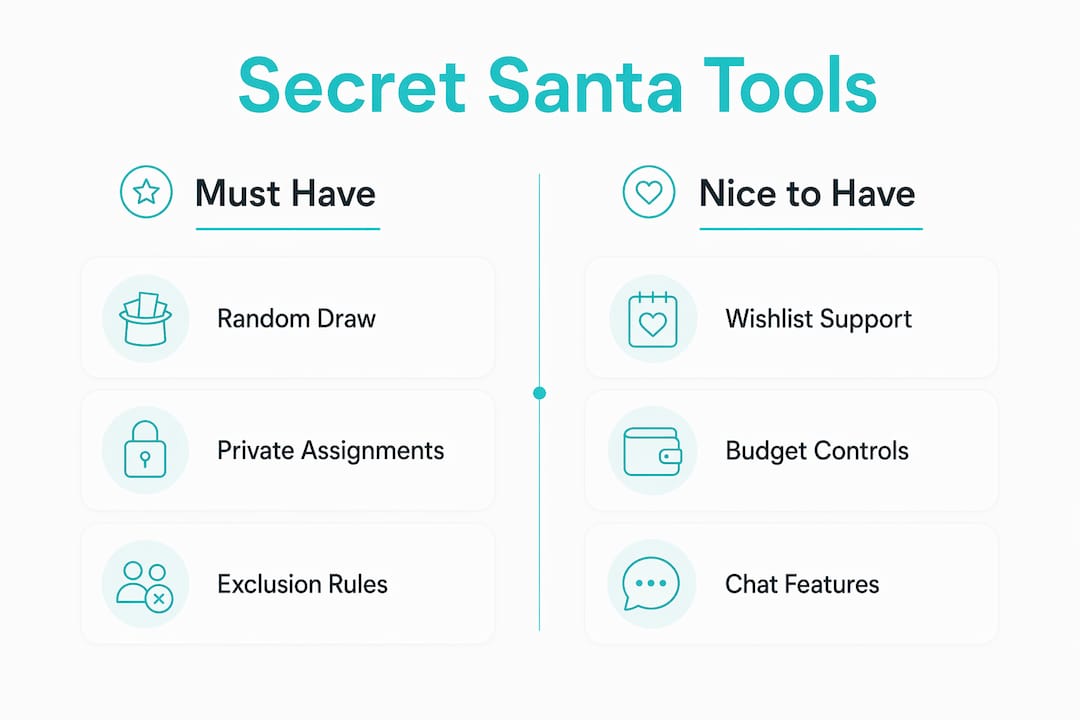
Pro Tip: Choose a platform that lets participants add wishlists before the draw runs. That way, gift givers already have ideas waiting when they receive their assignment.
How do you plan and set rules for a successful exchange?
Good planning is the single biggest factor in whether a Secret Santa exchange runs smoothly or falls apart. Start planning at least 6 weeks before your intended exchange date. That window gives you time to collect confirmations, run the draw, and leave participants enough shopping time without rushing.
Follow these steps in order to keep the process organized:
- Set your budget. The standard recommended range is $15–$25, which keeps the exchange inclusive and removes pressure from participants on tighter budgets. State the budget clearly in your first message to the group.
- Collect participant confirmations. Only add people who have confirmed they are joining. A tentative “probably” leads to last-minute dropouts that disrupt the draw.
- Define exclusion rules. Decide upfront whether spouses, partners, or household members should be excluded from drawing each other. Set these rules in the organizer tool before running the draw.
- Decide on delivery method. Establish whether gifts will be mailed directly, handed over in person at a gathering, or delivered digitally. Remote groups almost always mail gifts, so set a firm shipping deadline.
- Run the draw and send assignments. Use your chosen digital organizer to run the draw and deliver assignments privately. Never share the full draw list with anyone, including yourself as the organizer.
- Set a wishlist deadline. Ask participants to add their preferences to a shared wishlist within one week of receiving their assignment. This gives gift givers time to shop without waiting until the last minute.
Communicating rules and budget clearly before collecting signups aligns expectations and reduces the back-and-forth questions that slow everything down.
Pro Tip: Pick one or two backup participants before the draw. If someone drops out after assignments are sent, you can reassign without rerunning the entire draw and revealing who had whom.
Handling replacements is the part most organizers skip until it becomes a crisis. Organizers should identify backup participants and set exclusions before the draw to avoid scrambling when someone cancels at the last minute. A simple group message asking “Is anyone willing to be a backup?” takes 30 seconds and saves a lot of stress later.
How do you coordinate participants and keep everyone engaged?
Coordination in a virtual gift exchange depends on clear, timely communication at every stage. The organizer’s job does not end after the draw. Keeping participants informed and engaged through the shopping period is what prevents the exchange from going quiet and falling apart.
- Send a welcome message immediately after the draw. Include the budget, the wishlist deadline, the shipping deadline, and the date of the virtual unwrapping event. One message with all four details prevents repeat questions.
- Encourage wishlist sharing without making it mandatory. Some participants prefer the surprise of an unknown gift. Others want to guide their giver. Offering the option respects both preferences.
- Use anonymous messaging features. Many digital organizers let gift givers ask their recipient a question without revealing their identity. This is the best way to clarify preferences without spoiling the surprise.
- Schedule a video call for the unwrapping. Virtual unwrapping on a video call preserves the shared experience that makes Secret Santa enjoyable, even when participants are in different cities or countries. Platforms like Zoom or Google Meet work well for this.
- Send a reminder one week before the shipping deadline. Late shipments are the most common reason a virtual exchange disappoints. A single reminder email or group message catches procrastinators before it becomes a problem.
The goal is to keep the group feeling connected without over-communicating. Two or three well-timed messages across the six-week window are enough for most groups.
What are the best gift ideas for online Secret Santa participants?
Choosing a gift for someone you may not know well is the hardest part of any Secret Santa exchange. Wishlists solve most of this problem. When a recipient has added items to a shared gift list, the gift giver can pick something the person actually wants rather than guessing. That shift from guessing to knowing is what makes wishlist-enabled exchanges more satisfying for everyone involved.
For participants who have not shared a wishlist, these categories work well across most budgets and interests:
- Books and subscriptions. A well-reviewed book in a genre the recipient enjoys, or a one-month digital subscription, fits easily within a $15–$25 budget and ships without fragility concerns.
- Home and kitchen items. A quality candle, a set of specialty coffee or tea, or a compact kitchen gadget are crowd-pleasing options that feel personal without requiring deep knowledge of the recipient.
- Beauty and self-care sets. Curated gift sets from brands like The Body Shop or Lush are widely available, easy to ship, and suitable for most recipients.
- Electronics accessories. Phone stands, cable organizers, or portable chargers are practical gifts that most people appreciate regardless of their specific tech setup.
- Digital gift cards. When shipping is impractical or the recipient’s preferences are genuinely unknown, a digital gift card to a retailer like Amazon or a streaming service is a reliable fallback.
Wishlists and price tracking reduce shopping stress and improve gift selection by giving buyers a clear target and alerting them when a saved item drops in price. That combination of guidance and timing is especially useful for participants shopping on a strict budget.
Pro Tip: If you are mailing a physical gift, add a handwritten note inside the package. Remote exchanges lose the in-person moment of giving. A personal note recreates some of that warmth.
Focus the gift on what the recipient will enjoy rather than on impressing the group. Shifting the focus to the joy of the gift rather than the element of surprise consistently produces higher satisfaction in online exchanges.
Key takeaways
A successful online Secret Santa gift exchange requires a digital organizer with wishlist support, a clear budget, and a firm timeline starting at least 6 weeks before the event.
| Point | Details |
|---|---|
| Start early | Begin planning at least 6 weeks before the exchange date to allow time for confirmations and shopping. |
| Set a clear budget | The standard range of $15–$25 keeps the exchange inclusive and reduces stress for all participants. |
| Use a digital organizer | Automatic draw tools prevent self-matches, send private assignments, and support wishlist sharing. |
| Plan for dropouts | Identify one or two backup participants before the draw to handle last-minute cancellations. |
| Schedule a virtual unwrapping | A group video call on the exchange date preserves the shared experience for remote participants. |
Why I think most Secret Santa exchanges fail before the draw even runs
The most common failure point in any Secret Santa exchange is not a bad gift. It is a disorganized start. I have seen groups of 20 people collapse into confusion because the organizer sent one vague message in a group chat and assumed everyone was in. By the time the draw ran, three people had not confirmed, two had different budget expectations, and nobody had a wishlist ready.
The fix is almost embarrassingly simple: treat the first message as a formal invitation, not a casual mention. State the budget, the deadline, the delivery method, and the wishlist tool in that first communication. People respond to specifics. They ignore vague invitations.
The other thing I have noticed is that organizers underestimate how much the virtual unwrapping event matters. Mailing gifts and never seeing the reaction is a flat experience. A 30-minute video call where everyone opens their gift at the same time turns a transactional exchange into an actual memory. That is the part worth protecting when you are planning the timeline.
My honest recommendation is to use a purpose-built tool rather than running the draw manually or through a spreadsheet. Manual draws create the risk of the organizer seeing all assignments, which kills the anonymity. A good digital organizer removes that problem entirely and adds wishlist features that make the whole experience better for participants. The planning overhead drops significantly, and the experience improves for everyone.
— Stuart
Wantthis makes your next gift exchange easier
Running a digital Secret Santa does not have to mean juggling spreadsheets, group chats, and manual name draws. Wantthis offers a free Secret Santa organizer that handles the draw automatically, sends private assignments by email, and lets every participant build and share a wishlist before shopping begins.
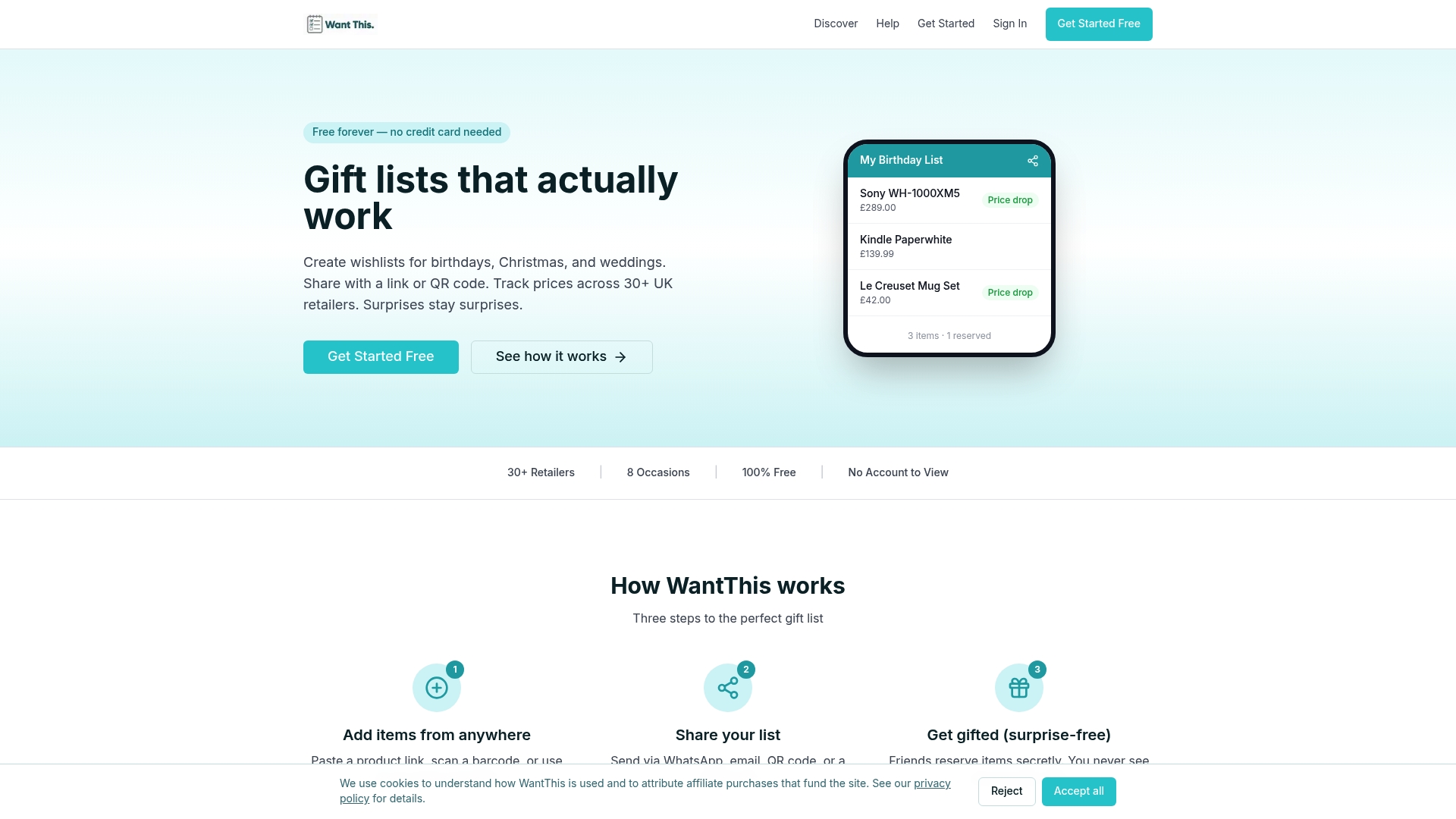
Participants can add items from any online retailer to their Wantthis gift list, and the platform pulls in the title, image, and current price automatically. Price tracking alerts buyers when a saved item drops in price, which is genuinely useful for anyone shopping on a $15–$25 budget. Friends and family can privately reserve items so gifts are never duplicated and surprises stay intact. Visit wantthis.co.uk to set up your exchange for free.
FAQ
What is an online Secret Santa gift exchange?
An online Secret Santa gift exchange is an anonymous gift swap where participants are randomly assigned one person to buy for, with the draw and coordination handled through digital tools instead of in person.
How far in advance should I organize a Secret Santa exchange?
Start planning at least 6 weeks before the exchange date to allow time for confirmations, wishlist sharing, shopping, and shipping.
What is a good budget for Secret Santa?
The standard recommended budget is $15–$25. This range keeps the exchange accessible for participants at different income levels and removes pressure from the gift-giving process.
How do online Secret Santa generators keep assignments private?
Digital draw tools email assignments individually to each participant and prevent self-matches or duplicate assignments, so no one, including the organizer, sees the full draw list.
What should I do if a participant drops out after the draw?
Reassign their recipient to a backup participant you identified before the draw ran. Setting exclusions and identifying backups before the draw is the most reliable way to handle last-minute cancellations without disrupting the whole group.